Tonight, somewhere in Britain, a perfectly sensible adult will wait until their child is asleep, creep into their bedroom, retrieve a small piece of human bone from beneath the child’s head and replace it with money. And nobody will think that this is particularly odd.
This is, of course, the Tooth Fairy tradition. But strip away her wings and glitter and the whole business starts to look considerably stranger.
A child sheds a piece of their body and, rather than just throwing it away, we treat it differently from ordinary rubbish. It is kept, placed in a particular location at a particular time and surrendered overnight to a supernatural visitor in exchange for a gift.
I’m not saying the Tooth Fairy is a surviving witchcraft ritual. There is no good evidence for making that leap and the familiar Tooth Fairy tradition appears comparatively recently in the historical record. But it is kind of lovely, nevertheless. Because long before British children were putting their teeth beneath pillows, people were very concerned indeed about what happened to the pieces of themselves that fell off.
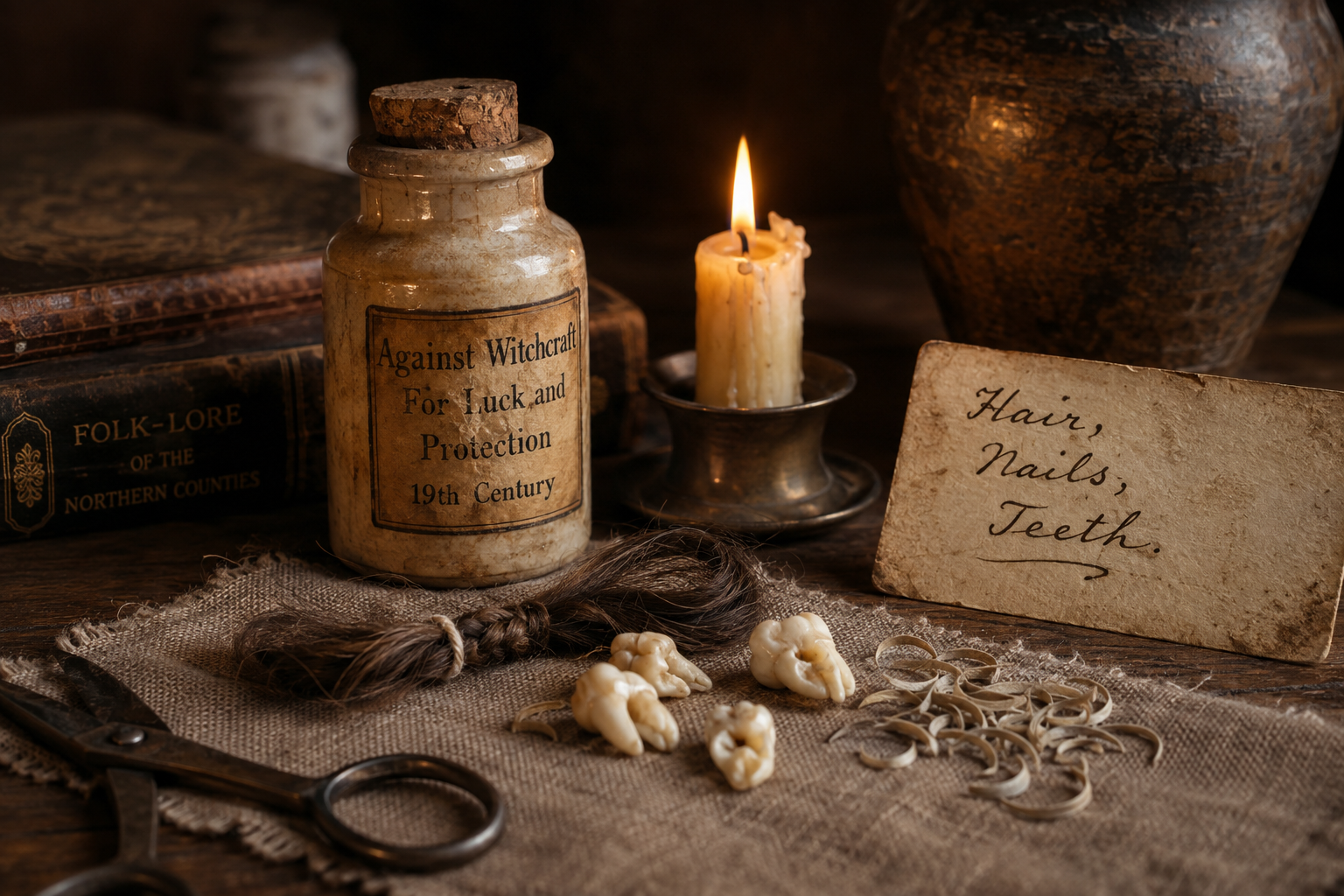
Hair, fingernails, teeth. The things we now sweep up, rinse down the drain or throw in the bathroom bin were once potentially dangerous objects. They were still ‘you’. And you wouldn’t want the wrong person getting hold of them.
This idea belongs within a very old and widespread principle of magic: Something that has been a part of a person can continue to retain a connection with that person after it is removed. A lock of hair is therefore not just hair. A nail clipping is not just keratin. A tooth isn’t just an inconvenient little object that has jus fallen out while someone was eating an apple. They are pieces of a human being , and if that connection remains, then whatever is done to the piece may potentially affect the person from whom it came. Which. I’m sure you’ll agree, makes the bathroom bin far more exciting than it was five minutes ago.
Folklore collections from Britain contain wonderfully specific instructions about how these discarded bits of humanity should be handled. In nineteenth century Durham, when a tooth came out, the socket could be filled with salt and the tooth itself thrown into the fire. A short rhyme was said during the act, asking the fire to burn the old tooth and God to send another. This practice was recorded in ‘Notes on the Folklore of the Northern Counties of England and the Borders’ published in 1866, and appears again in later collections of Durham folklore. Here, the tooth wasn’t just rubbish and it’s disposal had a procedure. And Durham wasn’t alone.
Charlotte Sophia Burne’s monumental nineteenth century collection of Shropshire folklore records a very similar custom: when a child’s tooth came out, salt was put upon it before it was thrown into the fire. Burne also supplies us with an explanation. The tooth needed to be safely destroyed in case an enemy obtained it and used it to bewitch the child. And suddenly we see that the little white object sitting in the parents palm becomes something quite different. It becomes a vulnerability. A piece of the child has become detached and until it is safely disposed of, somebody else could theoretically possess it. Fire solved the problem.
But failing to dispose of a tooth correctly could have other consequences. In Sussex, a young woman reportedly objected to children’s shed teeth being simply thrown away because an animal might find them and gnaw them. If it did. she believed, the child’s replacement tooth might resemble that of an animal. She even had supporting evidence.
According to the story, an unfortunate lad known only as Master Simmons possessed an unusually large tooth because his mother had accidentally thrown one of his childhood teeth into a pig trough. the pig apparently ate it and poor Master Simmons paid the price.
It’s easy for us to laugh at now but beneath the pig and the unfortunate Master Simmons is the same principle – the tooth remained connected to it’s former owner. What happened to one could affect the other.
Hair was treated with similar caution. In Shropshire, Burne recorded that cut hair should be carefully burned. Throwing it outside was considered unwise because a bird might collect it and weave it into it’s nest. If that happened, the former owner of the hair could suffer headaches. This same belief turns up in Durham. Hair clippings and combings were to be burned rather than left where birds could take them. One explanation offered by later collectors was precisely he danger we have already encountered: somebody might obtain the hair and use it magically against it’s owner.
There were omens in the burning too. If the hair burned brightly, it’s owner could expect a long life. If it smouldered, death might be waiting. Even the timing of a haircut could matter, Durham folklore advised cutting hair while the moon was waxing. So something as ordinary as having your hair cut could involve the moon, divination. magical protection and the careful destruction of your bodily remains.
And then there were fingernails. Those tiny crescents we clip off and immediately forget once had rules of their own. The Durham material contains a splendid rhyme assigning consequences to the day on which nails were cut. Monday promised wealth, Tuesday wealth, Wednesday news, Thursday new shoes. Friday and Sunday were best avoided. Again though, beneath the rhyme lurked the same uncomfortable possibility.
Nail clippings could be used.
Burne suggested that beliefs about when nails could safely be cut were connected with the fear that somebody might obtain the parings and use them for witchcraft. She even recorded a case known in Sir Walter Scott’s time in which a woman allegedly placed a pot containing nail clippings in a neighbours barn with malicious intent.
And this is where Old Magic becomes more than a collection of very quaint things the Victorians wrote down. Because sometimes the objects themselves survive.
The Museum of Witchcraft and Magic at Boscastle holds an extraordinary magical deposit discovered in the wall of a bomb damaged house in Plymouth.
It involved an old Bellarmine jar which had apparently been reused much later and concealed around the end of the nineteenth and beginning of the twentieth century. Inside were pins, pierced animal bones, a protective or fertility amulet – and human bodily material. Nail parings, and a plait of course white hair, possibly human.
The museum interprets the assemblage cautiously because it’s precise purpose cannot now be known. It may have been counter- magic, a love charm or some other magical working. But someone deliberately collected those materials, put them together and hid them inside a wall.
Hair and nails also appear in the wider history of British witch bottles and counter magic. Written seventeenth century instructions describe bottles containing bodily substances alongside pins and salt, intended to turn supposed witchcraft back against whoever had sent it.
The logic is pleasingly circular. A witch can read you through something connected to you. But if a magical connection already exists between victim and witch, perhaps you can use that connection to reach back. Old magic can be a dangerous tug of war.
That is why the apparently trivial business of sweeping up some hair really mattered. The body didn’t end at the skin. Bits of it escaped. Hair came out on brushes. nails grew and were cut. Children shed teeth. Blood was spilled and urine left the body. Modern life categorises most of these things immediately as waste. Earlier magical thinking could place them in an entirely different category. They were belongings in the most literal possible sense. They belonged to you. And because they belonged to you, they might remain you in some small and dangerous way.
Which brings us back to that bedroom.
A child is asleep and beneath their pillow is a tooth. Mum or Dad creeps in, takes the tooth and replaces it with a pound coin – although judging by current Tooth Fairy inflation, I suspect some children have negotiated considerably better terms.
We should resist the temptation to draw a straight historical line from the burned teeth of Durham and today’s tooth fairy. Folklore rarely behaves that neatly, and the evidence doesn’t justify it. But the comparison is irresistible for another reason:
We have changed the story enormously. We have changed what happens to the tooth. We have changed the supernatural characters involved. We have even changed what we think the ritual means…
But we still haven’t quite managed to treat a child’s first lost tooth like ordinary rubbish.
We pick it up. we preserve it, we put it somewhere special. Some parents secretly keep them for years, others surrender them to the mysterious nocturnal economy of the Tooth Fairy. And almost nobody stops halfway through the process and thinks:
“This is a piece of my child’s skeleton.”
Magic doesn’t always survive as magic, sometimes the explanation disappears first. The old woman who knew exactly why hair must be burned dies. Her daughter remembers that you shouldn’t leave hair lying around. Her granddaughter vaguely remembers something about birds. Her great granddaughter has heard none of it and sweeps the hair into the bin.
The belief unravels, the ritual becomes habit, the habit becomes superstition. Eventually even the superstition disappears. But every so often something survives. A coin in a new purse. A particular way of entering a house. A warning about putting shoes on a table.
A little white tooth under a pillow.
Tiny fossils of a world in which the boundary of the human body was not quite where we think it is today.
So next time you clean your hairbrush, clip your nails or discover your child proudly wobbling a loose tooth at you, spare a thought for the people who came before us. They knew something important about those insignificant little pieces of ourselves.
Don’t throw yourself away.
You never know who might pick you up.
Sources & Further Reading
William Henderson, ‘Notes on the Folk-Lore of the Northern Counties of England and the Borders’
Charlotte Sophia Burne, ‘Shropshire Folk-Lore: A Sheaf of Gleanings’ ‘
Museum of Witchcraft and Magic, Boscastle – Bellarmine Jar/Witch Bottle.
[1]: https://books.google.co.uk/books?id=a0iwAAAAIAAJ “Notes on the Folklore of the Northern Counties of England and the Borders – William Henderson – Google Books”
[2]: https://en.wikisource.org/wiki/Notes_on_the_Folk-Lore_of_the_Northern_Counties_of_England_and_the_Borders “Notes on the folk-lore of the northern counties of England and the borders – Wikisource, the free online library”
[3]: https://museumofwitchcraftandmagic.co.uk/object/witch-bottle-bellarmine-jar/ “14 – Bellarmine Jar with boxed contents – Museum of Witchcraft and Magic”

Leave a Reply