There is a point in forensic anthropology where a human bone stops simply being a bone.
A fine line across its surface becomes a cut mark. A fracture becomes evidence of when the bone broke. Discolouration becomes evidence of heat. A tooth becomes a record of childhood geography. And a collection of broken, burned and butchered human remains dumped somewhere they should not normally have been buried becomes a question. At Wharram Percy, that question is a particularly uncomfortable one.
What were these people afraid of?
Wharram Percy lies in the Yorkshire Wolds, a deserted medieval village which has become one of the most intensively studied archaeological sites in Britain. Excavations took place over some forty years, beginning in 1950, revealing houses, roads, manorial buildings, a mill, fishpond and the ruined church of St Martin. The churchyard alone produced hundreds of medieval burials. Those people were, broadly speaking, where we would expect medieval Christian dead to be.
But another group wasn’t.
During excavations in the 1960s, archaeologists recovered a strange collection of human remains from a pit within the settlement itself. Not the cemetery. Not consecrated ground beside the church. The village.
There were 137 pieces of human bone, representing at least ten individuals. Men, women and children were all present – the youngest was somewhere around two to four years old. And disturbingly, somebody had done things to their bodies. Much later, human skeletal biologist Simon Mays and colleagues returned to those remains with a question that the original excavators could not answer.
Why?
Before we introduce ghosts, revenants or anything else that might have been roaming medieval Yorkshire after sunset, we need to do what forensic anthropologists do – look at the evidence. Bones record trauma differently depending upon their condition when damage occurs. Fresh bone, whether belonging to somebody still alive or recently dead, contains collagen and moisture. It has a degree of elasticity. Dry archaeological bone behaves differently. It becomes more brittle. Break it centuries after burial and the fracture characteristics are different from damage inflicted while the bone was still fresh. That distinction matters enormously at Wharram Percy because some of these bones weren’t simply damaged by ploughs, excavation or centuries underground. They appear to have been deliberately broken around or shortly after the time of death. Six long bones showed fractures consistent with breakage while the bone was still fresh.
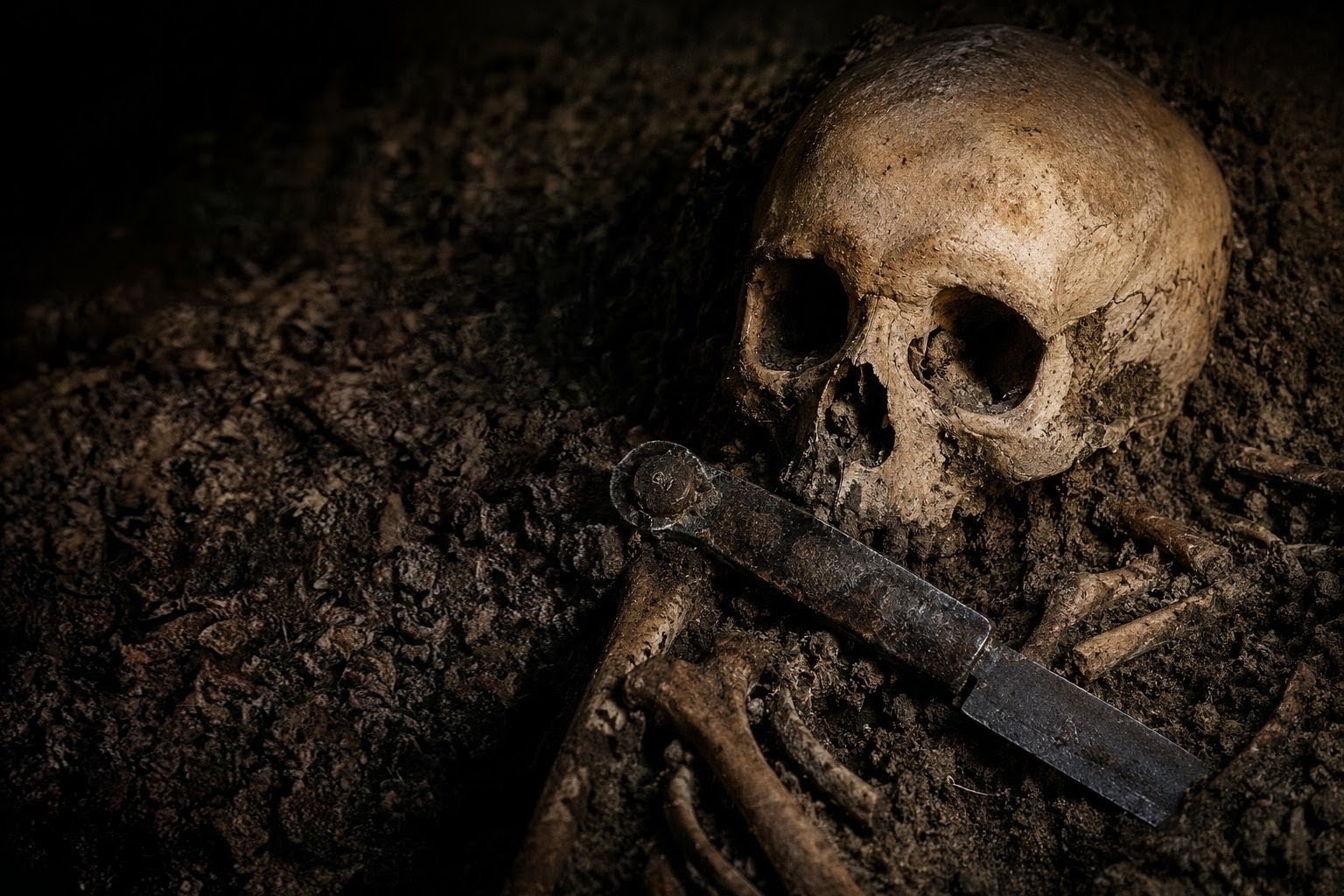
Then there were the blades. Seventeen bones carried a total of 76 sharp-force marks. Some were unmistakable cuts produced by metal blades. Their location is important because they weren’t randomly scattered across the skeleton. Many were concentrated around the head and neck. There were cuts on cervical vertebrae.Cuts around the skull. Marks consistent with the separation of body parts. In other words, these people appear to have been decapitated or otherwise dismembered after death. ([Historic England][1])
Then there was the fire. At least seventeen bones showed evidence of burning. Again, that isn’t as straightforward as seeing a black patch and declaring that somebody lit a bonfire. Burned bone behaves in particular ways. Its colour changes according to temperature, oxygen availability and duration of exposure. Heat can produce cracking, shrinkage, warping and eventually calcination. The Wharram Percy bones had been subjected to relatively low temperatures, these weren’t cremations. Some body parts had been exposed to fire.
So now our examination table contains:
Human remains. Fresh-bone breakage. Sharp-force trauma. Probable decapitation and dismemberment. Burning. And afterwards, the pieces were placed in a pit away from the ordinary cemetery.
Something happened here. The difficult part is working out what.
One possibility is unpleasant but entirely reasonable. Cannibalism. Medieval England experienced famine. Wharram Percy itself survived through periods when harvest failure and food shortage were very real possibilities. Could starving villagers have butchered human corpses? Forensic anthropology can test that hypothesis surprisingly well. If you butcher a carcass for food, you tend to make cuts in predictable places. It doesn’t particularly matter whether the carcass is a deer, pig or human being. If you’re trying to remove useful muscle tissue, separate limbs or access marrow, blades tend to encounter bones around joints and major muscle attachments, you leave a pattern.
But the Wharram Percy pattern was wrong. The researchers found the sharp-force marks clustered particularly around the head and neck rather than the large joints and major muscle attachments expected from systematic butchery. The bones also lacked other combinations of modification that would have made cannibalism a convincing explanation. Mays and his colleagues therefore considered starvation cannibalism and rejected it as a poor fit for the evidence. ([Historic England][1])
Someone cut these people apart.But apparently not because they wanted to eat them – which is both reassuring and somehow worse.
There is another explanation for strange burial. The dead aren’t always treated equally. Throughout history, burial has been used to express identity, religion, belonging and exclusion. People considered outsiders may be buried separately. Executed criminals may receive different treatment. People denied normal rites may end up outside established cemeteries. Perhaps our ten individuals simply weren’t members of the Wharram Percy community.
This is where their teeth become witnesses.
Your skeleton changes throughout your life but your tooth enamel largely doesn’t. As enamel forms during childhood, chemical elements from food and water become incorporated into it. Among them is strontium. Different geological landscapes produce different characteristic ratios of strontium isotopes. That means the enamel in a person’s teeth can preserve information about the geological environment in which they spent their childhood. But it isn’t a postcode. Forensic and archaeological isotope analysis cannot usually tell us that someone grew up at number seven next to the mill but it can tell us whether their childhood environment is compatible with the local geology.
Researchers sampled teeth from the Wharram Percy remains and the results were consistent with the local area. These people appear to have grown up around Wharram Percy or somewhere geologically compatible nearby. Professor Alistair Pike, who directed the isotope work, said this surprised the team because they had initially wondered whether the unusual treatment reflected the individuals being outsiders. ([Historic England][1])
Apparently not. They were probably locals. Which creates another uncomfortable question. Why would a community do this to its own dead?
What happened at Wharram Percy didn’t necessarily happen in one horrific afternoon. Radiocarbon dating placed the remains broadly between the eleventh and fourteenth centuries, with more detailed dating work indicating that the assemblage represents activity occurring across time rather than one single event. ([Historic England][1]). Ten people didn’t necessarily die together before somebody decided to chop them up and put them in a pit. Instead, we may be looking at a practice repeated. Perhaps occasionally, perhaps generations apart. Different people, different deaths, similar treatment and that makes a single catastrophe – massacre, accident or one episode of starvation – less satisfactory as an explanation. Whatever was happening may have been something people at Wharram Percy believed needed doing more than once.
Now we can fetch William of Newburgh.
Earlier this week, we met William’s revenants. Writing at the end of the twelfth century – right within the period represented by some of these bones – William recorded several stories of corpses which supposedly returned from their graves. These weren’t ghosts, they were physical dead bodies. They wandered at night, frightened neighbours, dogs reacted to them and disease followed them. And when communities wanted to stop them, there was a practical solution. Open the grave and deal with the body.
At Berwick, William tells us that a troublesome corpse was dug up, dismembered and burned. At another settlement, the bloated body of a revenant was opened, its heart removed and its remains burned. The methods described in medieval revenant stories therefore include exactly the sorts of interventions that leave traces archaeologists can potentially identify: cutting, decapitation, dismemberment, breaking, burning. And at Wharram Percy we have medieval human remains displaying precisely those forms of modification.
Now things get interesting.
This is where we have to be careful. Bones do not record beliefs. A cervical vertebra can tell a forensic anthropologist that a blade crossed it but it cannot tell us what the person holding the blade was thinking. A burned skull doesn’t have: “We did this because Margaret keeps getting out of her grave” carved into it. Archaeology reconstructs behaviour from physical evidence. Interpretation comes afterwards.
The Wharram Percy researchers considered the possibilities available to them. Cannibalism didn’t fit particularly well. The isotope evidence didn’t support the idea that these were geographical outsiders. The treatment occurred after death. The bodies were mutilated, dismembered and burned. And contemporary medieval accounts describe communities doing remarkably similar things to corpses believed capable of returning. Consequently Mays concluded that the interpretation that these bodies had been treated to stop them walking from their graves “seems to fit the evidence best.” ([Historic England][1])
Notice the wording. Not: We have proved these are revenants. Not: Medieval vampire cemetery discovered in Yorkshire. The interpretation fits the evidence. That’s how good forensic anthropology works.
The children bother me. And they should bother us because the assemblage wasn’t composed entirely of adult men with reputations for violence, crime or generally being absolute bastards. There were children. One was only around two to four years old. That makes the simplest version of the revenant explanation difficult. Medieval writers frequently present the returning dead as morally troublesome people. Bad person in life = Bad corpse afterwards. William’s revenants tend to fit that pattern beautifully. But what had a three-year-old done? Probably nothing. So if the Wharram Percy treatment really was intended to prevent revenants, then fear of the returning dead may have been more complicated than punishment for wickedness. Perhaps particular deaths were considered dangerous. Perhaps circumstances surrounding death mattered. Perhaps certain families were feared. Perhaps the treatment was applied to people believed vulnerable to returning rather than people thought morally corrupt. Or perhaps our entire interpretation is wrong.
There is another possibility, though, and it is one the bones may never be able to reveal. What if whatever marked these people as different wasn’t skeletal at all?
Neurological conditions, seizures, episodes of severe mental disturbance, unusual behaviour or cognitive impairment may leave little or nothing behind from which an archaeologist could make a diagnosis centuries later. We cannot say that any of the Wharram Percy dead experienced these things, and retrospectively diagnosing people from skeletal remains that provide no evidence for such a diagnosis would be irresponsible. But it exposes an important limitation in what forensic anthropology can tell us:
Perhaps we are asking the wrong question when we wonder what these people had done to make somebody fear their return.
Again, the presence of children makes that particularly uncomfortable. A two or three-year-old had hardly had time to acquire the sort of reputation William of Newburgh gives his wicked and troublesome dead. If the treatment at Wharram Percy really was intended to prevent revenants, perhaps the perceived danger wasn’t connected with personal wrongdoing at all. Could it have been associated with illness? Seizures? Behaviour that frightened or confused those around them? The circumstances in which they died? Some characteristic believed to run within a particular family? We simply don’t know.
And there is a tantalising question which modern analysis has not yet answered. Isotope analysis suggests that at least some of these people grew up locally, but that cannot tell us whether they were biologically related. No published genetic kinship analysis of this particular assemblage appears to have established whether these ten individuals belonged to the same families. If future ancient-DNA analysis were to reveal close relationships between people receiving this unusual treatment across different generations, it wouldn’t tell us why they were feared. It certainly wouldn’t prove that they shared a hereditary medical condition. But it would change the question considerably. Instead of asking why ten apparently unrelated villagers received similar treatment, we might have to ask why members of particular families did.
Perhaps the most important evidence, then, is the evidence we have lost. Bones can preserve disease, injury and violence for centuries. Teeth can preserve traces of childhood geography. DNA may preserve biological relationships. But a skeleton does not preserve a person’s reputation. It cannot tell us that somebody experienced seizures. It cannot tell us that they heard or saw things other people did not. It cannot tell us that their behaviour frightened their neighbours, that their family was surrounded by rumours, or that something happened during their death which the people watching interpreted as deeply wrong. Those things survive only if somebody records them.
If these people really were feared as potential revenants, the reason may therefore have been something forensic anthropology can never recover. The marks on their bones can tell us what was done to them. They cannot tell us why somebody believed it needed doing. The bones cannot answer that. And admitting that doesn’t weaken the archaeology. It makes it better.
Wharram Percy is particularly extraordinary because these ten individuals aren’t being studied in isolation. The site has produced one of Britain’s most important collections of medieval rural human remains. Excavations recovered 687 burials from the church and churchyard, allowing researchers to investigate what ordinary medieval village life did to the human body. ([Historic England][2]) Teeth reveal childhood stress and diet. Long bones record growth. Joints record degeneration. Spines preserve evidence of disease. Chemical analysis can investigate food and movement. At Wharram Percy, researchers have even identified skeletal evidence consistent with tuberculosis and confirmed infection in particular remains through biomolecular analysis. ([Historic England][3])
This is what I love about forensic anthropology. A skeleton isn’t simply evidence of death. Most of it is evidence of life. How someone grew. What illnesses they survived. What they ate. Where they may have lived. How much physical stress their body experienced. Whether injuries healed. Sometimes even what disease finally reached their bones. Then occasionally you find something that records what happened after life ended. And those marks can be just as revealing.
Perimortem does not necessarily mean murder.
This is another distinction worth making because it’s very easy to see the words perimortem trauma and immediately imagine somebody being hacked to death. In skeletal analysis, perimortem describes damage occurring when bone was still fresh and retaining its living-like mechanical properties. That window can extend beyond the actual moment of death. So the fresh-bone fractures and cut marks at Wharram Percy do not automatically mean these people were murdered. They may already have been dead when the treatment began. In fact, the interpretation proposed by the researchers depends upon precisely that possibility. These weren’t necessarily injuries that killed people. They may be evidence of what their neighbours did to their bodies because they were already dead and that’s a very different forensic story.
Then there is where they were found. Context matters enormously in forensic archaeology. A skeleton isn’t interpreted independently of the place surrounding it. Position matters. Depth matters. Associated objects matter. Soil matters. Relationship to other burials matters. And at Wharram Percy, these remains weren’t laid carefully in individual graves within the established Christian cemetery. They were mixed and deposited in a pit within the settlement. ([Historic England][1])
That separates them physically from the hundreds of people receiving more conventional burial at St Martin’s. Whatever happened to these ten individuals, their bodies were treated differently. Their community – if it was their community – made a choice. Cut. Break. Burn. Separate. Deposit. The forensic evidence can reconstruct much of that sequence. It’s the motive we can’t recover.
And so we arrive at the place where folklore becomes evidence – Not evidence that revenants existed. Evidence that belief in revenants existed. That’s an important difference. William of Newburgh doesn’t prove corpses walked around Yorkshire. Wharram Percy’s bones don’t prove they did either. But put the two sources together and something extraordinary happens. The historical record tells us that medieval people in northern England told stories about dangerous physical corpses and described destroying those bodies through mutilation and burning. The archaeological record gives us medieval human remains from northern England which were mutilated and burned after death. One provides cultural context. The other provides physical evidence. Neither proves the interpretation independently, but together, they make it considerably harder to dismiss.
These are ten people whose names we don’t know – this is where I keep coming back. Not to vampires. Not even to revenants. To the people. At least ten of them. A woman. A man. A child barely old enough to understand death. People who appear to have grown up somewhere around this landscape. People whose bones suggest that after they died, somebody returned to their bodies with blades and fire. We don’t know their names. We don’t know what happened immediately before their deaths. We don’t know whether their neighbours loved them, feared them or both. And we cannot ask the question we most want answered – Why did you do this?
But their bones survived.Centuries passed. Wharram Percy emptied. Its houses disappeared. The church fell into ruin. Eventually archaeologists came. And slowly, painstakingly, the dead began giving up pieces of their story. Not through séances or ghosts. Through fracture mechanics. Cut-mark morphology. Burn patterns. Radiocarbon. Strontium isotopes. The wonderfully unromantic tools with which forensic anthropology occasionally uncovers something far stranger than folklore ever needed to invent.
Were the dead of Wharram Percy mutilated because somebody feared they would rise again? We don’t know. The researchers themselves didn’t claim certainty but they tested other explanations against the physical evidence and the revenant hypothesis survived. Perhaps that is as close as archaeology can ever bring us to a medieval ghost story. Not proof that the dead walked but something considerably more human.
Evidence that the living may genuinely have been frightened that they would.
[1]: https://historicengland.org.uk/whats-new/news/archaeological-evidence-living-dead-in-mediaeval-england/ “New Archaeological Evidence Throws Light on Efforts to Resist “the Living Dead” in Medieval England | Historic England”
[2]: https://historicengland.org.uk/images-books/publications/research-news-07/researchnews7/ “NEWSLETTER OF THE ENGLISH HERITAGE RESEARCH DEPARTMENT”
[3]: https://historicengland.org.uk/images-books/publications/conservation-bulletin-45/cb45full/ “Issue : Spring ”