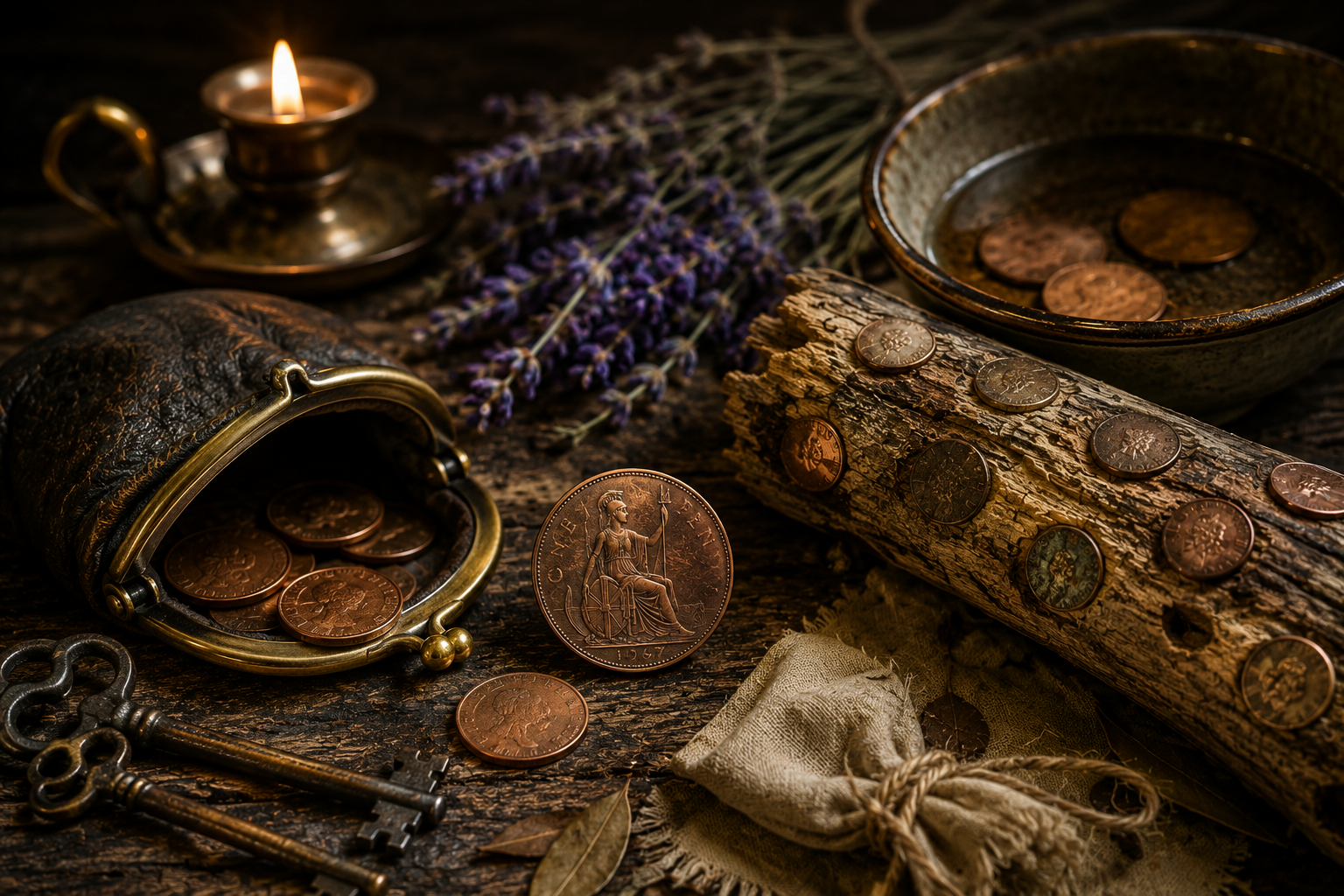
There’s a peculiar thing when you decide to give a purse as a present – you put money in it.
Not much, a penny will do. Perhaps a shiny coin if you’re feeling generous. But you never give an empty purse.
Why?
Well… You just don’t. Somewhere along the way, somebody probably told you that an empty purse given as a gift would always remain empty, or that putting a coin inside would ensure its owner was never without money. You may not believe that. You may nevertheless put the coin in.
Congratulations.
You just performed a small prosperity spell.
Welcome back to Old Magic. Pull up a chair… 🙂
Money is supposed to be one of the least mysterious things humankind has ever invented. It is practical, measurable and horribly good at disappearing three days after payday. Yet coins have never been just currency.
Fore centuries they have been carried for luck, placed beneath buildings, given to babies, dropped into wells, hammered into trees, tucked into clothing, bent into offerings and exchanged for objects that weren’t really being bought at all. And what is really remarkable is that we still do some of it.
Take the new purse.
The custom of putting money in a new purse or wallet before giving it as a gift survives widely. The explanation is usually that the purse should never be empty. The amount doesn’t really matter, which suggests that the purpose isn’t economic. If it was, putting a penny in a £30 purse would be somewhat ridiculous.
But symbolically?
That one penny changes everything. The purse is no longer empty.
In folk magic, beginnings matter. Start as you mean to go on. Move into prosperity rather than poverty. Bring something into the house rather than taking something out. Begin the year with food in the cupboard and money in your pocket. That little coin does an enormous amount of work.
The same principle once applied to clothes.
William Henderson’s nineteenth century collection of folklore from northern England and the Borders records a belief surrounding a new coat or dress. When you first put it on, money should immediately be placed in the right hand pocket. Do that and supposedly the pocket would never be empty. Accidentally put money in the left hand pocket instead?
Bad news!
According to the tradition, you wouldn’t have a penny for as long as you owned the garment. The universe, apparently, was extremely particular about pockets.
It sounds ridiculous until you look at the logic. The first condition of the pocket determines it’s future condition – Begin full = Remain full. This is sympathetic magic reduced – quite literally – to pocket change.
Coins could perform another useful trick too.
They could turn a gift into a purchase.
And sometimes that mattered greatly.
There is still a widespread belief that you should never just give somebody a knife. Give a blade to a friend and it may symbolically ‘cut the friendship.’ The solution is very simple – the recipient gives you a penny. Now the knife wasn’t given, it was bought. Problem solved.
And this isn’t merely something somebody made up for an online list of quirky superstitions.
Charlotte Sophia Burne recorded the custom in nineteenth century Shropshire. An elderly gardener near Shifnal who received knives would promise to bring the giver a penny in return. The underlying belief was that giving a knife or scissors without receiving something back would ‘cut love’.
Henderson recorded essentially the same idea in Durham. A schoolmaster wanted to reward a pupil with a knife but would not simply give it to him. Instead he took a penny from the boy. The knife had therefore been purchased.
In Sussex, another nineteenth century account describes a servant receiving a pair of scissors. She was initially delighted, then apparently remembered what accepting a sharp gift might mean and immediately produced a penny in return.
Across counties we find the same curious little transaction. Nobody is actually buying the knife for it’s market value. The penny is changing what happened. Gift becomes purchase, danger becomes harmless. The relationship remains uncut.
Which brings us to salt.
Salt is one of those substances that seems to attract folklore wherever humans use it. It has been valuable, necessary, preservative, purifying and symbolically protective. It appears in beliefs surrounding thresholds, witches, spilled salt, hospitality, funerals and luck. And an old rule still occasionally surfaces:
Never borrow salt. Pay a penny for it.
Versions of the belief have been collected in which borrowing salt threatens friendship or brings bad luck unless some form of payment is made for it. Again, the amount is irrelevant, Nobody seriously believes that a penny is the correct retail value of a spoonful of salt. The transaction is symbolic. Borrowing has become buying. The penny has changed the rules.
Exactly where every surviving version of this custom originated is difficult to pinpoint. Folk traditions rarely travel with paperwork attached. They pass between neighbours, families, workplaces and communities, sometimes crossing counties and countries while leaving almost no written trail. That is part of what makes them fascinating. Sometimes the archive records them, sometimes somebody’s granny says: “Don’t borrow salt. give me a penny.” And nobody thinks to ask why.
Coins also accompany us into life.
The old custom of ‘crossing a baby’s palm with silver’ remains familiar in England and Ireland. A silver coin was placed in or passed across the baby’s hand as a wish for future prosperity and good fortune. There could even be a little divination included – if the baby grasps the coin, you had a future saver on your hands, If the little spendthrift dropped it, things weren’t looking quite so good. Long before the child understood money, a coin was being used to tell – and perhaps influence – their financial future.
but perhaps the strangest thing we still do with coins is deliberately throw them away.
Go to almost any popular fountain and look at the bottom.
Money.
Perfectly rationally adults walk up to a body of water, take legal currency out of their pockets, throw it somewhere they can’t retrieve it and silently ask for something they want. Lets just all take a moment to think about that one…
Nobody expects the fountain to provide goods or services, there is no vending mechanism, the ten pence has not purchased anything. It is an offering. We just don’t usually call it that.
The association between water, offerings and wishes is a great deal older than the tourist wishing fountain. Coins and other valuable objects have been deposited in springs, wells, rivers and watery places for centuries, although the reasons behind individual deposits cannot always be known. Christian holy wells inherited and developed their own traditions of offerings, cures and pilgrimage, and somewhere across that vast history, throwing something valuable into water became something you could do outside a shopping center while wishing for a new boyfriend. Magic, dear reader, is extremely adaptable. But if you want to see that adaptation happening before your very eyes, we need to go to a tree.
Across Britain and Ireland there are trees and fallen logs absolutely covered in coins. They are usually called ‘coin trees’, ‘money trees’ or ‘wishing trees’. People hammer coins into the cracks in the wood. Sometimes they make a wish or they do it for luck. Sometimes they believe the tree has healing powers. And sometimes they do it because there are already hundreds of coins in the tree and clearly you’re supposed to put one in.
That last reason may be the most interesting of all, because it demonstrates how a ritual can reproduce itself even when nobody explains it.
You encounter an unusual object. You recognise evidence of repeated human behaviour. You copy the behaviour and the tradition gains another recipient.
Folklorist Dr Ceri Houlbrook has studied the British coin trees extensively and documented more than two hundred examples across Britain and Ireland. Importantly, her research cautions against the claim that every coin tree is some untouched survival of ancient Celtic tradition.
Many are surprisingly modern. Some appeared in recent decades – which makes them more interesting, not less. Old magical ideas don’t necessarily need an unbroken, two thousand year old pedigree. Humans can revive them. Reinterpret them. Reinvent them. Or just see somebody else’s penny and add their own.
One of Britain’s best examples stands – or rather lies – at Ingleton Waterfalls in Yorkshire. The fallen tree contains tens of thousands of coins hammered into it’s wood. People keep on adding them. Imagine encountering it without knowing anything about the custom. A fallen tree bristling with metal. Thousands upon thousands of tiny offerings left by strangers.
You might ask what you’re supposed to do. And somebody will probably tell you – put a coin in.
Why? Luck. Or make a wish. Or…
Well… That’s just what you do.
There is an older and much grander example at Isle Maree in Loch Maree, Scotland. The island contains a holy well associated with St Mael Ruba and traditions of healing. Over time, offerings were made there and coins were inserted in a nearby tree. And in 1877 it acquired a very distinguished visitor.
Queen Victoria.
Victoria recorded seeing the old tree beside the well and noted the custom of placing coins in it. Then she joined in. The Queen of England took pennies with her own face on them and hammered them into a tree. There is something pretty cool about that.
Whatever else we call it – custom, tradition, curiosity, offering, superstition – the action itself would have been completely recognisable within the world of folk magic.
Take something of value. Put it somewhere significant. Hope for something in return.
And the coin didn’t always have to remain a coin. One particularly fascinating tradition involved ‘Bending money.’
Coins could be deliberately bent while making vows or seeking cures, particularly in connection with saints, shrines and holy wells. The act transformed ordinary currency into something else. It was no longer just spendable money. It had become part of a promise.
Over and over again, that’s what happens in Folk belief. Their value becomes almost irrelevant. A penny can be worth practically nothing and symbolically everything.

Leave a Reply