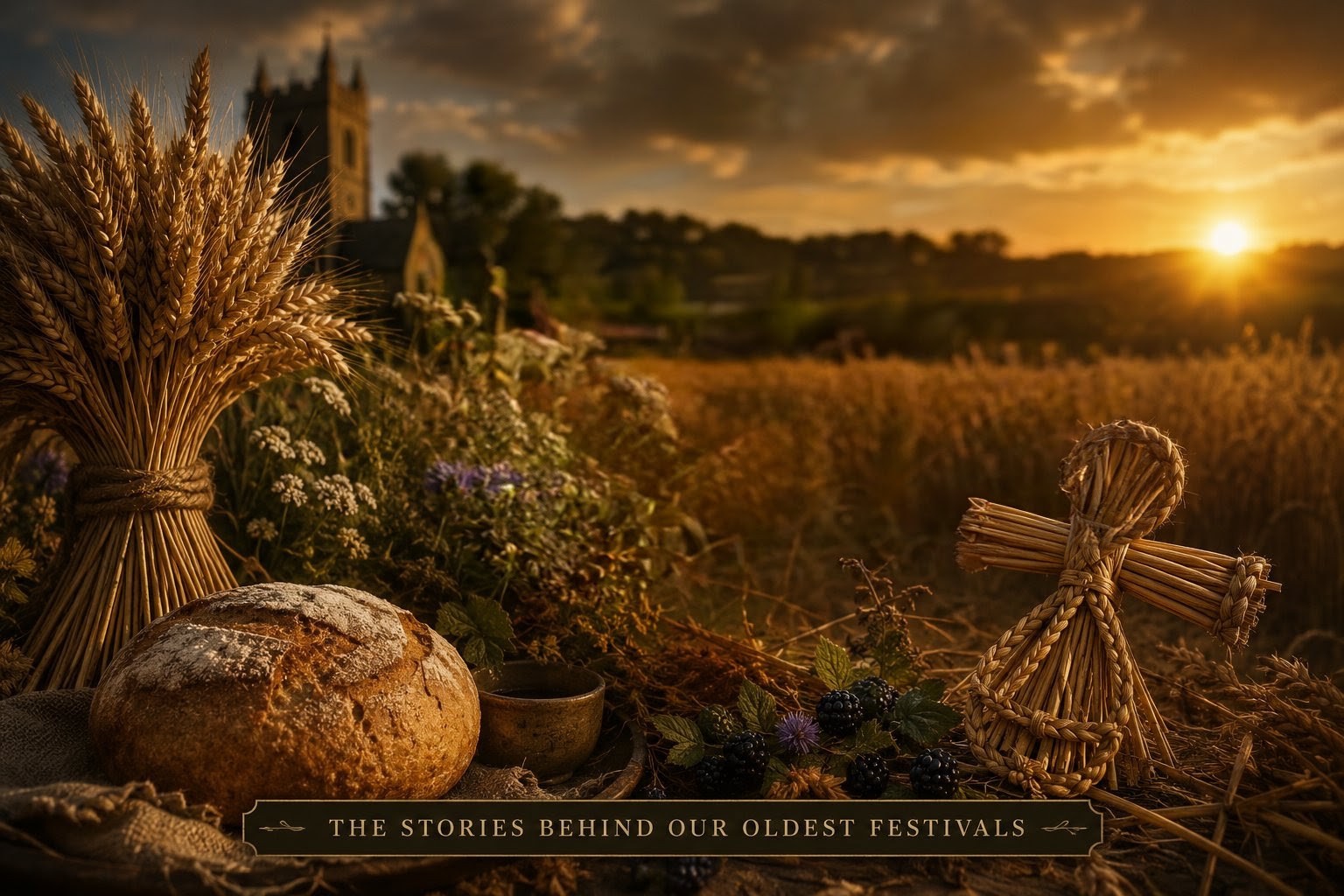
At first glance, Lammas can seem like one of the quieter festivals of the old calendar. It has none of the ghosts of Halloween, none of the glittering lights of Yule, nor the riotous blossom of Beltane. Today it often slips past almost unnoticed, marked only by the changing colour of the fields and perhaps the first combines appearing on the horizon. Yet for our ancestors, few days carried greater importance.
Long before supermarket shelves and overnight deliveries, the first harvest was a matter of survival. If the grain failed, winter could become a season of hunger. If it flourished, there was hope. Every loaf baked from the year’s first wheat carried with it relief, gratitude and the promise that another year might yet be endured.That simple loaf gave Lammas its name.
The word derives from the Old English ‘hlāfmæsse’, – literally “loaf mass”.
On or around 1 August, freshly milled flour from the first cut of the harvest was baked into bread and carried to church to be blessed. Christianity embraced the existing rhythms of the agricultural year, weaving older seasonal customs into a festival that celebrated both God’s bounty and the labour of those who worked the land. Beneath the Christian tradition, however, lingered echoes of something much older.
Across Ireland, Scotland and the Isle of Man, the same season was known as Lughnasadh, named after the god Lugh. According to medieval Irish tradition, Lugh established the festival in honour of his foster mother, Tailtiu, who was said to have died after clearing the forests of Ireland to make way for fertile farmland. The festival therefore became both a memorial and a celebration. A reminder that every harvest comes at a cost.
Lughnasadh was never simply about crops. It was about community. People gathered from miles around to trade livestock, settle disputes, arrange marriages, race horses, wrestle, tell stories and strike bargains. Temporary markets sprang up on hillsides. Musicians travelled between settlements. Families who had not met since the previous year came together once again.
Many of these gatherings survived well into the nineteenth century. Some evolved into country fairs, while others became sporting events whose origins were long forgotten. Even today, echoes remain in village shows, agricultural exhibitions and local harvest festivals.
Throughout Britain, the first sheaf of wheat often carried particular significance. Rather than being mixed immediately with the rest of the crop, it might be treated with respect or even reverence. In some regions it became the seed from which the following year’s harvest would grow. Elsewhere it was woven into decorative forms that eventually evolved into the familiar corn dolly.
These weren’t simply ornaments. Many believed the spirit of the growing corn lived within the fields themselves. As harvest progressed, that spirit was thought to retreat into the final standing stalks. By weaving the last of the crop into intricate shapes and preserving it through winter, people believed they were giving the spirit somewhere to rest until it could be released back into the fields the following spring.
Whether anyone literally believed this is difficult to say. Folklore rarely deals in absolutes. It speaks instead in traditions, habits and rituals passed quietly from one generation to the next.
Harvest customs varied enormously from county to county. In parts of Yorkshire, Derbyshire and across the north of England, labourers performed the ancient ceremony known as ‘Crying the Neck’. Although now more commonly associated with Cornwall, similar customs appeared elsewhere, celebrating the final sheaf with songs, cheers and shared ale after weeks of exhausting work beneath the summer sun.
Elsewhere, farmers left a small patch of standing corn untouched, providing food for birds and wildlife while also satisfying older beliefs that something of the field should remain undisturbed. Practical kindness and ancient superstition often walked hand in hand.
There was another reason Lammas mattered. It marked the moment when the year quietly began its journey towards winter. The days remained warm, but evenings grew noticeably shorter. Blackberries ripened in the hedgerows. Swallows gathered upon telegraph wires before beginning their long migrations. The first hints of autumn crept almost unnoticed into the landscape.
Perhaps that’s why so much folklore surrounds this time of year.
Across Britain, people watched the weather carefully on Lammas Day. Fine weather promised a good autumn; storms could be interpreted as warnings of hardship ahead. While few of these sayings stand up to modern meteorology, they reveal just how closely our ancestors observed the natural world. Their calendar wasn’t measured by mobile phones or digital reminders. It was written in birdsong, ripening fruit, flowering heather and fields slowly turning from green to gold.
Today, Lammas occupies a curious place. Churches still celebrate Harvest Festival. Pagan communities continue to observe Lughnasadh with feasts, bread baking and offerings of thanks. Morris dancers perform at village fêtes. Agricultural shows attract thousands of visitors each summer.
Many people who would never describe themselves as religious still find quiet satisfaction in baking fresh bread, visiting a local farm shop or simply walking through golden fields beneath a late summer sky. Perhaps that tells us something. The old festivals never truly disappeared, they simply changed clothes. Beneath every loaf lies the same gratitude our ancestors knew – that food does not appear by magic, that every harvest depends upon weather, hard work and a little good fortune.
Whether we call it Lammas, Lughnasadh or simply the beginning of harvest, the first of August still invites us to pause.
To give thanks.
To recognise the turning of another season.
And to remember that, for thousands of years before us, others stood beneath the same ripening skies, wondering what the coming winter might bring.
Sources
Ronald Hutton – Stations of the Sun
Steve Roud – The English Year
Miranda Green – Dictionary of Celtic Myth and Legend
Folklore Society archives
Historic England (harvest customs)
National Library of Ireland (Lughnasadh traditions)

Leave a Reply