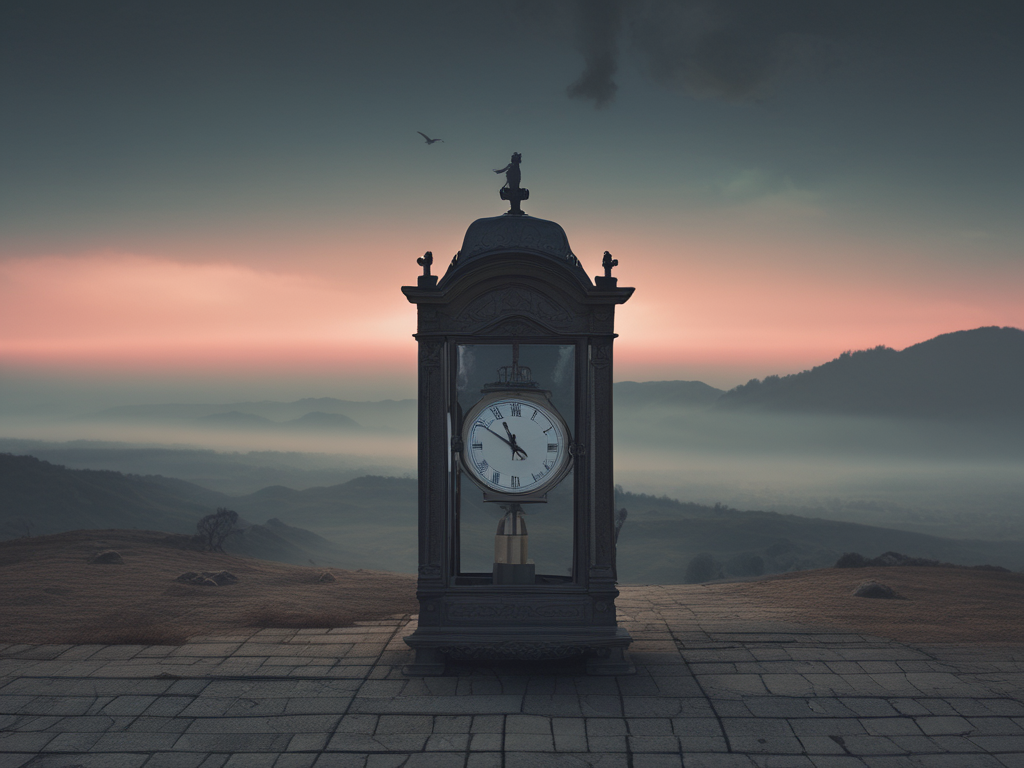
The phrase ‘time slip’ is used to describe a phenomenon where individuals inexplicably experience a temporary shift to another time period, perceiving past or future events as though they were happening in the present.
Unlike traditional concepts of time travel, time slips are often spontaneous, short-lived, and usually involve the individual returning to their original time without any apparent physical transition.
Stories of time slips can be traced back to ancient and medieval times. In mythology and folklore there are tales of individuals who enter mystical realms or enchanted lands where time flows differently. For example, the story of Rip Van Winkle, who sleeps for twenty years and awakens to a changed world, can be seen as an early depiction of a time slip.
The concept of time slips gained popularity in the 19th and 20th centuries, particularly with the rise of spiritualism and interest in the paranormal. Several notable cases were documented during this period, often involving credible witnesses and detailed accounts.
One of the most famous time slip cases involves two English women, Charlotte Anne Moberly and Eleanor Jourdain, who visited the Palace of Versailles in 1901. They reported experiencing a vivid encounter with figures from the 18th century, including Marie Antoinette.
Their detailed account, later published in the book “An Adventure,” describes how they perceived the surroundings and people as if they had traveled back in time.
In Liverpool, England, Bold Street has been the site of numerous reported time slips.
One well-known case involves Frank, a former police officer, who claimed to have experienced a sudden shift to the 1950s while shopping with his wife. He described seeing old-fashioned storefronts, vehicles, and people dressed in period attire.
Similar reports from other individuals have added to the mystery of Bold Street.
Another documented case occurred in 1997 when a man named Andrew MacKenzie experienced a time slip at Piccadilly Circus in London.
He reported seeing the area as it appeared in the 1940s, with old-fashioned vehicles and people in period clothing. The experience lasted only a few minutes before he found himself back in the present.
Some researchers suggest that time slips may be psychological phenomena, potentially triggered by stress, fatigue, or a dissociative state.
These experiences could be akin to hallucinations or vivid daydreams, influenced by the individual’s subconscious mind.
Others propose that time slips could be real events caused by temporal distortions or anomalies. This theory posits that certain locations or conditions might create rifts in the space-time continuum, allowing individuals to briefly perceive or enter another time period.
Some scientists hypothesize that electromagnetic fields might play a role in time slips. They suggest that strong or fluctuating electromagnetic fields could disrupt the brain’s perception of time, creating an illusion of temporal displacement.
From a scientific perspective, quantum mechanics offers another potential explanation. Theories involving parallel universes and alternate realities suggest that time slips might occur when individuals momentarily cross into another dimension or timeline.
Time slips have captured the imagination of writers and filmmakers, inspiring numerous works of fiction.
Novels like H.G. Wells’ “The Time Machine” and films like “Back to the Future” explore themes of temporal displacement and time travel.
While these works often depict more controlled and deliberate forms of time travel, the spontaneous nature of time slips remains a compelling narrative device.
Time slips have become a part of modern folklore and urban legends, with many anecdotal accounts shared in books, documentaries, and online forums. These stories often reflect cultural anxieties and fascinations with the concept of time and its mysteries.
Time slips continue to be a subject of interest in both psychological and paranormal research. Psychologists study the phenomenon to understand the human mind’s perception of time, while paranormal investigators seek to document and explain reported cases.
Personal Accounts
John’s Experience in St. Augustine (2015):
In 2015, a man named John reported a time slip while visiting St. Augustine, Florida.
He claimed that while walking through the historic district, he suddenly found himself in what appeared to be the 18th century. He saw people dressed in colonial attire, horse-drawn carriages, and old-fashioned shops.
The experience lasted only a few minutes before he was back in the present. John’s account was detailed and consistent, sparking interest among local paranormal researchers.
Sarah’s Encounter in Edinburgh (2018):
Sarah, a tourist visiting Edinburgh, Scotland, in 2018, described a similar experience.
While exploring an old part of the city, she felt a sudden chill and noticed that the bustling modern street had transformed into a cobblestone lane with people dressed in medieval clothing. She heard the clatter of horses and the murmur of a market before everything returned to normal.
Paranormal investigators often explore reported time slip locations to gather evidence and interview witnesses.
Techniques include historical research to verify the accuracy of descriptions, environmental measurements to detect anomalies, and psychological assessments to understand the witnesses’ mental states.
Some academic studies have attempted to categorize and analyze time slip experiences.
Researchers also look for common patterns, triggers, and environmental factors that might contribute to these phenomena.
Documentaries and media coverage have brought time slips to a wider audience, often featuring interviews with witnesses and experts. Shows like “Unsolved Mysteries” and “Ancient Aliens” have explored the topic, blending historical accounts with modern reports to create a compelling narrative.
Time slips remain one of the most intriguing phenomena in the realm of the paranormal. Whether viewed through the lens of psychology, science, or folklore, these experiences challenge our understanding of time and reality.
As reports continue to emerge from around the world, the mystery of time slips continues to captivate, vex and invite further exploration.
Whether they are psychological anomalies, physical distortions, or glimpses into parallel worlds, time slips remind us of the complex and often mysterious nature of time itself.




Leave a Reply