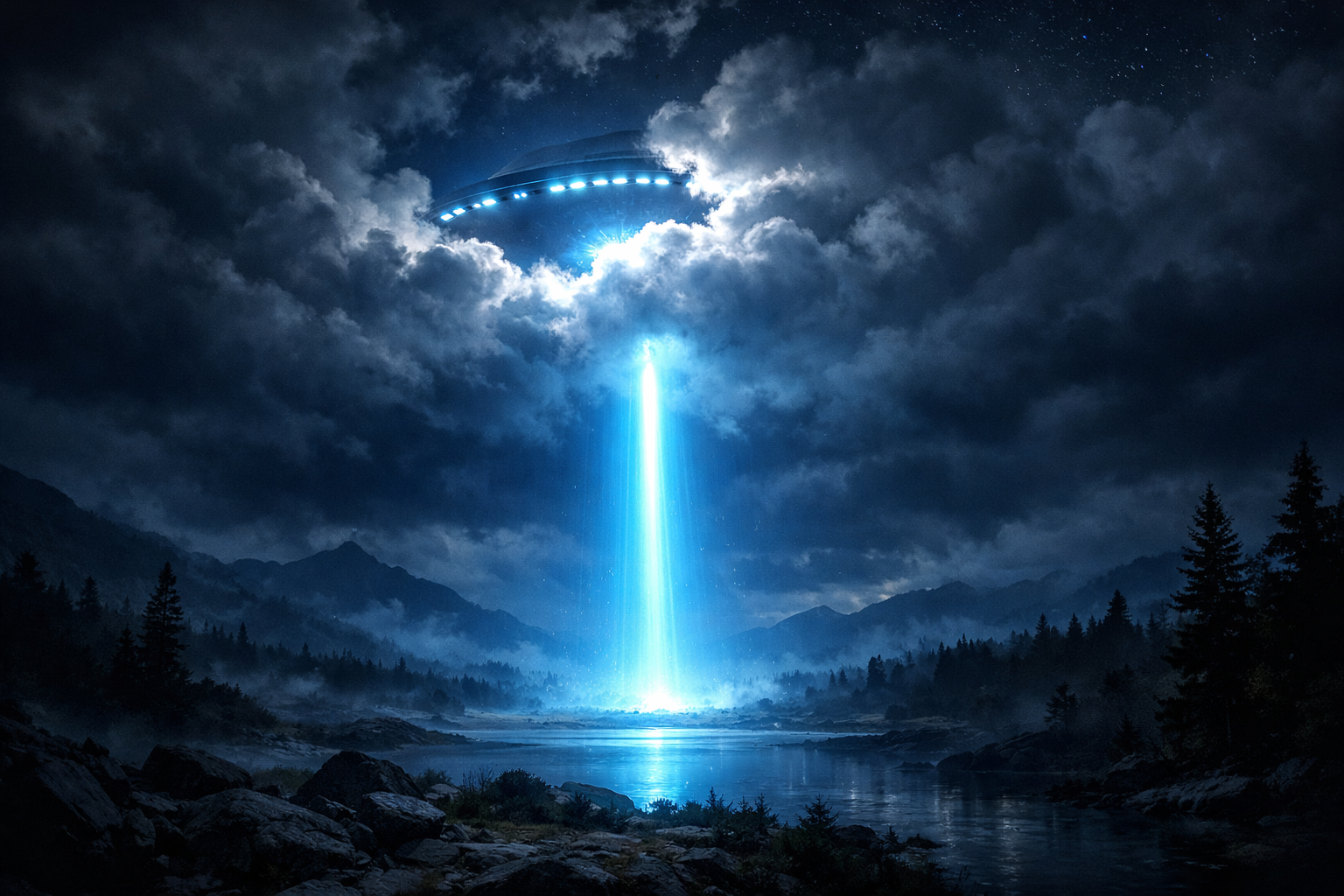
Portals, often depicted in science fiction and fantasy as gateways between different realms or dimensions, intrigue us with their potential for exploration and adventure. While the concept of portals remains for the most part in the realm of speculation, scientific study and theoretical physics offer tempting insights into the possibility of such phenomena.
In theoretical physics, the idea of portals or “wormholes” comes from Einstein’s theory of general relativity. Wormholes are hypothetical tunnels through spacetime that might connect distant points in the universe, potentially allowing for shortcuts across vast cosmic distances. These tunnels are envisioned as regions where spacetime is highly curved, forming a bridge or passage between two separate locations.
According to Einstein’s equations, wormholes could theoretically exist as solutions, although their stability and practicality remain somewhat questionable. Theoretical physicist Kip Thorne, a pioneer in the study of wormholes, suggests that to keep a wormhole open and traversable, unknown matter with negative energy density would be needed to counteract the immense gravitational forces that would otherwise collapse it.
Research into wormholes and spacetime curvature continues to be a focus of theoretical physics, with ongoing efforts to understand their mathematical properties and potential implications for cosmic structures. While no observational evidence of naturally occurring wormholes has been found, their existence remains within the realm of theoretical possibility based on current scientific understanding.
In popular culture and speculative fiction, portals often serve as a handy narrative devices for instantaneous travel between distant worlds or alternate realities. While these portrayals are imaginative and entertaining, they are typical of our fascination with the unknown and our desire to explore the boundaries of scientific knowledge.
The concept of portals also intersects with discussions on black holes, another phenomenon predicted by general relativity. Black holes are regions of spacetime where gravity is so strong that nothing, not even light, can escape from within a certain distance called the event horizon. Theoretical studies have suggested potential connections between black holes and wormholes, proposing that certain types of black holes could serve as portals to other regions of spacetime or even other universes.
In summary, while portals and wormholes remain speculative constructs in theoretical physics, they offer a tantalizing glimpse into the complexities of spacetime and the potential for extraordinary journeys across the cosmos. As our scientific understanding advances and technological capabilities evolve, the exploration of such phenomena may one day move from the realm of fiction to scientific reality, unlocking new frontiers in our quest to understand the universe and our place within it.