Monday began with a pigeon.
Not an unusual pigeon, as far as pigeons go. It was grey, irritable and had the unwavering confidence of a creature that had never once had the occasion to question it’s right to be anywhere. It currently was strapped in the chimney of a terraced house in Sheffield.
By 9.30am, the owner of the house, a fifty-nine year old man with a history of vestibular disorder and poor decision making, was on the roof with a broom, a bedsheet and the sort of gritty determination usually associated with siege warfare. By ten past ten, he was dead.
Dr Carrie Dale stood in the post mortem room, regarding what was left of his dignity.
“Cause of death?” asked DS Malik.
“Gravity”, Carrie replied.
Malik glanced at her over the top of his notebook.
“I can’t write gravity!”
“You can if you phrase it correctly. Try -‘Craniocerebral trauma due to Tumarkin otolithic crisis secondary to Meniere’s Disease’. – pretty standard for a two-story plunge.”
The dead man lay beneath the clinical lights, still wearing one slipper. The other slipper had described a graceful arc during the fall and landed in next doors’ bird bath, ironically.
Malik cleared his throat.
“So he went onto the roof – “
“With a broom.”
“To rescue a pigeon.”
“To evict a pigeon.”
“And fell through the conservatory?”
“Onto a decorative stone Buddah.”
“Do I need to know which part of him hit it?”
“No.”
“Good.”
“Carrie pulled off her gloves. For twenty three years, she had worked with the dead. The dead, she had found, were more reliable than the living. The dead didn’t exaggerate, or forget or suddenly remember a crucial detail after three cups of tea and a vape.
Bones kept their own counsel, but they rarely lied. The living lied constantly. Mostly to themselves. Monday’s deceased had told his wife he had fixed chimneys before. He had not.
“Did the pigeon survive?” Carrie asked.
“Yes.” replied Malik. “It was released by the fire brigade and immediately flew back up to the roof. Some creatures learn nothing.”
Carrie looked at the body on the table between them.
“Apparently.”
*
Tuesday arrived beneath a sheet painted with medieval heraldry. The deceased had been a founding member of the Barnsley Historical Combat ans Siege Society, a group which met twice a month in a field behind a garden centre. They wore chainmail, shouted in Norman French and regularly argued about whether having crisps at the buffet lunch was historically appropriate.
The dead man’s name was Colin Pepper and he had built a trebuchet. Not a model or a scaled down educational replica. A full-sized, functioning siege engine made from reclaimed timber, scaffolding poles and what one witness described as “a fair bit’o optimism”.
“What was he launching?” Carrie asked. Malik turned a page in his notebook.
“A pumpkin.”
“In August?”
“They had some left over.”
“From when?”
“No one knows.”
The trebuchet had worked perfectly for six attempts. On the seventh, Colin Pepper had decided that the counterweight was insufficient. So he added an engine block from a Ford Cortina. The frame collapsed. The pumpkin travelled around forty feet before rolling gently to rest beside a gatepost.
Colin travelled to the morgue.
Carrie studied the injuries.
“He was wearing a helmet.”
Malik nodded.
“Thirteenth Century replica.”
“It’s made of aluminium.”
“Steel’s too heavy, apparently.”
Carrie looked at him. Malik looked back. Neither said anything for several seconds. Eventually, he asked, “Cause of death?”
“Medieval enthusiasm.”
“Carrie…”
“Exsanguination secondary to pelvic disruption.”
Malik wrote it down.
*
That afternoon she ate lunch alone in the mortuary canteen. The canteen was not technically part of the mortuary. It was a small , overlit room shared by pathologists, porters and whichever police officers had not lost their appetites. The vending machine hummed, the kettle was furry on the inside and someone had left a yoghurt in the fridge that had become less a dairy product and more an independent life form.
Carrie stirred powdered milk into coffee and opened a journal article on pelvic trauma, She read the same paragraph four times before she closed the journal. Two absurd deaths didn’t make a pattern.It barely made a coincidence.
*
By Wednesday, there was a frozen turkey.
It had fallen from the twelfth floor balcony of a flat in Rotherham. The victim was a forty two year old traffic warden called Christopher. The turkey weighed just over six kilograms and had been stored in a chest freezer since Christmas, It’s owner had decided to defrost the turkey by placing it on a plastic garden chair on the balcony, During a heatwave,
The turkey had slid from the plastic chair, passed neatly through a gap in the railings, and struck Christopher, who was issuing a parking ticket below, at 60mph. The ticket was still in his hand.
“This is ridiculous.” Carrie said. Malik stood beside her, looking tired.
“It gets worse.”
“How?”
“The turkey belonged to his sister.”
Carrie looked up. Malik handed her the scene report. The sister had not spoken to her brother in six years following an argument about their mothers sideboard. The sideboard had eventually been given to charity. The grudge had remained.
“You sure she didn’t throw it?”
“Three witnesses saw it slide. She had her mates ’round for coffee.”
“She could’ve placed it deliberately.”
“She was in the flat, arguing with British Gas.”
“That proves nothing.”
“She was on hold for forty-three minutes.”
Carrie conceded the point.
Wednesday evening, she remained at work after everyone else had gone home. The building changed after hours. By day, the mortuary was stainless steel, paperwork and fluorescent light. By night, every sound became… significant. A pipe settling in the wall. A refrigeration unit beginning it’s cycle. The dull expansion of metal.
Carrie didn’t believe the mortuary was haunted. She didn’t believe in ghosts, not like that. She believed that people carried ghosts with them. Regret was a ghost, so was guilt. But the worst ghost of all was memory.
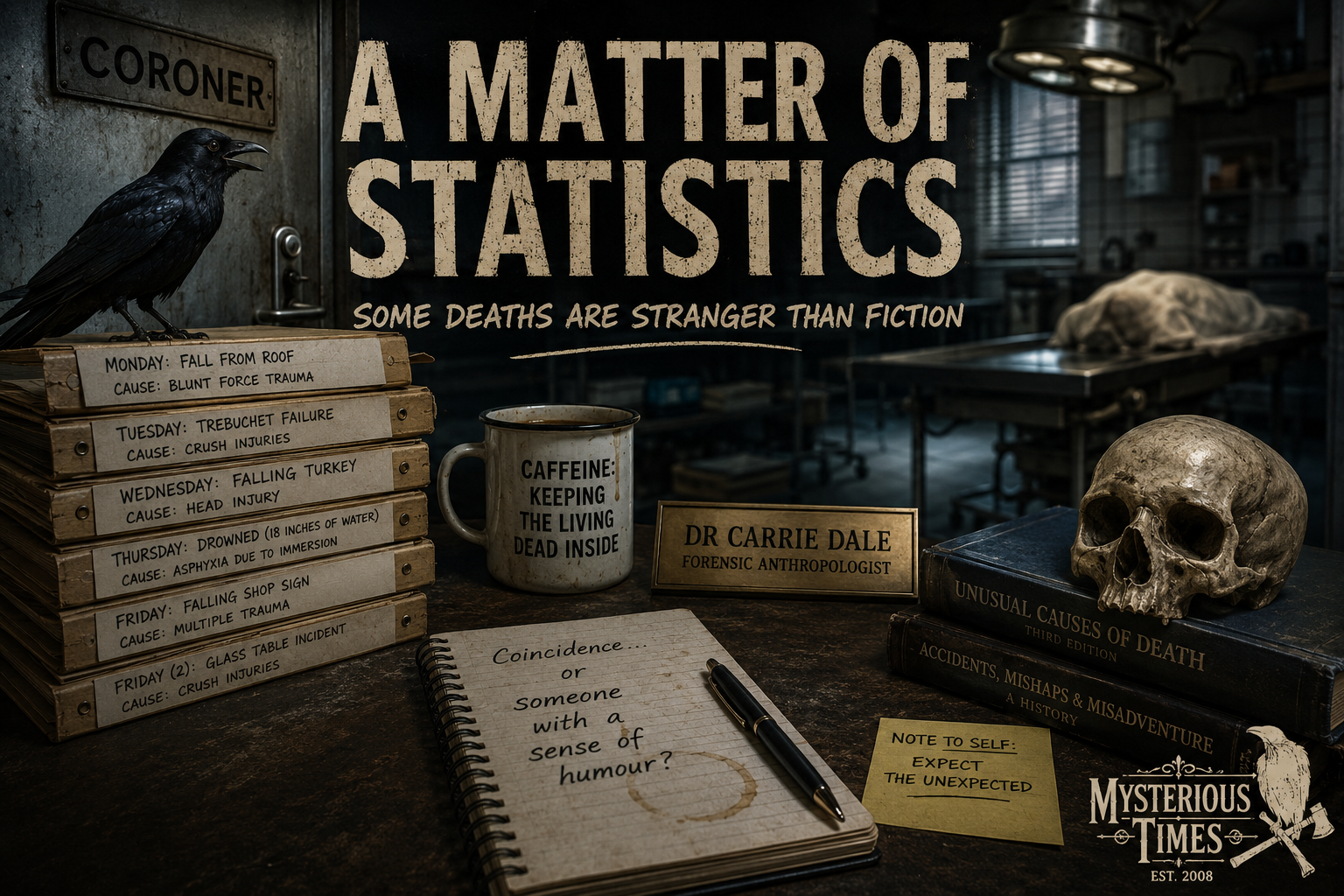
She looked at the week’s reports laid across her desk. A chimney. A trebuchet. A turkey. Three deaths connected by nothing except improbability. She wrote the word ACCIDENT across the top of a notepad. Then beneath it:
COINCIDENCE?
She stared at the question mark.
*
Thursday’s body arrived wearing flippers. His name was Graham Wilkes, fifty-eight, semi-retired accountant, amateur metal detectorist and chairman of his local Neighbourhood Watch. He had drowned in eighteen inches of water.
“In a boating lake?” Carrie asked.
“Ornamental pond.”
“How?”
“He was testing a homemade snorkel,”
“Why?”
Malik consulted his notes.
“He wanted to retrieve coins.”
“From an ornamental pond.”
“Yes.”
“While wearing flippers.”
“Yes.”
“And a homemade snorkel.”
“It was a section of garden hose attached to a ski mask.”
Carrie closed her eyes.
“Dead Space Suffocation…”
She looked down at Graham Wilkes. The flippers were bright yellow and still had the price stickers on them. There was pondweed in his hair.
“You see it now, don’t you?” she said,
Malik frowned, “See what?”
“The pattern.”
“There isn’t one.”
“There are four impossible deaths in four days.”
“Unlikely isn’t impossible.”
“That sounds like something you’d find in a fortune cookie.”
“It sounds like statistics.”
Carrie turned to face him.
“You think this is random?”
“Yes.”
“Four people, each dying in a manner so absurd it borders on theatrical?”
“People do absurd things.”
“Not at this frequency.”
“Seven billion people on the planet. Someone, somewhere, is always doing something idiotic.”
“This is one county.”
“Yorkshire is ambitious.”
Carrie did not return his smile and it bothered him. Malik tucked his notebook away.
“You’ve been working too much.”
“I work the same hours I’ve always worked.”
“Yes, but now you’re talking like the opening act of a conspiracy documentary.”
“I’m not suggesting aliens.”
“Good.”
“I’m suggesting a person.”
Malik sighed.
“What person?”
“Someone engineering accidents.”
“With pigeons, trebuchets, frozen poultry and garden hose?”
“When you say it like that, it sounds foolish.”
“It is foolish.”
Carrie looked back at the body.
“Foolishness can hide things.”
*
Friday brought two.The first died while attempting to demonstrate that a glass coffee table was strong enough to support his weight. It was not. The second was killed by a falling shop sign advertising life insurance. That was when Malik stopped making jokes.
They sat in Eleanor’s office with the blinds closed. Six files lay between them.
“They’re not connected,” he said, though less confidently than before.
“Everyone is connected.”
“Not in a useful way.”
Carrie tapped the first report.
“Roof fall. Crushing. Falling object. Drowning. Glass trauma. Falling sign.”
“That isn’t a pattern. That’s a list.”
“All public or semi-public incidents.”
“The first was on his own roof.”
“His wife filmed it.”
Malik winced.
“She thought it would be funny.”
“It was viewed two million times before she took it down.”
He rubbed his face.
“What are you looking for?”
“Attention.”
“From whom?”
“I don’t know.”
“That’s not very forensic.”
“No,” Carrie said. “It isn’t.”
She had slept three hours in two nights. Her kitchen bin contained four takeaway cartons and a cracked mug she had thrown there after dropping it. Her hands felt unsteady. Her mind did not. That was the problem. Everything felt clear. Too clear. Someone was arranging these deaths. Not necessarily causing them directly. A loosened railing. A weakened frame. A moved chair. A planted idea.
People could be nudged. Most disasters needed only an invitation.
“Let’s assume you’re right,” Malik said. “What’s the motive?”
“That’s what bothers me.”
“Because you haven’t got one?”
“Because there may not be one.”
Malik leaned back.
“People kill for money, revenge, control, fear, obsession.”
“People also kill because they enjoy it.”
“There’s no sign anyone was there.”
“There’s always someone there.”
He stared at her.
Carrie lowered her voice.
“Perhaps we’re looking for the wrong kind of presence.”
Malik stood.
“That’s enough.”
“I’m not saying supernatural.”
“You’re about three sentences away from it.”
“I’m saying indirect.”
“You need sleep.”
“I need Saturday’s body.”
He froze.
“What?”
“If the pattern continues, there will be another tomorrow.”
“That’s not a pattern. That’s a week.”
“Exactly.”
He looked at her for a long moment.
Then he left.
Saturday morning, nobody died absurdly. At ten, Carrie checked the incident log. At eleven, she phoned Malik. At noon, she walked through the emergency department under the pretence of delivering paperwork. At one, she sat in the mortuary canteen with a cup of tea she did not drink.
Perhaps she had been wrong. The relief felt almost like disappointment. At twenty past one, the door opened.
A man entered. Carrie had never seen him before. He was perhaps sixty, perhaps eighty. His face had the quality of an old photograph: sharply defined in places, blurred in others. He wore a dark suit, polished shoes and a black tie. Not fashionable black. Funeral black. He carried a leather ledger beneath one arm.
“Is this seat taken?” he asked.
The canteen was empty. Eleanor looked at the chair opposite her.
“No.”
He sat, placing the ledger on the table with care. The cover was cracked at the corners. The leather had darkened with age and handling. There was no title.
The man looked at the vending machine.
“Terrible coffee.”
“Yes.”
“Tea’s safer.”
“Debatable.”
He smiled. There was nothing threatening about him. That made Carrie uneasy.
“You work here?” she asked.
“Occasionally.”
“What department?”
“Personnel.”
“We don’t have personnel on site.”
“Everyone has personnel.”
He opened the ledger. The pages were filled with names. Hundreds of them. Perhaps thousands. Each written in neat, dark ink. Beside each name was a date. Carrie recognised the first immediately. Harold Finch. The man with the pigeon.
Below it:
Colin Pepper.
Christopher Bell.
Graham Wilkes.
She stood so quickly the table shook. The stranger looked up.
“Sit down, Doctor Dale.”
“How do you know my name?”
“It’s on your badge.”
She glanced down. Her badge had turned backwards. The blank plastic backing faced outward. The man stirred sugar into his tea.
“You keep looking for motive,” he said.
Eleanor remained standing.
“There has to be one.”
“Not always.”
“What did you do?”
“Nothing.”
“You expect me to believe that?”
“I rarely require belief.”
“Six people are dead.”
“Many more than six.”
“This week.”
“Ah.”
He turned a page.
“This week has been unusual.”
“You chose them.”
“No.”
“You wrote their names.”
“Afterwards.”
“Then how did you know?”
He lifted his teaspoon and watched tea drip from it.
“I know how everything ends.”
Eleanor looked towards the door. It seemed farther away than before. The canteen clock clicked loudly. One second. Another. Another.
“You’re insane,” she said.
“Possibly. Though I’ve existed long enough to see every diagnosis become unfashionable.”
“Who are you?”
The man closed the ledger.
“Personnel.”
“That isn’t an answer.”
“It’s the only one you’re getting.”
He rose. Carrie’s throat tightened.
“Is my name in there?”
He studied her. Not cruelly. Almost kindly.
“Everyone’s name is in there.”
“When?”
“That would spoil things.”
He tucked the ledger beneath his arm.
“You were wrong, by the way.”
“About what?”
“No one arranged the deaths.”
“Then why so many?”
He considered this.
“Statistical clustering.”
“That’s your explanation?”
“It’s a very good explanation.”
“They were ridiculous.”
“Most deaths are, seen from the correct distance.”
Carrie felt anger rise in her.
“Those were people.”
“Yes.”
“They had families.”
“Yes.”
“And you stand there making jokes?”
His expression changed. Only slightly. But the room became colder.
“I do not make jokes about the dead, Doctor Dale.”
The fluorescent light above them flickered.
“I make notes.”
The clock stopped. Eleanor could hear her own breathing. Then the stranger’s face softened again.
“People prefer meaningful endings,” he said. “Final words. Last stands. Hands held at bedsides. Music swelling at precisely the right moment.”
He glanced towards the mortuary doors.
“But life does not become dignified simply because it is ending.”
Carrie said nothing.
“Sometimes a king dies in battle. Sometimes a child survives a building collapse. Sometimes a good woman dies in her sleep at ninety-seven.”
“And sometimes?”
“A man climbs onto a roof in one slipper to argue with a pigeon.”
Despite herself, Carrie laughed. It came out as a single startled sound.
The stranger smiled.
“Exactly.”
He walked to the door.
“Wait.”
He stopped.
“Why come here?”
“You looked for me.”
“I looked for a killer.”
“People often confuse us.”
“That still doesn’t explain the ledger.”
“No,” he said. “It doesn’t.”
He opened it once more. Carrie caught sight of the final page. Unlike the others, it held only one name.
Her own.
Beside it was today’s date. The chair scraped backwards as she stood.
“What happens to me?”
The stranger glanced towards the untouched tea beside her hand.
“You haven’t eaten since Thursday. You’ve slept for three hours. You drove here this morning while reading a case report at the traffic lights.”
Carrie said nothing.
“You were expecting something elaborate,” he continued. “A falling gargoyle, perhaps. A poisoned umbrella. Something worthy of your pattern.”
He closed the ledger.
“Most people are killed by something much less imaginative.”
The fluorescent light flickered. The chair was empty.
Then Malik opened the canteen door. Carrie turned sharply. The stranger had gone. There was no ledger on the table. Only her tea, cold now, and a small paper packet of sugar resting beside it. Malik frowned at her.
“Who were you talking to?”
“No one.”
“You look terrible.”
“I’m going home.”
“That’s the first sensible thing you’ve said all week.”
Carrie picked up her coat and followed him into the corridor. At the mortuary entrance, Malik’s phone rang. He stepped aside to answer it while Carrie continued towards the car park. Rain had begun to fall. She crossed between two parked ambulances, searching her bag for her keys.Behind her, an engine started. Someone shouted her name. Carrie stopped.
A delivery van swept past the end of the row, close enough for its wing mirror to catch the sleeve of her coat. The force spun her around and she fell against the side of an ambulance, keys scattering across the wet tarmac. Malik ran towards her.
“What the hell were you doing?”
Carrie stared at the road. The van had already disappeared through the gates.
“I didn’t see it.”
“No,” Malik said. “You didn’t.”
He helped her to her feet. Something white lay among her keys. A small paper packet of sugar. Carrie picked it up. On the reverse, written in neat black ink, were four words:
NOT TODAY, DR DALE
She looked towards the mortuary windows. A man in a dark suit stood behind the glass.
He raised one hand. Not waving.
Counting.
Then an ambulance passed between them, and he was gone.