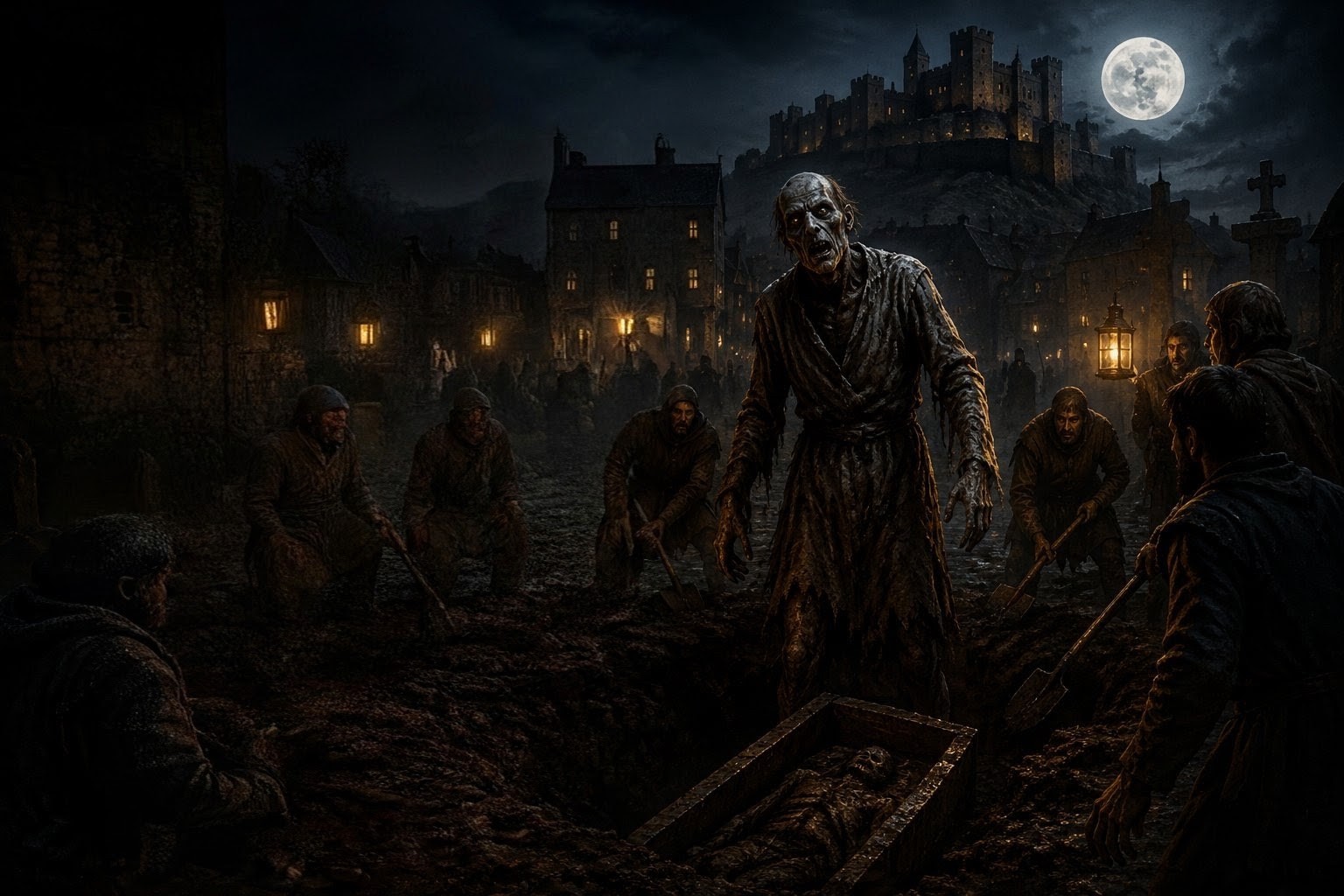
Long before Dracula bought property in Whitby, before Carmilla developed an unhealthy interest in young ladies and before the Croglin Vampire started scratching at bedroom windows, Britain already had a problem with people who refused to stay dead. They just weren’t called vampires.
They were corpses – walking ones and, according to the twelfth-century chronicler William of Newburgh, one of them caused absolute havoc in Berwick-upon-Tweed.
William was an Augustinian canon at Newburgh Priory in Yorkshire. Born around 1136, he spent much of his life there and towards the end of the twelfth century wrote his ‘Historia rerum Anglicarum’ – ‘History of English Affairs’ – covering events from the Norman Conquest almost to his own death. Our William is an interesting source because he wasn’t some medieval collector of ghost stories who believed absolutely anything he heard, in fact he was famously rude about Geoffrey of Monmouth for writing what William regarded as nonsense about King Arthur. Then William went on to write about green children and corpses getting out of their graves – but hey… Nobody is perfect.
His four accounts of the walking dead appear in Book V of the ‘Historia’, written during the final years of his life. They are sufficiently peculiar that William himself commented on the apparent novelty of such events and the absence of comparable stories in ancient writings. Modern historians have consequently spent a great deal of time trying to work out exactly what these tales tell us about the collision between medieval theology, popular belief and folklore. ([OUP Academic][1])
One of William’s walking corpses lived – and died – at Berwick. He doesn’t give us the man’s name. He does, however, give us his character and it isn’t flattering. The man was wealthy but thoroughly wicked. After his death he was buried in the usual manner, which really ought to have been the end of his involvement in community affairs. Thankfully it wasn’t or I’d be missing an article this week.
William tells us that the dead man’s body was animated after burial and began leaving its grave. The corpse wandered around at night. Dogs followed it, barking furiously. The people of Berwick became terrified. Nobody wanted to meet the thing in the street, which seems an entirely reasonable position to take when one of your recently deceased neighbours is roaming town after dark accompanied by a pack of hysterical dogs. Soon people were shutting themselves inside their houses at night. The dead man had effectively imposed a medieval curfew and the inhabitants of Berwick began discussing what to do about him.
There was apparently a practical concern beyond simply being frightened half to death. The corpse was decomposing. Some of the townspeople feared that this putrefying body, wandering repeatedly through the air, would contaminate it and cause disease. To medieval minds, this was not necessarily supernatural thinking. Disease was widely associated with corrupted air, foul smells and putrefaction. And so the people of Berwick decided that something had to be done about their troublesome former neighbour.
They hired ten young men renowned for their courage. Their job was simple – Dig him up. Cut him to pieces and burn him. Which does rather put modern neighbourhood disputes about wheelie bins into perspective.
The men opened the grave, removed the corpse, dismembered it and committed the remains to fire. And it worked. The dead man stopped walking. Unfortunately, everybody else started dying.
William reports that a pestilence followed, killing many people in the area. For the medieval audience, the connection was obvious enough to be worth recording: the foul wandering corpse had polluted the atmosphere and disease followed in its wake. The revenant had been destroyed. Its consequences had not. ([OUP Academic][1])
So was this Britain’s first vampire? Not really, at least, not if we are being careful about terminology. William never calls the creature a vampire. The familiar word and the cluster of traditions we now associate with vampires belong to a much later European context. There are no elegant cloaks here, no seductive aristocrats, no tiny puncture wounds and no desperate hunt for a wooden stake. The Berwick corpse doesn’t even drink blood. What William describes is better called a ‘revenant’: a dead person who physically returns from the grave. And medieval Britain had some spectacular examples.
In fact, Berwick wasn’t even William’s only one. At Buckingham, he records a dead man returning to torment his widow. The corpse appeared in her bedroom and nearly crushed her beneath its weight. When relatives began keeping watch with her, it moved on to harass other members of the family and eventually appeared during daylight. This time the solution was ecclesiastical rather than agricultural. The Bishop of Lincoln supplied a written absolution which was placed upon the corpse’s chest. The wandering stopped. Apparently even the undead respect paperwork. ([OUP Academic][1])
Then there was Melrose – and this one is magnificent. William tells of a chaplain attached to a wealthy lady who had lived a distinctly worldly life. He was particularly fond of hunting and acquired the nickname ‘Hundeprest’ – the Dog-Priest. After he died, the Dog-Priest began wandering. He attempted to get into Melrose Abbey but apparently couldn’t penetrate its holy precincts – I can sympathise. We too tried to penetrate Melrose Abbey but it was closed. It was after 10pm though and we did see a massive fox… anyway, I digress – so instead he turned his attention to the house of his former mistress, appearing outside her bedchamber and making sufficiently alarming noises that she sought help from the monks.
Eventually four men kept watch at his grave. When three temporarily left, the corpse rose. The remaining monk struck it with an axe, although why a monk was hanging around a grave with an axe is not recorded. Unsurprisingly, the revenant fled back towards its grave. Whether the axe wielding monk pursued the revenant is also unrecorded, but it presents a sufficiently comedic image to warrant it’s hypothetical inclusion here.
The following morning the monks opened the tomb and reportedly found the body showing the wound it had received. They removed it, carried it away and burned it. No stake. No garlic. No sunlight. Just an axe and a bonfire. Medieval problems required medieval solutions. ([Historic Environment Scotland Blog][2])
On a serious note, there is an important reason these stories matter. They show that the idea of the ‘dangerous physical dead’ was firmly present in Britain centuries before the literary vampire arrived. These aren’t the translucent ghosts familiar from later British folklore. William’s dead have bodies. They leave graves. They enter houses. They physically attack people. They frighten animals. Their corpses can be dug up and destroying or otherwise treating those bodies can stop the haunting. That doesn’t make them vampires but it places them in the same enormous family of European beliefs about the restless dead from which later vampire traditions would emerge.
And there is something else particularly interesting about William. He was a churchman trying to make sense of stories that didn’t fit comfortably into orthodox Christian ideas about death. A soul could return as an apparition – that was understandable. But what exactly was everyone supposed to do with a dead neighbour who still had his corpse and was currently stomping down the road? William’s stories sit right on that uncomfortable boundary.
Modern scholarship has argued that they combine popular beliefs about physically returning corpses with Christian ideas about sin, punishment, absolution and clerical authority. William wasn’t merely recording horror stories; the revenants could serve as examples of what happened to people who had lived badly, while the different methods used to defeat them allowed him to contrast secular force with religious authority. ([OUP Academic][1])
The Berwick case illustrates that beautifully. The dead man was wicked in life and became dangerous after death. Ten brave young men solved the immediate physical problem with shovels, blades and fire but they couldn’t prevent the pestilence that followed. Compare that with Buckingham, where ecclesiastical absolution lays the troublesome corpse without anybody having to chop it into pieces. There may be a little medieval clerical advertising going on here.
Church: 1. Ten blokes with spades: 0.
But underneath William’s theological purpose is something older and considerably stranger. People were apparently telling stories in which bad deaths and bad lives produced bad corpses .Burial did not necessarily render the body harmless. Sometimes the grave itself had to be reopened.
Archaeological evidence suggests such anxieties were not confined to chronicles. Across medieval Europe, archaeologists have found burials involving decapitation, stones placed upon bodies, unusual positioning and other forms of post-mortem treatment. Not every unusual burial represents fear of revenants – there are many possible explanations and interpretation requires considerable caution – but medieval texts make it clear that communities could genuinely fear the possibility of troublesome dead bodies.
William of Newburgh gives those fears a voice and his accounts have another advantage over many famous British supernatural stories. We don’t have to rely on somebody in 1973 claiming that their grandmother knew somebody whose uncle had seen the Berwick corpse. The story is medieval. William’s ‘Historia’ survives through a manuscript tradition reaching back towards his own period; passages including these Book V chapters are known from a manuscript dating to around 1200. ([Antiquaries Collections Online][3])
That doesn’t prove a dead man actually wandered around Berwick but it does prove something arguably more useful to the folklorist: people in medieval Britain told stories about dead people doing exactly that. And William thought those stories important enough to record.
So perhaps Britain wasn’t quite as late to the vampire party as Dracula would have us believe. Our medieval dead simply hadn’t learned the rules yet. They didn’t sleep neatly in coffins. They didn’t require invitations to enter. They weren’t particularly interested in anybody’s neck. They didn’t sparkle. They got buried, got back up, frightened the neighbours, acquired packs of barking dogs and eventually caused ten local lads to turn up with digging equipment.
Frankly, I prefer them.
The Vampire of Berwick wasn’t really a vampire. He was something older. A walking corpse. A wicked man whose death had failed to make him harmless. A reminder that, for some medieval communities, the boundary between living and dead wasn’t necessarily crossed only once.
And if William of Newburgh is to be believed, sometime in the late twelfth century the people of Berwick discovered an important rule of British folklore:
when the dead don’t rest, somebody eventually fetches a spade.
William’s Berwick story is Book V, chapter 23 in the standard numbering; the surviving text describes Berwick at the mouth of the Tweed and the dismemberment and burning of the corpse, while recent historical scholarship analyses it alongside William’s other three revenant narratives. ([Ruth J. Salter][4])
Sources:
[1]: https://academic.oup.com/histres/article/96/273/283/7146770 “Religious masculinities in William of Newburgh’s Historia rerum Anglicarum* | Historical Research | Oxford Academic”
[2]: https://blog.historicenvironment.scot/2024/10/the-melrose-vampire/ “The Melrose Vampire – Historic Environment Scotland Blog”
[3]: https://collections.sal.org.uk/mss.0010 “Society of Antiquaries Collections Online | MSS/0010”
[4]: https://ruthjsalter.wordpress.com/wp-content/uploads/2017/10/william-of-newburgh-historia-rerum-anglicarum-5-xxii-xxiv1.pdf “William of Newburgh, Historia rerum anglicarum 5.xxii-xxiv1”