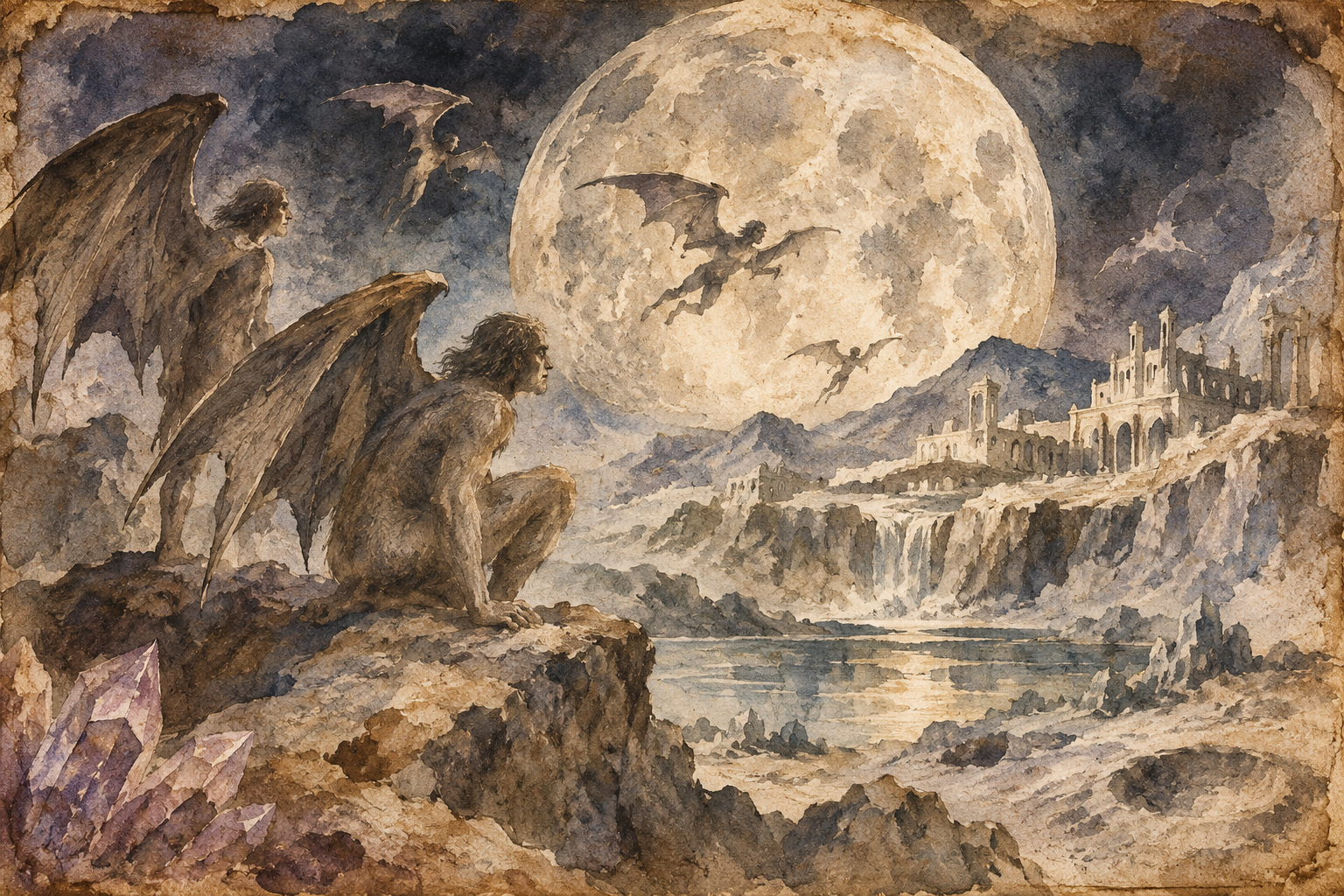
Imagine opening your morning newspaper and discovering that the Moon was inhabited.
Not by little green men, mind you. They hadn’t been invented yet. No, these were rather more sophisticated creatures. There were enormous bison wandering across lunar plains, beavers that walked on their hind legs, goats, unicorns and, most astonishingly of all, an entire race of furry, winged humanoids who apparently spent their time flying about and building temples. And this wasn’t some ridiculous tale whispered over a pint in the local tavern. Oh, no. This was science. Proper science. With telescopes and learned gentlemen and everything. Or so the readers of the New York Sun were assured.
On 25 August 1835, the newspaper began publishing a series of articles under the magnificent headline Great Astronomical Discoveries Lately Made by Sir John Herschel at the Cape of Good Hope. It was quite an announcement. Sir John Herschel was one of the most respected astronomers in the world, the son of William Herschel, who had discovered Uranus in 1781. John was no scientific lightweight himself. He was a serious and accomplished astronomer, and he really was working at the Cape of Good Hope in South Africa, observing the southern skies. That tiny bit was important. Because if you’re going to tell the world that you’ve discovered bat-men on the Moon, it helps enormously if you attach the claim to somebody whose scientific reputation is beyond question.
The articles were supposedly written by Dr Andrew Grant, described as a colleague of Herschel, and reproduced from a supplement to the Edinburgh Journal of Science. There was an impressive scientific journal. There was a famous astronomer. There was a remote observatory. There was even an enormous telescope. What more could anybody possibly want?
Well, perhaps a little evidence. But we’ll come to that.
The newspaper explained that Herschel had developed an extraordinary new instrument, capable of magnifying the lunar surface to an unprecedented degree. The fictional telescope was an absolute monster, with a lens twenty-four feet across and optical capabilities that would have made the finest instrument makers of the day weep into their workshops. Through this technological marvel, the astronomers had supposedly begun examining the Moon in remarkable detail.
And what a Moon it was. Gone was the barren, cratered landscape that we recognise today. In its place stood a world of extraordinary beauty, with great forests, magnificent mountains, fertile valleys, rivers, lakes and vast formations of amethyst. Imagine the excitement. Humanity had spent centuries looking up at that familiar silver disc, wondering what might exist upon its surface. Now, apparently, somebody had finally found out.
The discoveries began with vegetation and geological wonders. Then came the animals. There were creatures resembling bison, others that looked like goats, and peculiar little beavers that apparently lacked tails and had taken to walking upright. There were even unicorns.
Actual unicorns. On the Moon. Frankly, at this point, I think I’d have put the kettle on and settled down for the next instalment. Because things were about to get considerably stranger.
The astronomers had spotted movement near some lunar cliffs. At first, the shapes appeared to be birds, but closer examination revealed something altogether more remarkable.
They were humanoid.
They had faces, bodies, limbs and great membranous wings. Their bodies were covered in copper-coloured hair, and they moved about the landscape with the apparent ease of creatures entirely at home in their extraordinary surroundings. The newspaper’s invented scientific observers named them Vespertilio-homo, or man-bats.
And these weren’t merely animals. They appeared to be intelligent, social beings. The reports described their movements, their interactions and even their apparent conversations, although quite how the astronomers determined what counted as a conversation from nearly a quarter of a million miles away was a question best left unasked.
Later descriptions introduced remarkable lunar architecture, including temples, suggesting that the Moon possessed not merely life but civilisation. It was sensational. It was extraordinary. And it was complete and utter nonsense.
The man responsible was Richard Adams Locke, a journalist working for the New York Sun. Locke had constructed one of the most elaborate newspaper fabrications of the nineteenth century, and he’d done it with considerable skill.
You see, the articles weren’t simply a collection of outrageous claims. They were carefully dressed in the language of contemporary science. Technical descriptions of optical equipment were mixed with astronomical observations, geological speculation and the sort of confident scientific prose that could make even the most unlikely proposition sound perfectly respectable.
And the timing was excellent. The early nineteenth century was an age of astonishing discovery. Explorers were bringing home accounts of unfamiliar animals and landscapes. Astronomers were improving their instruments. Geologists were revealing an Earth far older and stranger than many had imagined. The boundaries of human knowledge seemed to be expanding almost daily. Why shouldn’t the Moon be inhabited?
Indeed, some perfectly serious writers had already argued that other worlds must contain living creatures. The Scottish minister and popular science writer Reverend Thomas Dick had speculated extensively about extraterrestrial populations, even calculating that the Moon might support billions of inhabitants. Locke appears to have regarded such speculation as thoroughly deserving of ridicule. His lunar adventure was therefore more than a simple practical joke. It was also satire, directed at the increasingly extravagant claims being made in the name of science and religion.
Unfortunately for Locke, or perhaps fortunately for the newspaper’s circulation figures, rather a lot of people missed the joke. The Sun was part of America’s rapidly developing penny press, selling inexpensive newspapers to an expanding readership hungry for crime, scandal, sensation and extraordinary events. And here was the most extraordinary event imaginable. Life on another world! The newspaper’s readership surged, and the lunar discoveries were discussed and reproduced far beyond New York. The story attracted attention internationally, while illustrated versions helped give the imaginary Moon creatures a life of their own.
There is something wonderfully absurd about the whole affair. Somewhere, people were earnestly discussing the habits of lunar bat-men while the actual Sir John Herschel was getting on with his astronomical observations in South Africa, entirely innocent of the civilisation that had supposedly been discovered through his telescope.
The deception also benefited from a particularly cunning detail. The Edinburgh Journal of Science, from which the articles were supposedly reproduced, had been a genuine publication. Unfortunately, it had ceased publication before the Moon reports appeared. That made it an excellent choice for a fraudulent attribution. The name sounded respectable, and most readers were hardly in a position to check whether the relevant supplement existed. Nor could they simply telephone Herschel to ask whether he’d recently spotted any unicorns. Communication between continents was slow, and the Cape of Good Hope was a very long way from New York. By the time the truth could catch up, the story had already travelled.
The hoax began to unravel within weeks, and by September 1835 the supposed discoveries were being openly discussed as a fabrication. Yet the public reaction was not quite what we might expect. There was certainly criticism, and some readers had been thoroughly deceived, but there was also considerable amusement. The story had been so gloriously entertaining that many people seemed willing to forgive its author.
The Sun had gained an enormous amount of publicity, and Locke’s imaginary lunar inhabitants had become a cultural sensation. The original articles were subsequently reproduced in pamphlets and books, preserving the extraordinary adventure for later generations.
And the images!
The surviving illustrations are a delight. Winged humanoids wander across fantastical lunar landscapes, surrounded by vegetation and peculiar architecture. They look like creatures from a fever dream, somewhere between classical mythology and the earliest imaginings of science fiction.
It is difficult not to admire the sheer audacity of the thing. But beneath all the lunar nonsense lies a rather interesting lesson about how people decide what to believe.
The Moon Hoax worked because its author understood the importance of authority. He didn’t simply announce that there were bat-men on the Moon. He claimed that a famous astronomer had found them, using a revolutionary scientific instrument, and that the discoveries had appeared in an established scientific journal. The impossible was wrapped in the apparently credible. And people believed it.
Nearly two centuries later, the technology has changed beyond anything Locke could have imagined. We have spacecraft, orbital telescopes and photographs of the lunar surface. We can examine the Moon in detail without relying upon the claims of an imaginary assistant to an unsuspecting astronomer. But the human appetite for astonishing discoveries remains much the same. So does our tendency to trust a remarkable story when it arrives wearing the right credentials.
Perhaps that’s the real legacy of the Great Moon Hoax. Not the unicorns, the lunar forests or even the magnificent bat-men, but the reminder that a convincing story and a true story are not necessarily the same thing.
Although, between ourselves, I do think the Moon would be considerably more interesting with a few unicorns.
And as for the bat-men?
Well, perhaps they’re simply very good at hiding.
After all, nobody thought to check behind the amethyst mountains.
Sources and further reading
- The Moon Hoax (1859), Smithsonian Libraries — A public-domain reprint of the original articles.
- Library of Congress: Peoples & Creatures of the Moon — The creatures, the claims and the historical context.
- Smithsonian Libraries: Infinite Worlds — Locke’s satire, its scientific targets and its remarkable reception.
- Smithsonian Magazine: The Great Moon Hoax Was Simply a Sign of Its Time — Further historical analysis.


