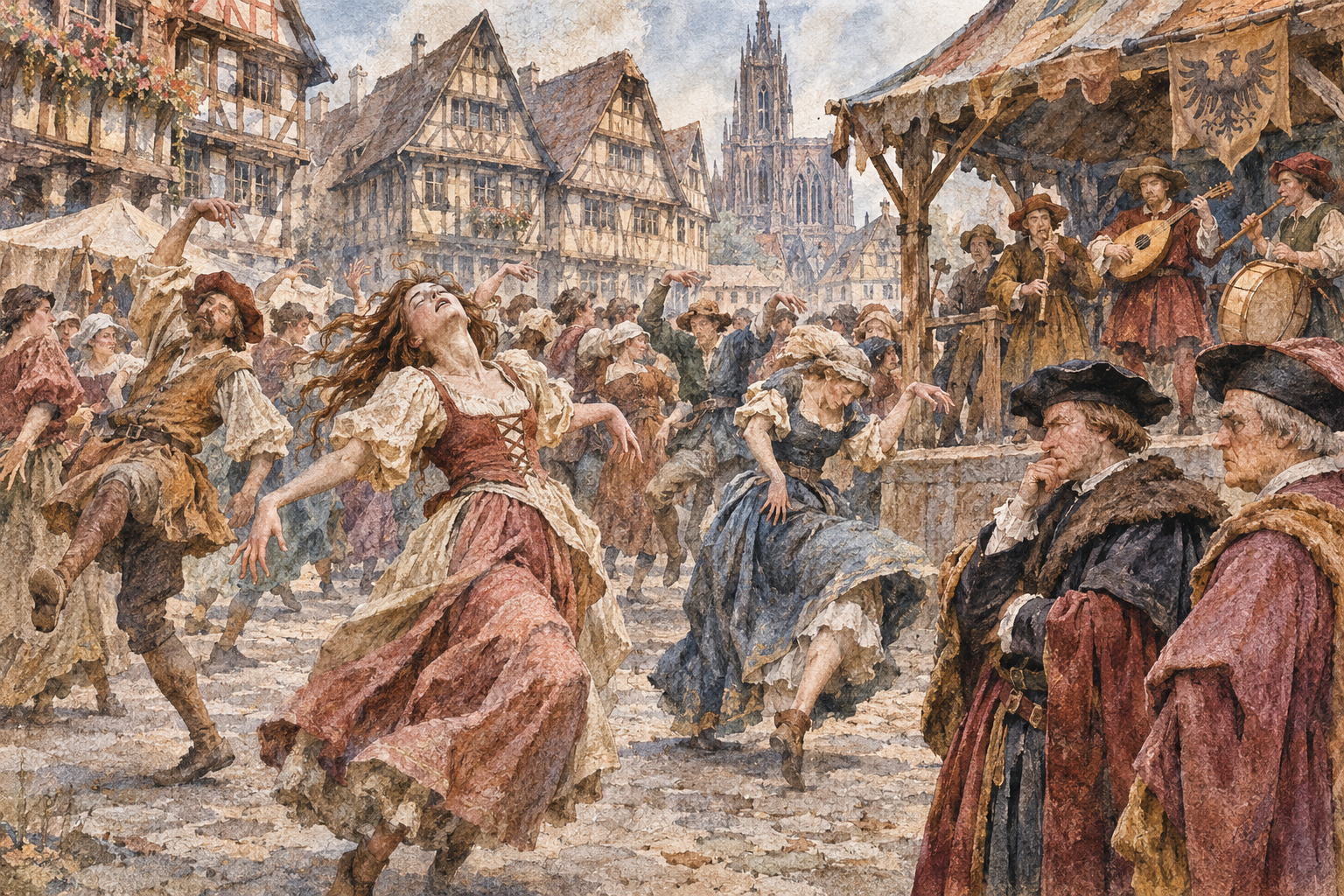
In the summer of 1518, the citizens of Strasbourg were confronted by one of the strangest disturbances in European history. People began dancing in the streets, apparently unable or unwilling to stop, and the authorities responded with a solution so peculiar that it sounds like something from a comedy. They hired musicians and told everyone to keep dancing.
There are some historical events that sound as though somebody must have invented them after an unusually enthusiastic evening in the pub. The dancing plague of Strasbourg is one of them. In the summer of 1518, a remarkable disturbance swept through the streets of this prosperous city on the Rhine, leaving its inhabitants bewildered and its authorities struggling to restore order. Men and women began dancing in public places, sometimes for extended periods, and the behaviour proved so alarming that the city council became involved. Physicians were consulted, religious explanations considered, and eventually the authorities resorted to an extraordinary experiment involving musicians, specially prepared dancing spaces and the apparently optimistic belief that the best way to cure people of excessive dancing was to encourage them to do even more of it.
It sounds ridiculous, of course, but the incident was real. Strasbourg’s surviving records confirm that the authorities were dealing with an outbreak of unusual dancing in July 1518, and the city’s response left behind a paper trail that historians have been examining ever since. What remains uncertain is precisely why the dancing began, how many people participated, and whether the event was quite as deadly as some later writers would have us believe.
At the beginning of the sixteenth century, Strasbourg was a free imperial city within the Holy Roman Empire, an important centre of trade, learning and religious life. Its streets were lined with timber-framed houses, its markets bustled with merchants, and its cathedral dominated the skyline. Like many European cities of the period, however, prosperity was unevenly distributed. Ordinary people remained vulnerable to poor harvests, rising food prices, disease and the everyday uncertainties of life in a society where a succession of unfortunate events could quickly become a catastrophe.
It was against this background that something peculiar began happening in July 1518.
According to the best-known version of the story, the trouble started with a woman called Frau Troffea. One day, apparently without warning or musical accompaniment, she stepped into the street and began to dance. She moved and turned for hours, continuing long after ordinary exhaustion should have brought her to a halt. Her husband pleaded with her to stop, but she refused or was unable to do so. By the following day she was dancing again, and before long other people had begun behaving in much the same way.
There is just one difficulty with this wonderfully dramatic opening. It comes principally from accounts associated with the physician and alchemist Paracelsus, who arrived in Strasbourg years after the disturbance. Although his story has become inseparable from the dancing plague, we cannot confidently establish that Frau Troffea was the woman who started it, or even that the surviving details of her behaviour accurately describe what happened. Paracelsus had some distinctly unflattering opinions about women, and he suggested that the supposed first dancer had deliberately behaved this way to annoy her husband. His explanation probably tells us rather more about his attitudes than it does about the woman herself.
What we can establish is that, by the latter part of July, Strasbourg’s authorities were sufficiently concerned about the dancing to take official action. Municipal records from 23 July refer to the situation and to the involvement of families whose children had joined the dancing. Other contemporary documents show that the magistrates were consulting influential figures and looking for ways to bring the disturbance under control.
The city was not dealing with an ordinary celebration. Dancing was already a familiar part of European communal life, accompanying weddings, religious festivals and public festivities, but this was something different. The behaviour was described as an affliction, and those involved were treated as people suffering from a disturbing condition rather than simply enjoying themselves.
Imagine, then, the bewilderment of the city authorities. They had a problem which appeared to be spreading, yet nobody could agree on what caused it. There was no obvious enemy to arrest, no fire to extinguish and no broken wall to repair. Instead, people were dancing, apparently against their better judgement, while the government of Strasbourg attempted to determine whether the trouble belonged to the realm of medicine, religion or something altogether more mysterious.
Some physicians interpreted the outbreak through the prevailing medical theories of their age. The human body was believed to depend upon the proper balance of four humours, and disturbances in that balance could supposedly produce all manner of physical and mental symptoms. Excessive heat in the blood was among the explanations offered for the dancing, which meant that the afflicted were understood to be suffering from a natural illness rather than simply behaving badly.
Unfortunately, the treatment recommended in some contemporary and later accounts was spectacularly counterintuitive.
The dancers, it was thought, might recover if they were permitted to continue moving until the condition had run its course.
So the authorities arranged for places where they could dance.
Later chronicles describe guild halls being cleared and platforms constructed in public areas, including the city’s horse and grain markets. Musicians were employed to provide accompaniment, while healthy dancers were supposedly encouraged to join in and keep the afflicted moving. Drums, pipes and other instruments provided the rhythm as the city attempted to turn an apparently uncontrollable outbreak into something resembling an organised performance.
It is difficult to imagine what a stranger arriving in Strasbourg might have made of the scene. Here was a prosperous and respectable city, governed by officials who undoubtedly regarded themselves as sensible men, apparently paying musicians to encourage an outbreak of dancing they were desperately trying to stop.
And, according to the later accounts, the experiment did not work.
The disturbance continued, prompting the authorities to reconsider their approach. On 2 August 1518, the city issued restrictions on public dancing, with the order associated with Sebastian Brant, the celebrated humanist writer and author of The Ship of Fools, who served as a senior civic official. Certain respectable celebrations were permitted under controlled circumstances, but the use of drums and tambourines was restricted, apparently because such instruments were thought particularly likely to encourage the troublesome behaviour.
One can almost hear the exasperation in the council chamber. Having tried more dancing, the authorities were now attempting considerably less of it.
But the medical explanation was not the only one circulating through Strasbourg. To many people, the behaviour was not simply an illness of the body. It was a manifestation of supernatural punishment, and the figure most closely associated with it was St Vitus.
Vitus was an early Christian martyr whose cult had become widespread in medieval Europe. He was invoked for protection against a variety of afflictions, including certain movement disorders, and his name became attached to the phenomenon known as St Vitus’s dance. This expression was used historically for more than one kind of involuntary or unusual movement, and it later acquired a medical association with chorea, a term derived from the Greek word for dance.
In the religious imagination of sixteenth-century Strasbourg, the troubling behaviour could therefore be understood as an expression of divine displeasure. The dancers were not merely ill. They might be suffering under the anger of a saint whose intervention was required to restore them to health.
The distinction was important, because it suggested an entirely different kind of cure.
Rather than continuing to dance, the afflicted could be taken to a shrine associated with St Vitus, where prayers and religious rituals might bring relief. The authorities arranged for sufferers to be transported to Saverne, some distance from Strasbourg, where a shrine offered the possibility of spiritual intervention.
Later descriptions of these journeys are wonderfully elaborate. The dancers were transported in wagons, presented before the saint’s image and given special red shoes decorated with crosses. Holy water and consecrated oil were applied as part of the ritual, while prayers were offered for their recovery. These details come largely from chronicle traditions rather than a complete contemporary medical record, but they reveal how closely the treatment of illness could be intertwined with religious belief.
Eventually, the dancing subsided.
Quite how long it lasted is uncertain, although the principal disturbance appears to have occupied several weeks during the summer of 1518. Later accounts describe an outbreak continuing into late August or even early September, but the surviving evidence does not allow every stage of its development to be reconstructed with confidence.
And what of the people who supposedly danced themselves to death?
This is where the story becomes considerably more complicated than many popular versions suggest. The dancing plague is frequently described as a deadly epidemic in which hundreds of people danced until their hearts failed, their bodies collapsed or they simply dropped dead from exhaustion. Some accounts claim that fifteen people died each day at the height of the outbreak, while others repeat the figure of four hundred dancers as though it were an established contemporary census.
The problem is that the surviving municipal documents do not provide a reliable death toll. Figures for the number of participants appear in later accounts, and descriptions of fatal exhaustion are not consistently supported by the earliest evidence. The often-repeated claim that fifteen people were dying every day cannot be treated as an established fact. It is entirely reasonable to believe that prolonged physical exertion could have caused serious suffering, particularly among people who were already vulnerable, but we should not mistake a dramatic possibility for a documented casualty list.
The uncertainty extends to the cause of the outbreak itself, and this is perhaps the most fascinating aspect of the entire affair.
One explanation sometimes advanced is ergot poisoning, caused by a fungus that can infect rye and other cereals. Ergot contains substances capable of producing severe physical symptoms, including convulsions and disturbances of perception. Because rye was an important food crop in parts of Europe, the suggestion has occasionally been made that contaminated bread might have contributed to outbreaks of strange behaviour.
It is an interesting possibility, but it has substantial weaknesses. Ergot poisoning does not readily explain sustained, coordinated dancing over several days, and its effects on circulation and physical health would make prolonged exertion extremely difficult. There is also no conclusive evidence linking contaminated grain to Strasbourg’s particular disturbance.
Another interpretation, favoured by historian John Waller, is that the outbreak represented a form of mass psychogenic illness, in which genuine physical symptoms spread through a community under intense psychological and social pressure. This does not mean that the participants were pretending, nor that their suffering was imaginary. Rather, it suggests that deeply held beliefs, fear and the behaviour of those around them might have shaped how distress was experienced and expressed.
Waller has argued that the people of Strasbourg were living through difficult circumstances, and that their fear of supernatural punishment could have influenced the form taken by the disturbance. If people genuinely believed that an angry saint could compel them to dance, the appearance of individuals behaving in precisely that fashion might have created an atmosphere in which anxiety and suggestion reinforced one another.
It is a compelling interpretation, although not the only one. Recent historical scholarship has also emphasised the importance of understanding the dancing within the religious and cultural practices of the period. Some historians have questioned whether modern descriptions of an epidemic of helpless, frenzied dancers sufficiently reflect the complexity of the surviving accounts. The sixteenth-century observers themselves did not agree about what they were witnessing, and the language of illness, punishment, sin and ritual could overlap in ways that are not always easy to translate into modern medical categories.
Strasbourg’s dancing plague was not entirely without precedent. Similar episodes had been recorded in parts of medieval Europe, particularly in the Rhineland, where accounts of collective dancing had circulated since at least the fourteenth century. One particularly notable outbreak occurred in 1374, when groups of people were reported dancing through towns along the Rhine and surrounding regions. These earlier traditions formed part of the cultural background against which the events of 1518 were interpreted.
That history matters, because it means Strasbourg’s inhabitants were not confronting something for which they possessed no frame of reference. Their explanations may seem strange to us, but the idea of a dancing affliction, potentially linked to supernatural punishment, already existed within European religious and popular culture.
Perhaps this is why the events of 1518 have continued to fascinate historians, physicians, folklorists and writers for more than five centuries. The story sits at an extraordinary crossroads between medicine and religion, between the behaviour of individuals and the fears of an entire community, and between the evidence preserved in official records and the increasingly elaborate narratives that developed afterwards.
It is tempting to imagine a city suddenly seized by an irresistible rhythm, with hundreds of people whirling through the streets until they collapsed. Certainly, that image has proved irresistible to generations of storytellers. Yet the surviving history is more elusive, and in many ways more interesting. We know that people danced, that the authorities became seriously concerned, that restrictions were imposed and that religious intervention was sought. We know that contemporaries and later observers struggled to explain the event. But the precise experience of the participants, their number and the ultimate human cost remain uncertain.
What survives most clearly is the remarkable response of a city attempting to solve a problem it did not understand. Strasbourg tried medical advice, organised dancing, restrictions on music and finally religious pilgrimage, all within the space of a few extraordinary summer weeks.
And somewhere in those events lies a lesson about the curious ways human beings respond to fear, uncertainty and the inexplicable.
Five hundred years later, we can examine the records, debate the theories and smile at the apparent absurdity of hiring a band to cure a dancing epidemic. But we should perhaps remember that the people involved were doing their best to make sense of something genuinely disturbing, using the knowledge and beliefs of their own time.
Still, one cannot help feeling a certain sympathy for the Strasbourg officials who began by asking how they might stop everyone dancing and somehow ended up paying musicians to make sure they carried on.
It must have been a very long summer.