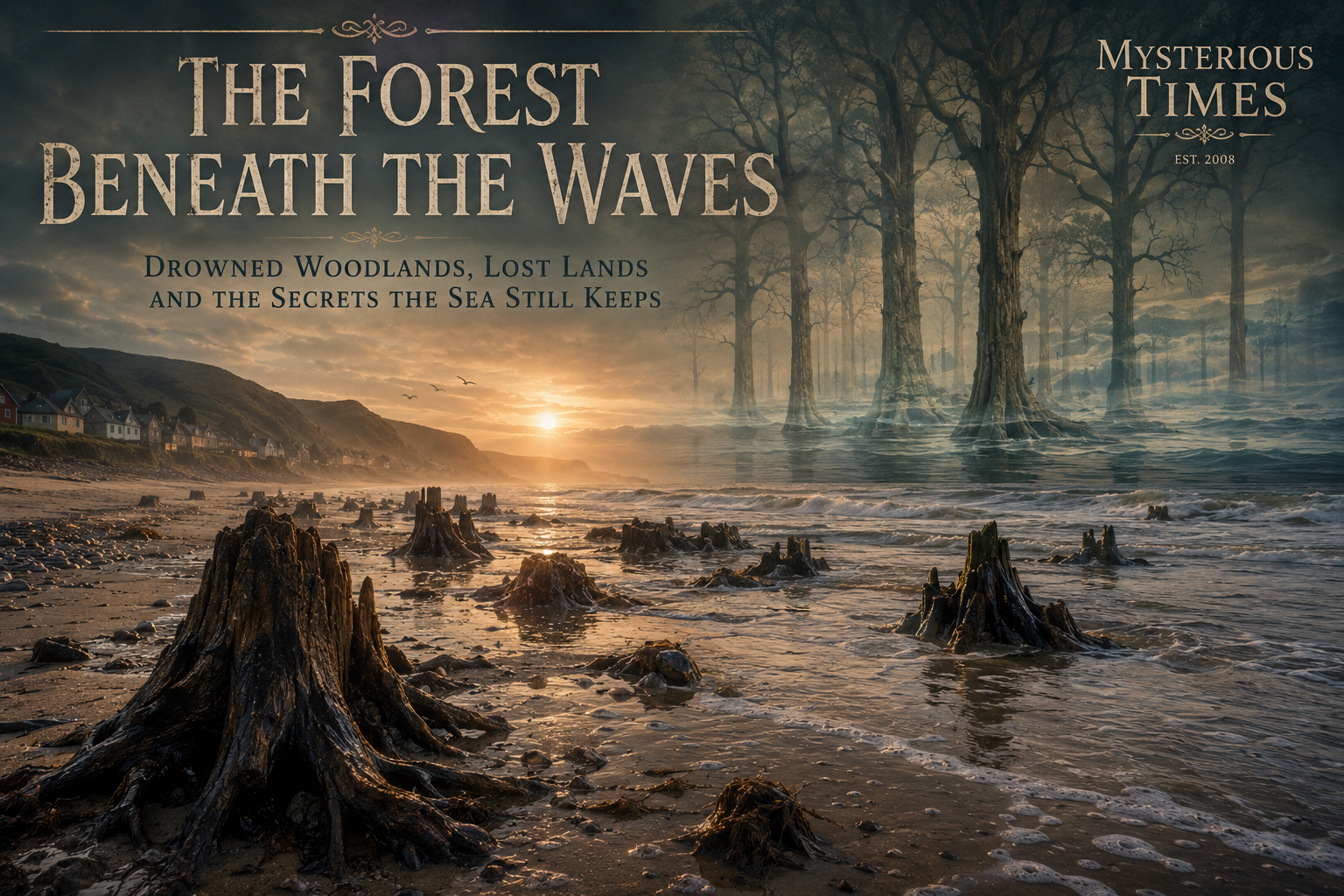
It usually begins after a storm.
The wind has finally dropped, the sea has retreated a little farther than usual and people wander down to the beach, wrapped in coats, expecting little more than a brisk walk and perhaps a few shells washed ashore. Then somebody stops.
At first glance they look like driftwood. Then old fence posts. Then, slowly, something remarkable begins to emerge. Tree stumps. Dozens of them. Sometimes hundreds. Their roots still clutching the earth where they grew thousands of years ago.
For a few precious hours, perhaps a day or two before the tide and shifting sand reclaim them once more, Britain briefly reveals one of its oldest secrets. A forest.
Not a modern woodland flooded by a reservoir. Not the remains of some forgotten Victorian plantation. An ancient forest that stood here long before history was written. Long before Stonehenge. Long before the pyramids. Long before Britain was even an island.
It sounds like fantasy. It isn’t. Some of the most extraordinary archaeological sites in Britain aren’t found beneath fields or hidden inside caves. They’re beneath the sea.
One of the best-known examples lies along the coast of Ceredigion in west Wales, close to the village of Borth. After powerful storms or exceptionally low tides, dark tree stumps emerge from the sands, their twisted roots still anchored in ancient peat. Oak, pine, birch and hazel once grew here, forming a thriving woodland where people hunted, gathered food and followed rivers that have long since disappeared beneath Cardigan Bay.
Radiocarbon dating suggests many of these trees were alive between four and six thousand years ago, although the surrounding landscape has a much longer story stretching back towards the end of the last Ice Age.
The forest wasn’t suddenly swallowed by some catastrophic event. Instead, rising sea levels and changing coastlines gradually transformed woodland into marsh, marsh into estuary and, eventually, sea. Nature worked slowly. Human imagination, however, preferred something rather more dramatic. The drowned forest at Borth soon became woven together with one of Wales’ greatest legends – Cantre’r Gwaelod. Sometimes called the Welsh Atlantis.
According to medieval tradition, Cantre’r Gwaelod was a rich and fertile kingdom protected from the sea by embankments and floodgates. The gates were said to be watched over by a keeper named Seithenyn, whose fondness for drink proved rather more memorable than his dedication to flood prevention. One night, whether through drunkenness or neglect depending upon which version you prefer, the gates were left open. The sea rushed in and the kingdom vanished beneath the waves.
Even today, local tradition claims that church bells can sometimes be heard ringing beneath Cardigan Bay when conditions are just right.
It’s a wonderful story. History, unfortunately – or fortunately, depending on your point of view – is a little less dramatic.
There is no archaeological evidence that Cantre’r Gwaelod existed as described in medieval poetry. The drowned forest is very real, but it predates the earliest versions of the legend by thousands of years. Does that mean the two are entirely unrelated? Not necessarily.
Human beings are remarkably good at preserving memories through stories. While no one alive today remembers prehistoric coastlines disappearing beneath the sea, generations living beside Cardigan Bay would certainly have noticed ancient tree stumps appearing after storms. It’s hardly surprising that communities tried to explain them. Folklore often grows around things that seem out of place, and few sights are stranger than finding the remains of a forest where only waves should be.
Walk further around Britain’s coastline and you’ll discover Borth is far from unique.
Near Ynyslas, only a few miles away, more ancient woodland emerges from the sand when the conditions are right. Similar submerged forests appear along stretches of the Lancashire coast, in North Norfolk and around parts of Cornwall. Each tells the same story. Not of sudden destruction. But of patient, unstoppable change.
One of my favourite examples lies at Mount’s Bay in Cornwall. Today it’s difficult to imagine the sea ever being anywhere else. Fishing boats bob gently offshore while St Michael’s Mount rises dramatically from the water, joined to the mainland only when the tide allows. Yet legend insists that another land once existed here and its name was Lyonesse.
According to Arthurian tradition, Lyonesse was a prosperous kingdom stretching west beyond Land’s End. Churches, villages and castles flourished until one terrible night when the sea overwhelmed everything, leaving only one survivor to escape on horseback. Like Cantre’r Gwaelod, Lyonesse belongs firmly to the world of legend rather than archaeology. But legends rarely emerge from nowhere.
When sea levels rose dramatically following the last Ice Age, vast areas of low-lying land disappeared around Britain’s coast. Although Lyonesse itself almost certainly never existed as medieval writers imagined it, memories of changing shorelines may well have contributed to stories of drowned kingdoms passed from generation to generation. Sometimes, reality proves every bit as extraordinary.
Travel north to Formby and another surprise awaits. After storms, ancient peat beds appear beneath the sand, preserving not only the remains of prehistoric woodland but human footprints left by people who walked these shores thousands of years ago. Adults. Children. Hunters. Families. For a brief moment, separated from us by millennia, they become startlingly real. Someone paused here. Someone carried a child. Someone watched the tide exactly as we do today. The sea buried their footprints before patiently returning them to us.
Perhaps the greatest lost landscape of all, however, now lies far beyond the shoreline beneath the North Sea.
Its modern name is Doggerland. Ten thousand years ago it wasn’t underwater at all. Instead, Britain remained connected to continental Europe by an enormous landscape of rivers, forests, lakes and marshes stretching across what is now the southern North Sea. Red deer wandered through woodland. Aurochs grazed open meadows. Wolves hunted beneath towering trees while Mesolithic communities built camps beside rivers that no longer exist. Had you stood on the east coast of England then, you wouldn’t have looked across open water towards Europe. You would simply have walked there.
Gradually, as glaciers melted and sea levels rose, Doggerland began disappearing beneath the encroaching sea. It wasn’t one enormous flood swallowing everything overnight but a process unfolding across generations. Coastlines retreated. Rivers became estuaries. Families found familiar hunting grounds shrinking year after year.
Imagine living through that. Not reading about climate change in a newspaper. Watching your world physically disappear.
Even today, fishermen occasionally haul up pieces of that vanished landscape in their nets. Mammoth bones. Antlers. Flint tools. Fragments of peat. Every discovery reminds us that an entire prehistoric world still lies hidden beneath the waves.
It’s tempting to think of Britain’s coastline as permanent. Something fixed. Something inevitable. In truth, coastlines are among the most changeable landscapes on Earth. Cliffs collapse. Beaches migrate. Sandbanks appear and disappear. Salt marshes advance.
The sea is always negotiating with the land. Sometimes it wins. Sometimes, just for a little while, the land reminds us where it used to be.
Perhaps that’s why drowned forests capture the imagination so completely. They’re tangible.
You don’t need to imagine them. You can stand beside them. Touch them. Run your fingers across bark that last felt sunlight thousands of years before the Romans arrived in Britain. Very few archaeological sites offer that sort of connection.
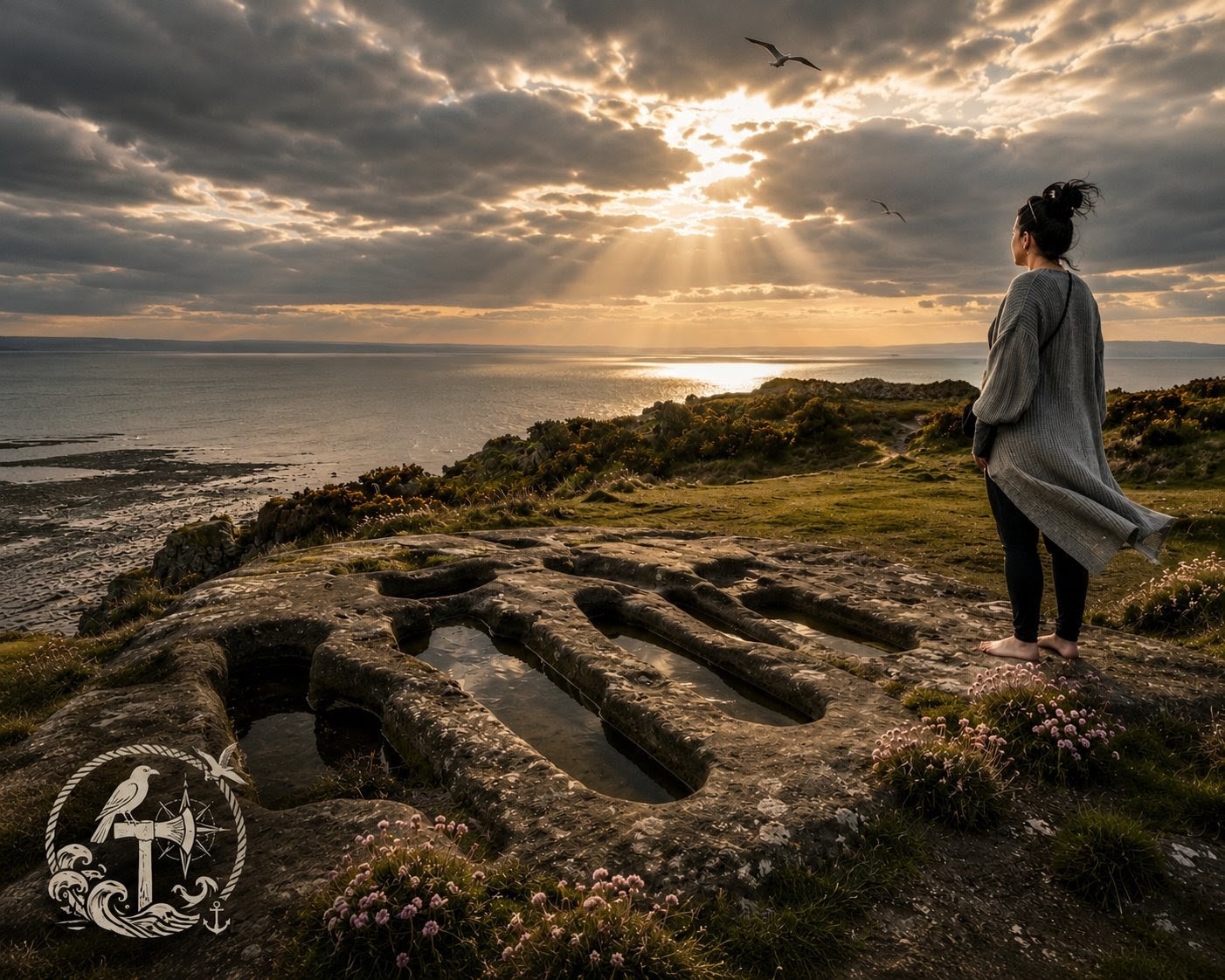
As Simon and I discovered at Heysham, there are places where history seems astonishingly close. Standing beside those rock-cut graves, it felt as though the people who carved them had only just walked away. The drowned forests create a similar feeling. Except their silence stretches back even further. Before monks and castles and kings. Back to a Britain almost beyond imagining.
I sometimes wonder what those ancient woodland clearings sounded like. Birdsong where waves now crash. Leaves rustling where gulls wheel overhead. Children laughing beneath trees whose roots still cling stubbornly to the earth beneath the sand.
We’ll never know.
The sea keeps many of its secrets. But every so often, after the storms have passed and the tide slips quietly away, Britain allows us a fleeting glimpse into that vanished world. A forest appears where no forest should be. Ancient roots reach towards the light once more. For a few hours, the past returns.
Then, as it always has, the tide comes in. The waves wash gently across the stumps. The sand settles. The forest disappears.
Not lost. Simply waiting beneath the sea for the next curious soul to come looking.
Sources
Bryony Coles, Doggerland: A Speculative Survey and subsequent research on the submerged Mesolithic landscape.
Historic England – research on submerged prehistoric landscapes and coastal archaeology.
Royal Commission on the Ancient and Historical Monuments of Wales – surveys of the Borth submerged forest.
Natural Resources Wales – information on the Borth and Ynyslas submerged forests.
The British Museum – information on Doggerland and Mesolithic Britain.
Coles, B. The Doggerland Project.
Archaeological publications on the Formby prehistoric footprints and submerged peat deposits.



Leave a Reply