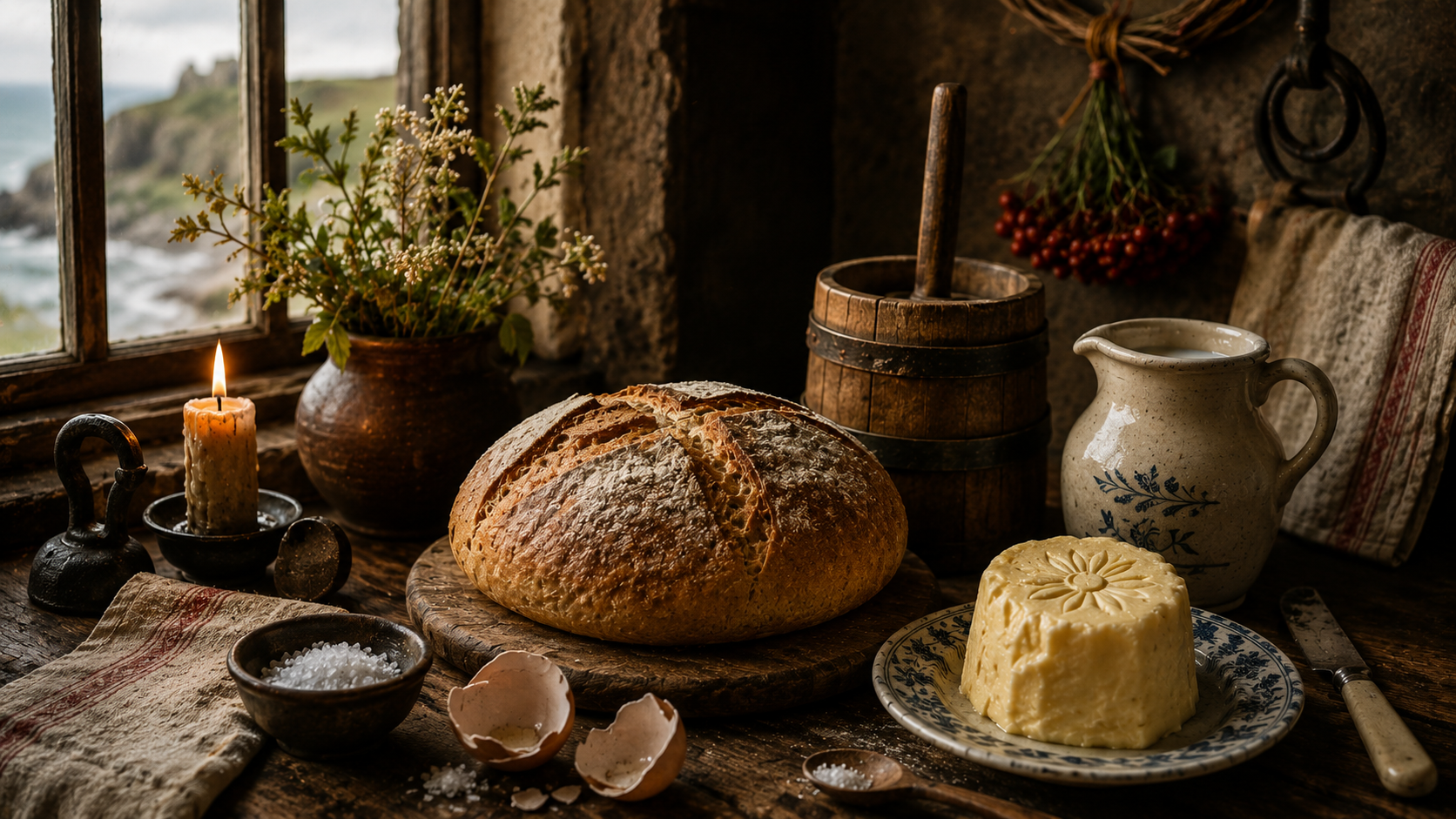
There is a rule about bread.
Never put a loaf upside down.
Why?
Well, depending on where you lived, something unfortunate might happen to the person who earned the household’s bread. Or you might simply bring bad luck into the house. Or, according to one particularly magnificent northern English explanation, the Devil might fly over your home. Which seems a frankly disproportionate response to somebody putting the Hovis down incorrectly. Nevertheless:
Turn it back over.
Welcome back to Old Magic. Put on an apron.
We’ve already discovered this week that our ancestors were remarkably particular about what happened to their hair, fingernails and teeth. We’ve put pennies into purses, bought knives from our friends for a penny, turned our clothes inside-out to confuse supernatural beings and opened the walls of old houses to discover shoes, bottles and dried cats hidden inside.
Today we’re going into the kitchen. And the kitchen may be the most magical room in the house.
Not because that’s where somebody keeps the cauldron. Although, admittedly, that would help. But because for most of human history this was where some of the things absolutely essential to survival were transformed. Grain became bread. Milk became butter. Raw food became cooked food. Fire became warmth. Salt prevented food from spoiling. A few basic ingredients could become enough to feed a family. And when your survival depends upon these transformations working reliably, you become extremely interested in anything that might make them fail. Including witches.
But let’s return to the bread…
Sidney Oldall Addy’s nineteenth-century collection ‘Household Tales with Other Traditional Remains’, drawing on material from Yorkshire, Lincolnshire, Derbyshire and Nottinghamshire, records an extraordinary collection of rules governing the humble loaf.
An upside-down loaf was unlucky.
One explanation claimed that turning it upside down meant the Devil would fly over the house. Another associated the inverted loaf with illness befalling the household breadwinner.
You shouldn’t cut both ends from a loaf. And apparently you shouldn’t interfere with bread while somebody else was cutting it either.
Bread had rules. And that makes rather more sense when we stop thinking of bread as something that comes sliced in a plastic bag for £1.40. Grain represented months of work, so a failed harvest could be catastrophic. A failed batch of bread meant wasted ingredients. The household loaf wasn’t simply an accompaniment to dinner. Bread was food security. It was survival made edible. No wonder we treated it carefully.
There was magic in making it too.
I make much of my own bread, partly because I was always taught that bread-making itself was magical. I was taught to pay attention to what I brought into the kitchen with me. Your mood, thoughts and intentions mattered. If you stirred a pot while angry, something of that anger went into what you were making. If you kneaded bread while upset, you kneaded that into the dough too.
And if you cooked for somebody with love?
That went in as well.
I can’t give you a neat seventeenth-century British source proving that the particular tradition passed to me has descended unchanged from some ancient practice. As I’ve mentioned before, folklore doesn’t usually behave that obligingly. Traditions travel through families and communities. They change. They merge. Sometimes their explanations disappear completely while the behaviour remains. So I won’t manufacture an antiquity for mine that I can’t demonstrate but the underlying idea is fascinating. Because we still say it.
Made with love.
Nobody examines a homemade cake and expects to find 14 grams of affection listed between the butter and caster sugar, yet everybody understands exactly what the phrase means. Something of the maker has gone into the thing that was made and bread makes that idea particularly powerful.
Put flour, water, yeast and salt into a bowl and you have ingredients. Then you put your hands into them. You mix. You knead and stretch. You fold.
You wait.
The dough grows beneath your hands and you knock it back. You shape it and let it rise again. Then you put it into the heat and transform it once more.
At the end of the process, you have something completely different from the materials you began with. Something you can break apart and give to other people. Whatever else we call it, bread-making is an act of transformation and, historically, bread accumulated rituals appropriate to something so important.
Crosses could be marked into dough or loaves. Part of that may be entirely practical – scoring dough controls expansion in the oven – but the cross could also carry an explicitly religious and protective meaning.
Bread baked at particular times could acquire special properties. Good Friday bread, for example, accumulated a substantial body of British folklore. Rather than being eaten normally, pieces might be preserved because they were believed resistant to decay and capable of protecting the household or curing illness. Again, food becomes something else. Bread becomes medicine, protection and blessing.
The kitchen was full of transformations like this. But occasionally the danger wasn’t what you did with the food. It was what somebody else might do with the leftovers.
Consider, if you will, the boiled egg.
You eat it, put the spoon down and you are left with an empty shell. What do you do next? In parts of Britain, the correct historical answer was:
Destroy the boat, otherwise a witch might sail away in it.
Yes. Really.
The idea is wonderfully old. Reginald Scot was already mocking beliefs involving witches and eggshells in ‘The Discoverie of Witchcraft’ in 1584, and the image of witches taking to sea in thoroughly unsuitable vessels belonged to a world in which magical interference with ships and weather could be taken extremely seriously. Only a few years later, the North Berwick witch trials of 1590-91 became entangled with James VI of Scotland’s terrifying voyage home from Denmark with his new wife, Anne. Violent storms had battered the royal fleet, and those subsequently accused of witchcraft were alleged to have raised the weather magically against the king.
The North Berwick witches were not said to have sailed in eggshells. Accounts instead describe witches putting to sea in sieves or riddles. The distinction is worth making, because the two stories are often easily muddled. But they do belong to the same extraordinary supernatural landscape:
witches, impossibly fragile vessels, the sea and the magical raising of storms.
James took the threat seriously. His involvement in the trials helped foster the intense interest in witchcraft that eventually produced his ‘Daemonologie’ in 1597. So when people later crushed an empty eggshell to prevent a witch putting to sea in it, they were participating in a tradition whose imagery might sound ridiculous to us now, but which existed in a culture where the idea of witches going to sea and conjuring lethal weather had once reached the attention of a king.
By the seventeenth century, Sir Thomas Browne was commenting on the custom of breaking empty eggshells so they could not be used for witchcraft and the belief proved remarkably difficult to kill. It became particularly strongly associated with maritime communities along the east coast of England.
Around Whitby and Staithes, empty shells could be crushed so that they didn’t fall into the wrong hands and become witch-boats – and the logic is glorious.
A complete half-shell floats. A witch is apparently very small when required by the narrative. Therefore:
Boat.
The solution?
Crush it. Pierce it. Burn it. Anything that rendered the supernatural vessel unseaworthy.
The custom survived astonishingly late. People within living memory have recalled grandparents insisting that empty boiled-egg shells should be turned over and punched through or crushed. Often, as happens with surviving folklore, the action lasted longer than a clear belief in the thing it was supposed to prevent. Which gives us another perfect Old Magic moment.
Breakfast finishes. Someone automatically pushes the spoon through the bottom of the empty shell.
“Why do you do that?”
“Dunno. My mum always did.”
Meanwhile, somewhere off Whitby, a witch is standing on the beach staring furiously at the wreckage of her maritime transport. The kettle has barely boiled and we’ve already destroyed a supernatural navy. But the really serious kitchen magic begins when we look at milk and butter.
Irish folklore preserves an enormous body of belief surrounding dairy production, and for good reason. A cow represented wealth. Milk represented food. Butter could feed the household, be sold, exchanged and stored. If the milk yield dropped or the butter failed to come in the churn, that wasn’t merely irritating. The household had lost something valuable. And naturally, folklore provided an explanation.
Somebody had taken the butter.
Not stolen the finished block from the pantry. Stolen the household’s ability to produce it.
Witches, fairies, envious neighbours and the evil eye were all capable of interfering with dairy prosperity. May Day was particularly dangerous. The beginning of summer was a threshold in the year, and thresholds – as we have already discovered – tend to make folklore nervous.
The National Museum of Ireland records a wealth of practices intended to protect cows, milk and butter around May Day. Rowan might be tied to cattle. Red ribbons could protect against the evil eye. Iron might be placed beneath the churn. Holy water might be sprinkled. Even flowers could guard the house and animals.
Sometimes a glowing ember from the household fire was placed beneath the churn – the churn which itself might even bear protective symbols. Surviving Irish butter prints include crosses, solar-looking designs, daisy wheels and eye motifs associated with protection.
Imagine that.
You churn the butter, shape it and the finished food receives a protective mark. The old magical household wasn’t merely producing food. It was defending it.
Salt was one of the weapons.
In a 1930s folklore account from County Westmeath, salt placed in milk on May morning was said to prevent the butter being “taken” during the year. Other accounts describe salt being put on the churn. In County Mayo, one record describes a pinch of salt being shaken over the churn while invoking the Father, Son and Holy Ghost. Christian prayer, folk magic, household routine and practical food production all occupying the same kitchen without apparently seeing any reason to separate themselves. And this is where we should abandon the modern temptation to divide everything neatly into boxes labelled CHRISTIAN, PAGAN, MAGIC and PRACTICAL, because ordinary people rarely lived like that. They used what worked – A prayer, piece of iron, some salt, red thread, a sprig of rowan or a hot coal. If the butter came, splendid.
The Irish National Folklore Collection contains thousands of accounts concerning butter and churning, many gathered from schoolchildren in the 1930s who obtained the traditions from older relatives and neighbours. One custom appears repeatedly.
If you entered a house while churning was taking place, you were expected to participate.
Take the churn dash… Give it a few strokes… Perhaps say:
“God bless the work.”
– That wasn’t merely neighbourly assistance. Refusing could make you suspicious. If the visitor left without helping and the butter subsequently failed to form, perhaps they had taken the butter luck with them.
A glowing coal could be dangerous too. Someone entering the house to light a pipe from the fire might be prevented from leaving until they had taken a turn at the churn. Otherwise they could carry the butter away with the flame. One Mayo account goes even further: throwing out tea leaves while churning was underway could symbolically mean throwing out the butter.
Think about the magical logic operating here.
Things can leave a house physically. But prosperity can leave with them symbolically.
Fire goes out.
Butter goes out.
Milk goes out.
Luck goes out.
The boundaries of the household aren’t merely keeping dangerous things away. They’re keeping good things in.
A wonderfully blunt Roscommon tradition recorded in the Schools’ Collection says there were three things that should not be given away on May Day: fire, salt or milk.
Give them away and you risk giving away the household’s luck for the coming year.
Now think back to yesterday.
The hidden shoe.
The witch bottle.
The dried cat.
The marks around the chimney.
We were looking at the house from the outside. How do we stop harmful things getting in? Today we’re standing on the other side of the wall asking the opposite question.
How do we stop prosperity getting out? Suddenly all those peculiar kitchen rules start to make sense.
Don’t waste bread. Don’t invert it. Don’t give away the salt at the wrong time. Don’t let somebody walk out carrying your fire. Protect the milk and the butter. Destroy anything a witch might conceivably commandeer as a small boat. The kitchen was a place where abundance was constantly being created – and could therefore constantly be lost.
Even washing up wasn’t safe from folklore. Addy’s collection from Yorkshire, Lincolnshire, Derbyshire and Nottinghamshire records the warning that two people washing in the same water would quarrel. Fortunately, preventative measures were available:
Spit into the water. Or make the sign of the cross over it.
Two people drying their hands on the same towel could also supposedly quarrel. Crossed knives were unlucky. Spinning a knife on the table was asking for trouble.
There were rules everywhere. Some are clearly magical, some may have begun as practical etiquette, some may have changed meaning repeatedly over centuries and for many, the original explanation is simply gone.
That’s worth remembering whenever somebody confidently announces that a particular kitchen superstition “definitely originated because…”
Well, maybe it did. But folklore is messy. People copy actions without copying explanations and new explanations attach themselves to old habits. Religious ideas merge with magical ones. Practical behaviour becomes ritualised and ritual becomes habit. Habit becomes something your grandmother shouts at you for doing incorrectly.
Which brings me back to making bread.
When I make it, I knead by hand and I remain conscious of what I’m doing while I make it – not because I believe one angry thought will cause the loaf to emerge from the oven possessed, although that would certainly improve The Great British Bake Off.
I do it because I was taught that the act of making food matters. That feeding somebody matters. That the state in which you prepare something can become part of what you give.
Modern science can tell us plenty about why that might be true without invoking magic. Someone cooking carefully produces different results from someone angrily throwing ingredients around the kitchen.
Food carries memory. Smell carries memory. A particular meal can return us instantly to somebody’s kitchen decades ago. We associate foods with safety, celebration, grief, childhood and home.
The kitchen deals in transformation. Raw into cooked. Liquid into solid. Grain into bread. Cream into butter. Ingredients into meals. And meals into memory.
For generations of people who had considerably less control over food security than many of us do today, those transformations mattered enormously. So people protected it with every tool available. Skill. Experience. Prayer. Ritual. Maybe a little magic. And occasionally violence against an eggshell.
Today we have refrigerators, thermostats, supermarkets, electric ovens and butter that arrives helpfully rectangular. Most of the old rules have disappeared. But not all of them.
People still refuse to put bread upside down, still throw spilled salt over their shoulder. Someone still marks a loaf before putting it into the oven and automatically crushes an empty eggshell. Someone still says grace. Someone still makes a particular meal because that’s what Mum made when somebody was ill. Someone still stirs a pot slowly while thinking about the person who is going to eat it. And someone still puts their hands into bread dough and thinks:
Don’t make this angry.
The old explanation may have gone. The gesture remains.
Perhaps we don’t need to decide whether that’s magic. Perhaps it’s enough to recognise that the kitchen has always been the place where ordinary things are transformed into what keeps the people we love alive.
Flour. Water. Salt. Fire. Time. Hands…
And something that never appears on the recipe.
Made with love.
Just remember to put the bloody loaf down the right way. We don’t want the Devil flying over the house.

Leave a Reply