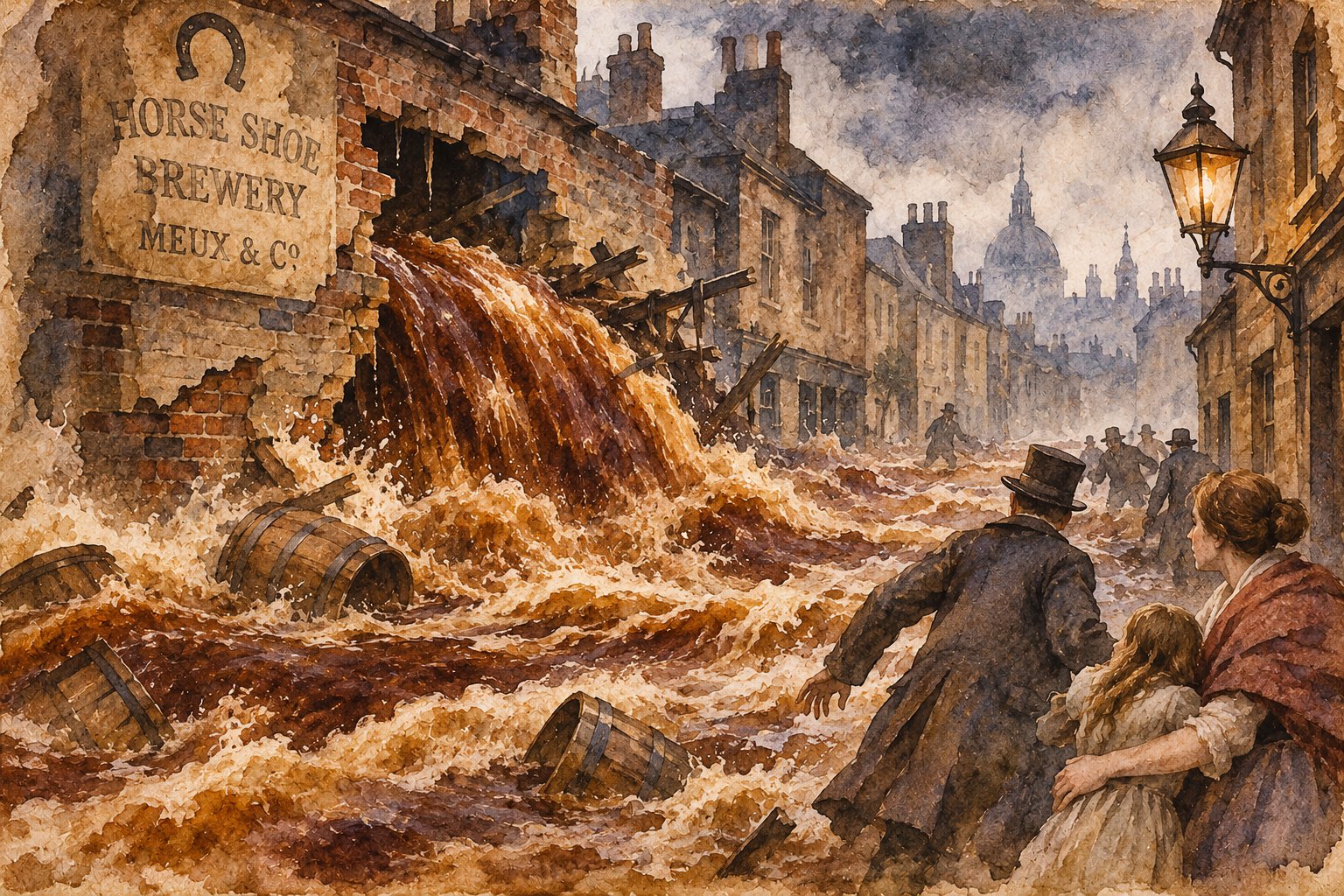
On an October afternoon in 1814, an enormous vat of beer exploded in the heart of London, sending a torrent of porter crashing through the surrounding streets. Buildings collapsed, homes were destroyed and eight people lost their lives. It remains one of the strangest industrial disasters in British history, although the truth is considerably more sobering than the legend.
There are some historical events that sound as though somebody invented them after a particularly enthusiastic evening in the pub. The London Beer Flood of 1814 is one of them.
Imagine an ordinary Monday afternoon in Georgian London. Horses clatter along the cobbled streets, tradesmen go about their business, and the inhabitants of St Giles are getting on with the daily struggle of earning a living. Then, without warning, an enormous quantity of beer comes hurtling through the neighbourhood, smashing walls, demolishing houses and flooding the narrow streets.
Not rainwater. Not sewage. Beer. Porter, to be precise. The dark, rich beer that had become enormously popular among London’s working population. And before anybody starts imagining a wonderful opportunity for a free drink, we ought to establish something. This was no amusing accident involving a few overturned barrels. It was a devastating industrial catastrophe that killed eight people, including several children. The extraordinary circumstances have made it a favourite of historical trivia collections ever since, but the people caught in its path deserve rather more than a punchline.
Our story begins at the Horse Shoe Brewery, near the junction of Tottenham Court Road and Great Russell Street. The brewery belonged to Henry Meux and Company, one of London’s substantial porter producers. Brewing was big business in the early nineteenth century, and the capital’s largest breweries had developed something of an obsession with enormous storage vats. These weren’t barrels of the sort you might find behind a public house. They were gigantic wooden structures, bound together with heavy iron hoops and capable of holding astonishing quantities of beer. Some were large enough for elaborate dinners to be held inside them before they were put into service. It was a wonderful opportunity for a brewery to demonstrate its prosperity, and presumably a rather effective way of convincing the guests that the company knew a thing or two about producing porter.
At the Horse Shoe Brewery, one particular vat stood approximately twenty-two feet high. It had been in service for years and held more than three thousand barrels of porter. And on Monday 17 October 1814, something went wrong. At approximately half past four in the afternoon, a brewery employee named George Crick noticed that one of the enormous iron hoops surrounding the vat had broken and fallen away. Now, you might imagine that the sight of a structural component falling off a vessel containing hundreds of thousands of gallons of beer would cause immediate alarm.
Apparently not.
Crick had worked for the brewery for seventeen years, and he was accustomed to seeing hoops fail. According to his subsequent testimony, such incidents had occurred before without serious consequences. He reported the problem to Mr Young, one of the brewery’s partners, who was also responsible for constructing the vats. The decision was made to arrange a repair. There was no evacuation, no urgent attempt to empty the vessel, and no indication that anybody expected a catastrophe. Crick prepared a letter requesting the necessary work. He was still dealing with the matter when the vat burst.
The resulting destruction was extraordinary.
The enormous wooden vessel gave way, releasing its contents with tremendous force. An adjoining vat was damaged, adding more beer to the torrent, while part of the brewery’s substantial brickwork collapsed under the impact. The Morning Chronicle reported that bricks were hurled over neighbouring houses. Within moments, an industrial accident inside the brewery had become a disaster for the people living outside it. The escaping porter surged through the surrounding streets, carrying debris and battering the fragile buildings in its path.
The neighbourhood was particularly vulnerable. St Giles was one of London’s poorest and most overcrowded districts, with families living in cramped rooms and cellars. The buildings nearest the brewery were hardly designed to withstand the sudden arrival of hundreds of thousands of gallons of liquid. Walls collapsed. Lower rooms flooded. Furniture and possessions were swept away.
For those living at street level, the disaster was terrifying enough. For people occupying basement rooms, there was almost nowhere to escape. At the nearby Tavistock Arms, a young servant named Eleanor Cooper was working when the brewery wall collapsed. She was buried beneath the falling masonry. Rescuers eventually recovered her body from the ruins.
In New Street, four-year-old Hannah Banfield was killed when the flood struck the house where she was staying. Three-year-old Sarah Bates also lost her life.
Elsewhere, a gathering of mourners had assembled for a wake. They were already grieving the death of a young child when the torrent struck the building. The collapse killed several of those present, turning one family’s funeral preparations into another tragedy. Among the dead were Ann Saville, Elizabeth Smith, Catherine Butler, Mary Mulvey and a young boy recorded as Thomas Murry. The precise ages and some family relationships vary between later accounts, but the inquest established the essential fact. Eight people had died. All were women or children.
It is difficult to imagine the horror of the scene. People who had been sitting down to tea or carrying out ordinary household work were suddenly trapped beneath shattered buildings, while their neighbours struggled to understand what had happened.
And the rescuers faced a peculiar difficulty. The streets were flooded with dark porter, mixed with broken timber, bricks and household debris. Somewhere beneath the wreckage, people might still be alive. Contemporary accounts describe efforts to maintain silence so that rescuers could hear cries from those trapped. That detail is particularly affecting. In the middle of one of the most bizarre disasters imaginable, the neighbourhood fell quiet, listening for the voices of people buried beneath their own homes. The newspapers described scenes of devastation comparable to those left by an earthquake. There were injured survivors, ruined dwellings and families suddenly deprived of everything they possessed.
And, of course, there was the beer. An immense quantity of it.
Estimates differ, partly because the original vat was not the only vessel damaged, but the total release amounted to hundreds of thousands of gallons. It was an extraordinary loss for the brewery. For the people of St Giles, however, the financial value of the porter was the least of their concerns. Their homes had been destroyed, their neighbours were dead, and the streets had become a wreckage-strewn floodplain.
Which brings us to one of the most persistent stories associated with the disaster. You may have heard that Londoners rushed into the streets with buckets, pots and pans, eagerly collecting the beer as it flowed past. Some versions go further, claiming that people lay in the gutters drinking directly from the flood, and that one unfortunate fellow subsequently died of alcohol poisoning. It makes a wonderful anecdote. Unfortunately, there is a rather serious problem with it.
The contemporary newspaper reports and surviving accounts of the inquest do not substantiate the supposed drinking frenzy. Beer historian Martyn Cornell has drawn attention to the absence of such behaviour from the early reports, which instead describe neighbours attempting to rescue victims and recover bodies. This is important because the district had a substantial Irish immigrant population, and nineteenth-century newspapers were hardly reluctant to portray impoverished Irish communities in an unflattering light. Had hundreds of residents abandoned the injured to drink beer from the streets, one suspects the newspapers would have made a great deal of it. Instead, the surviving descriptions emphasise rescue efforts and the dreadful condition of the neighbourhood.
The tale of the enthusiastic beer drinkers appears to belong to the later mythology of the disaster rather than its securely documented history. The same caution applies to the supposed ninth victim who drank himself to death. Eight deaths were recorded by the inquest. The additional death is not supported by the contemporary evidence examined by historians. Sometimes the truth is quite extraordinary enough without adding another body.
Two days after the disaster, an inquest began examining the circumstances surrounding the deaths. George Crick gave evidence about the failed hoop and his conversation with Mr Young. His testimony revealed that broken hoops were not considered especially alarming at the brewery. Similar incidents had occurred before, and repairs were generally arranged without any great urgency. On this occasion, however, the consequences had been catastrophic.
One might reasonably expect that the failure of an enormous industrial vessel, followed by the destruction of neighbouring houses and the deaths of eight people, would raise uncomfortable questions about the brewery’s responsibilities. And indeed it did. But the jury’s conclusion was that the victims had died accidentally, by misfortune. The catastrophe was treated as an unavoidable accident, commonly described in later accounts as an act of God. No criminal responsibility was established. The brewery was not ordered to compensate the bereaved families.
And here the story takes another extraordinary turn. The company had suffered a substantial financial loss. Not only had an enormous quantity of porter escaped, but the brewery had already paid excise duty on beer that could no longer be sold. Meux and Company therefore sought relief from Parliament.
In 1815, legislation allowed the company to brew a quantity of strong beer free of duty, effectively offsetting the tax paid on the beer destroyed in the disaster. The relief amounted to approximately £7,250. Consider that for a moment. The brewery lost its beer and received financial relief through Parliament. The families who lost their homes and loved ones had no equivalent parliamentary rescue. There were charitable efforts, of course. Money was collected towards funeral expenses, and the victims were mourned by their community. But the contrast remains striking. An industrial business could petition the government over the loss of its taxable product, while the people living in its shadow were left to deal with the human consequences.
The Horse Shoe Brewery survived. Indeed, it continued operating for more than a century after the disaster, eventually closing in 1921. The buildings were demolished the following year, and the site became associated with the development of the Dominion Theatre, which still stands on Tottenham Court Road. Thousands of people pass through the area without the slightest idea that one of London’s strangest industrial catastrophes unfolded beneath their feet.
The idea of a brewery releasing an enormous wave of porter into the streets sounds like a scene from a particularly eccentric comedy. It is easy to picture the bewildered expressions of passers-by as the beer came rushing towards them. But behind that extraordinary image were real people, living in one of the poorest districts of Georgian London, whose lives were abruptly and violently ended. There was Eleanor Cooper, working at the public house. There was little Hannah Banfield. There was Sarah Bates. And there were the mourners gathered to say goodbye to a child, only to become victims themselves. Their names deserve to be remembered rather than lost beneath the more entertaining legends that grew up around the disaster.
The Great Porter Flood is also a reminder of the extraordinary hazards that could accompany industrial expansion in an age before modern safety regulation. An enormous wooden vat stood beside a densely populated neighbourhood. Its iron hoops had failed before. Repairs were treated as routine. Then, one October afternoon, the system failed in the worst possible way. And the consequences poured straight into the homes of people who had no say in how the brewery operated. There is a certain grim irony in the fact that an industry devoted to producing something intended for public enjoyment should have caused such destruction. Yet that is precisely what happened.
On 17 October 1814, London experienced a disaster unlike almost anything else in its history. Not a flood caused by a storm or a river bursting its banks. A flood of beer.
And for eight unfortunate Londoners, it was the last thing they ever saw.