The Wolf Who Guarded a King’s Head: The Extraordinary Legend of St Edmund
When Viking warriors killed the king of East Anglia, they believed they had put an end to his reign. They had not reckoned on a loyal wolf, a miraculous voice from the forest, or the making of one of medieval England’s most beloved saints.
There is an extraordinary story hidden away in the history of Anglo-Saxon England, one that begins with the violent death of a king and ends with a wolf quietly standing guard over his severed head. It is a tale of loyalty, cruelty, faith and one of the strangest acts of kindness ever attributed to a wild animal. And although the events that inspired it took place more than eleven centuries ago, the legend remains so deeply woven into the history of East Anglia that the wolf and its royal charge can still be found in the heraldry of Bury St Edmunds.
The king was Edmund, ruler of the East Angles, and his death is traditionally commemorated on 20 November. Much of what we know about his life is frustratingly uncertain, although he appears to have ruled East Anglia from around 855 until his death in 869. The Anglo-Saxon Chronicle tells us that the Viking Great Army, which had already swept through parts of England, entered East Anglia, established winter quarters at Thetford, defeated King Edmund and killed him. It is a brief and rather brutal account, offering very little detail about the man himself or the circumstances of his death. Yet from this sparse historical record grew one of the most remarkable martyrdom legends of medieval England.
To understand how Edmund came to meet his fate, we must return to the ninth century, when England was not yet a single unified kingdom but a collection of competing territories, each ruled by its own royal house. East Anglia occupied much of what is now Norfolk and Suffolk, a region of rich farmland, scattered settlements and important religious communities. Beyond its borders, the political landscape was changing rapidly as Viking armies moved across the country, sometimes raiding, sometimes conquering, and increasingly establishing themselves in the lands they had invaded.
Edmund’s kingdom was caught in the path of this expansion. The Viking army had already made its presence felt in Northumbria and Mercia, and by the winter of 869 it had arrived in East Anglia. The surviving historical evidence gives us little opportunity to reconstruct the precise sequence of events, but the outcome is beyond serious doubt. Edmund was defeated and killed, and his kingdom fell under Viking domination.
If that were all we knew, Edmund might have remained one of the many unfortunate kings whose names appear briefly in early medieval chronicles before disappearing into obscurity. Instead, something rather remarkable happened. Within a relatively short time of his death, he was being venerated as a martyr, and stories began to circulate about his courage, his Christian faith and the extraordinary miracles associated with his remains.
The fullest early version of these stories was written towards the end of the tenth century by a French monk named Abbo of Fleury. Abbo was staying at Ramsey Abbey in England when he composed his account of Edmund’s martyrdom, apparently drawing upon a tradition said to have passed from an elderly member of Edmund’s household to St Dunstan, Archbishop of Canterbury. It is a fascinating claim, although the distance between Edmund’s death and Abbo’s writing means that his account must be read as religious literature rather than a straightforward contemporary record.
According to Abbo’s narrative, Edmund was confronted by the Viking leader usually identified as Ivar, or Hinguar in the medieval text, who demanded that he submit to his authority. Edmund refused to abandon his Christian faith or accept the invader’s demands, choosing instead to face whatever punishment awaited him. His captors bound him to a tree, beat him and shot him with arrows until his body was covered in wounds. In a deliberate comparison with the earlier Christian martyr St Sebastian, Edmund was portrayed as a man who endured terrible suffering without surrendering his beliefs.
Finally, the Vikings beheaded him.
It is at this point that the historical account gives way to something altogether stranger.
The king’s body was abandoned, and his severed head was thrown deep into the woodland, apparently to prevent his followers from recovering it and giving him a proper burial. The men who remained loyal to Edmund eventually discovered his body, but the head was nowhere to be found. Determined to reunite the king’s remains, they entered the forest and began searching among the trees and undergrowth, calling out to one another as they went.
Then, according to the legend, something answered them.
From somewhere among the trees came a voice, calling out, “Here! Here! Here!”
The searchers stopped and listened. The voice seemed to come from the direction of a thicket, and as they moved towards it, the cries continued, guiding them through the woodland until they reached a small clearing. There, lying among the leaves, was the severed head of their king.
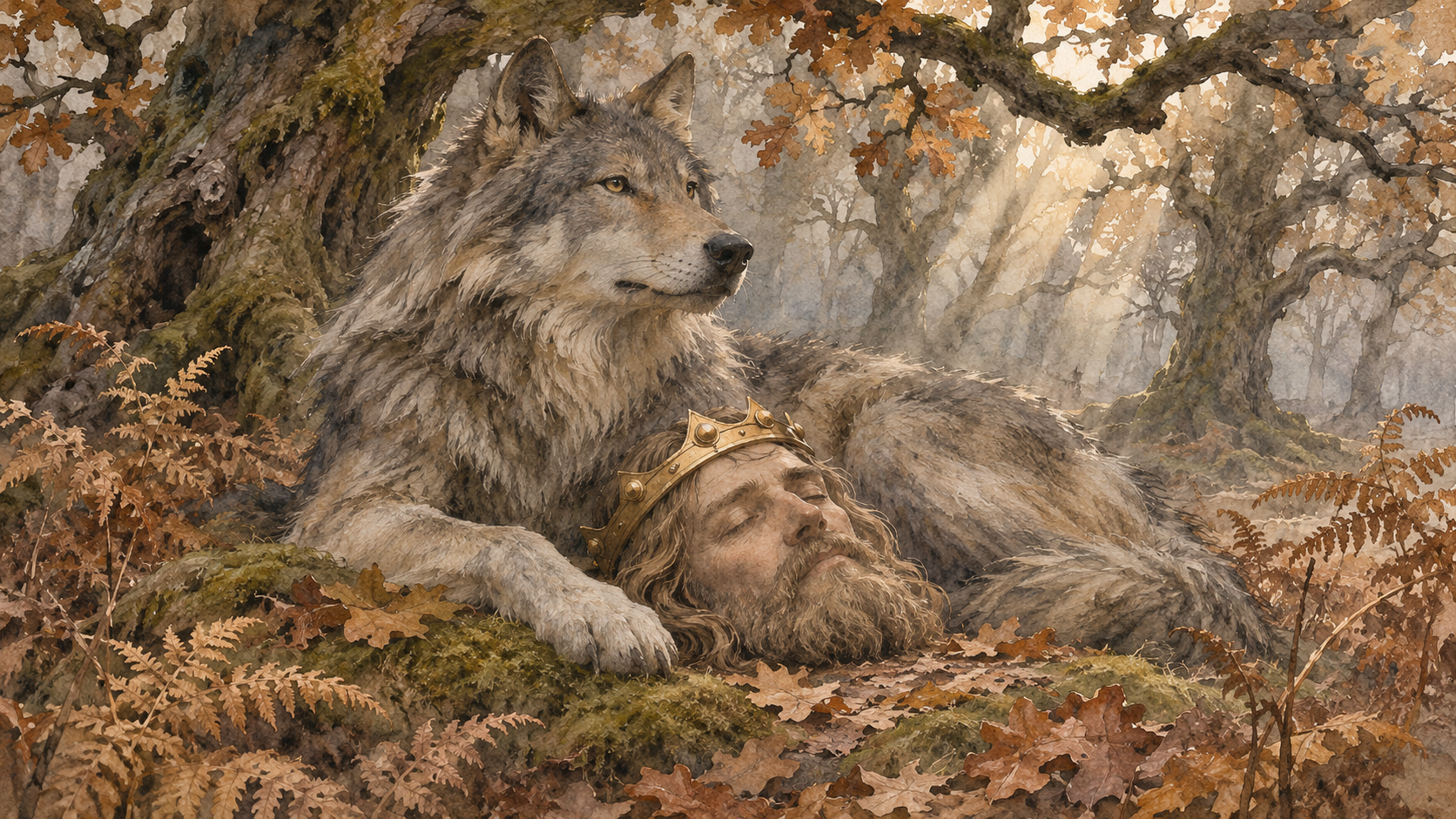
And beside it was a wolf.
Not a wolf preparing to feed upon the remains, nor one startled into flight by the arrival of men, but a great grey creature lying quietly beside the head, guarding it from other animals. In the later Old English retelling by the monk Ælfric, the wolf is described as holding the head between its forepaws, hungry but unwilling to harm it. It had remained there throughout the search, protecting the king’s remains until his followers arrived.
The men approached, presumably with a mixture of astonishment and considerable caution, but the wolf made no attempt to attack them. Instead, it allowed them to recover Edmund’s head, as though understanding that the task entrusted to it was finally complete.
And then it did something even more extraordinary.
As the men carried the head back through the forest, the wolf followed them.
The animal that might ordinarily have been feared as a dangerous predator accompanied the little procession, walking behind the men as they returned to the place where Edmund’s body lay. Only when the king’s remains had been safely recovered did the wolf turn away and disappear back into the woodland.
There is something wonderfully moving about that image. A king whose death had been marked by extraordinary violence was afforded a final gesture of gentleness by one of the wildest creatures in the English countryside. While armed men had destroyed his body, a hungry wolf had protected what remained of him. The contrast was surely deliberate, and it would have been immediately understood by the medieval audiences for whom the story was written.
Indeed, the wolf’s behaviour was central to the miracle. In medieval Christian writing, wild animals were sometimes depicted as recognising holiness in ways that sinful human beings could not. A creature that would ordinarily be expected to hunt, scavenge or attack instead became obedient to divine will. The wolf had not merely behaved unusually; it had acted against its supposed nature in order to protect a saint.
The story becomes even more striking when we consider the place of wolves in Anglo-Saxon literature. Wolves were familiar figures in the imaginative landscape of early medieval England, frequently appearing in poetry alongside ravens and eagles as creatures associated with battlefields and the aftermath of slaughter. They belonged to a world of bloodshed, wilderness and death, and their appearance often suggested that violence was close at hand.
In Edmund’s legend, however, this familiar image was turned completely on its head. The Vikings, who might themselves be compared to wolves in the language of the period, behaved with savagery, while the actual wolf demonstrated restraint, loyalty and compassion. The animal became the protector, and the human invaders the destroyers.
Once Edmund’s head had been recovered, his followers reunited it with his body and buried him. Later traditions claimed that when his remains were examined, the head and body had miraculously joined together, leaving only a faint mark around his neck. His body was also said to have resisted corruption, another familiar sign of sanctity in medieval accounts of saints and martyrs.
These details belong to the religious tradition surrounding Edmund rather than to verifiable history, but their importance in the development of his cult cannot be overstated. The stories transformed a defeated Anglo-Saxon ruler into a powerful symbol of Christian endurance, and the miracles associated with his remains encouraged generations of people to regard him as a protector and intercessor.
His resting place eventually became the centre of an extraordinary religious establishment. The town now called Bury St Edmunds took its name from the saint, and the great abbey established there became one of the wealthiest and most influential monasteries in medieval England. Pilgrims travelled from far and wide to visit Edmund’s shrine, bringing offerings and seeking his assistance, while kings and nobles regarded the abbey as a place of considerable spiritual and political importance.
For centuries, Edmund was among the most revered saints in England, and he was regarded as a patron and protector of the kingdom long before St George became the more familiar national figure. His feast day, 20 November, was an important occasion in the medieval calendar, and his story circulated through sermons, manuscripts and works of religious art.
The wolf, naturally, was not forgotten.
One of the most beautiful surviving depictions of the story appears in an illustrated manuscript of Edmund’s life and miracles dating from the twelfth century, now preserved by the Morgan Library and Museum in New York. In its colourful scenes, the wolf appears beside the king’s head as the searchers arrive, a wonderful example of how the legend continued to capture the medieval imagination long after the events it purported to describe.
Over time, the image of the wolf guarding Edmund’s head became one of the saint’s most recognisable symbols. It appeared in local heraldry and religious imagery, and eventually formed part of the identity of Bury St Edmunds itself. Even those who knew little about the ninth-century king could recognise the peculiar pairing of a wolf and a crowned head.
The precise location of Edmund’s martyrdom remains uncertain. Hoxne in Suffolk has long been associated with his death, although historians have questioned the evidence for identifying it as the original site. The place named in the early hagiographical tradition, often rendered as Hægelisdun, has never been established beyond dispute. As with so many events from Anglo-Saxon England, the boundaries between remembered history, religious tradition and local legend have become difficult to untangle.
Yet perhaps the uncertainty surrounding the king’s final days is part of what makes his story so enduring. We know that Edmund lived, ruled and died during the Viking conquest of East Anglia. We know that his memory inspired a powerful religious cult and that the story of his martyrdom became extraordinarily influential. What we cannot know is whether a wolf ever lay among the trees guarding the remains of a fallen king.
But the story was never simply about an unusual encounter with an animal.
It was about the belief that goodness could be recognised even in the wilderness, that compassion might appear where it was least expected, and that loyalty could survive the destruction of everything a man had once possessed. The wolf was dangerous, hungry and wild, yet in the legend it became the gentlest figure in a tale otherwise dominated by violence.
More than a thousand years have passed since Edmund’s death, and the East Anglian forests in which his followers supposedly searched for his remains have changed almost beyond recognition. Wolves themselves disappeared from the English countryside many centuries ago, and the great abbey that once housed Edmund’s shrine now stands largely in ruins.
But somewhere in the long memory of English folklore, a grey wolf is still lying beneath the trees, its paws resting protectively around the head of a fallen king, waiting patiently for the men who have come to take him home.
And I rather like to think that, when they finally arrive, it follows them all the way back.
