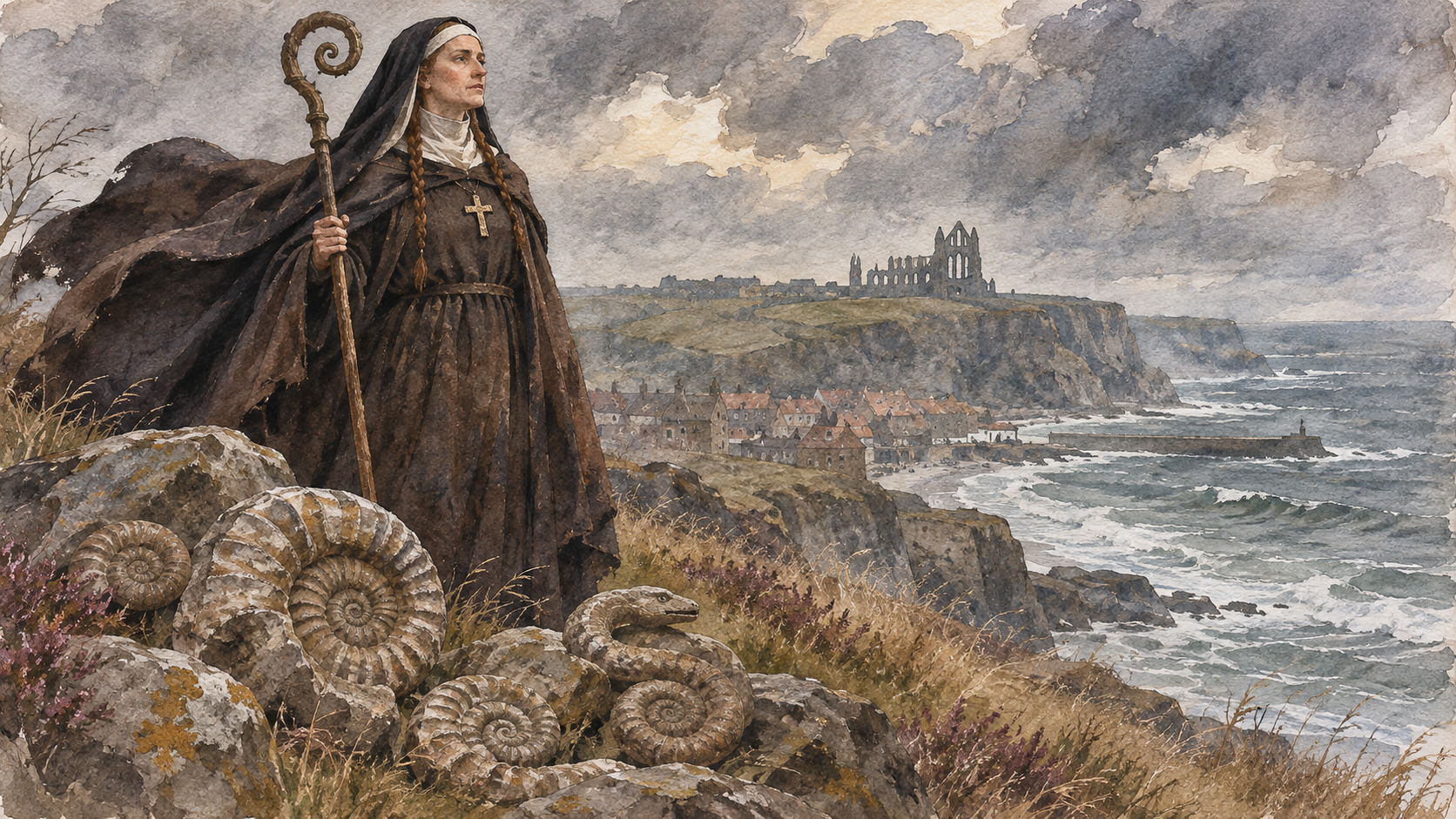
Along the Yorkshire coast, strange coiled stones have been washing out of the cliffs for centuries. According to an old legend, they are the remains of a plague of serpents defeated by one of England’s most remarkable women.
If you have ever wandered along the beaches beneath the towering cliffs of Whitby, you may have come across a rather peculiar little stone. It will be curled into a near-perfect spiral, with a ribbed surface and the unmistakable appearance of a snake coiled tightly upon itself. Some are scarcely larger than a coin, while others are substantial enough to fill the palm of your hand. They are beautiful things, and it is easy to understand why people have been picking them up, carrying them home and wondering about them for hundreds of years. What makes them particularly intriguing, however, is that they appear to have no heads. And, as anyone familiar with English folklore will know, when nature presents us with something unusual, we have a wonderful habit of inventing an extraordinary explanation for it.
In Whitby, that explanation involves an exceptionally determined woman named Hilda, a hillside apparently crawling with snakes, and a miracle that left an entire population of serpents turned to stone.
Hilda was born around AD 614 into the royal family of Northumbria, a world of competing kingdoms, political upheaval and the gradual establishment of Christianity across Anglo-Saxon England. She was related to King Edwin of Northumbria and, according to the eighth-century historian Bede, became one of the most respected religious figures of her age. After entering religious life, she eventually became abbess at Hartlepool before establishing a monastery at Streoneshalh, the settlement we now know as Whitby, in around 657. Hers was no insignificant little religious establishment. It was a community of both monks and nuns, governed by Hilda, which developed into one of the most important centres of learning and religious debate in Anglo-Saxon England.
Indeed, Hilda was sufficiently influential that kings and other powerful figures sought her advice, while the monastery under her leadership hosted the famous Synod of Whitby in 664, an assembly that helped determine the direction of the English Church. She also encouraged the talents of Cædmon, a humble cowherd whose remarkable gift for composing religious verse earned him a place in the history of English poetry. By any reasonable measure, Hilda was an extraordinary woman, quite without the assistance of supernatural serpent disposal.
But I’m seldom content to write about an extraordinary woman without mentioning her (alleged) extraordinary achievements.
According to the traditional story, when Hilda arrived at Whitby she discovered that the surrounding countryside was infested with snakes. They slithered across the ground, occupied the cliffs and generally made themselves thoroughly objectionable to anyone wishing to establish a respectable religious community. Depending upon which version of the legend one encounters, Hilda either confronted the serpents directly or prayed for divine assistance in removing them. In one telling, she picked up a snake and hurled it over the cliff, whereupon it curled itself into a spiral and turned to stone. In another, she prayed first for the creatures to lose their heads and then for their bodies to become petrified. Either way, the result was much the same. The snakes were defeated, the land was cleared, and the cliffs and beaches of Whitby became littered with the unmistakable evidence of her miraculous intervention.
There is something wonderfully uncompromising about this story. Hilda had a monastery to establish, a religious community to organise and, eventually, some rather important ecclesiastical politics to oversee. She was not about to have her plans interrupted by several thousand troublesome reptiles.
Naturally, the stones were presented as proof that the miracle had actually happened. Anyone doubting Hilda’s remarkable powers needed only to visit the shoreline, where the remains of her unfortunate victims could apparently be gathered by the handful. The curious absence of heads was particularly important, for it fitted neatly with the tradition that the saint had caused the serpents to be decapitated before transforming their bodies into stone. The very feature that might otherwise have undermined the story became part of its explanation.
And the stones themselves were real. They could be handled, examined, collected and passed from one generation to the next. For people living long before the development of modern palaeontology, their resemblance to coiled snakes must have seemed extraordinary. Here were objects apparently shaped like living creatures, yet composed entirely of rock, emerging from cliffs that had stood above the Yorkshire coast for as long as anyone could remember. It is hardly surprising that the imagination went to work.
We now know, of course, that Whitby’s snakestones are ammonites, the fossilised remains of extinct marine molluscs related to modern squid, octopuses and nautiluses. These remarkable creatures inhabited ancient seas for millions of years, long before human beings appeared, and many carried beautifully coiled external shells. When they died, their shells could settle into the sediment on the seabed, where some were eventually preserved as fossils. Over immense stretches of geological time, those sediments hardened into rock, and subsequent erosion exposed the ancient remains once more.
The Jurassic rocks around Whitby are particularly rich in ammonites, and the coastline has become famous for the fossils that emerge from its cliffs. One genus, Hildoceras, was even named in honour of St Hilda, ensuring that the formidable abbess achieved a rather splendid form of geological immortality.
But the scientific explanation does nothing to diminish the charm of the original legend. If anything, it makes the story more interesting, because the people of Whitby were attempting to explain something genuinely remarkable about the natural world, using the knowledge and beliefs available to them. The stones were prehistoric, but the questions they inspired were thoroughly human.
The association between Hilda and the snakestones is certainly an old one, although it is important to distinguish the seventh-century saint from the later folklore attached to her. Bede, who provides our principal early account of her life, does not describe her turning snakes into stone. The serpent story appears in medieval traditions that developed after her lifetime, with evidence of the legend surviving in later manuscripts and early printed collections of saints’ lives. By the sixteenth century, the tale was sufficiently established to form part of the saint’s popular reputation.
The Elizabethan antiquarian William Camden also recorded the strange coiled fossils found in the region, noting their serpentine appearance and lack of heads. Eventually, the snakestones became so closely associated with Whitby that three of them appeared in the town’s heraldry, each equipped with the head that nature had so inconveniently failed to provide.
Which brings us to my favourite part of the entire business.
By the nineteenth century, Whitby was attracting increasing numbers of visitors, many of whom were eager to take home a souvenir of the town and its celebrated history. Local fossil collectors were perfectly happy to oblige, and the snakestones offered an obvious opportunity. There was, however, a small problem. Although ammonites looked remarkably like coiled snakes, they did not look quite enough like them for everyone.
The solution was magnificently simple. The collectors carved snake heads onto the fossils.
Whitby Museum preserves examples of these modified ammonites, in which enterprising individuals transformed genuine prehistoric specimens into considerably more convincing petrified serpents. The results were then sold to visitors as snakestones, complete with the satisfying appearance of the legendary creatures that Hilda had supposedly dispatched. It was an ingenious combination of natural history, local folklore and commercial enterprise, and one suspects the saint herself might have had something to say about it.
These carved examples are particularly fascinating because they represent something more than an ordinary tourist souvenir. They show how folklore can influence the physical objects people create, and how those objects can then reinforce the folklore in return. A visitor purchased a snakestone because of the legend, but the carefully carved snake’s head made the legend seem all the more credible. The story gave the fossil significance, and the altered fossil appeared to confirm the story.
The legend also reached a wider literary audience through Sir Walter Scott, who included the tale of Hilda’s petrified serpents in his poem Marmion, published in 1808. By then, the miracle had become firmly embedded in the romantic landscape of Whitby, alongside the ruins of its abbey, the restless North Sea and the ancient history that seemed to inhabit every corner of the town.
Nor was Whitby alone in explaining ammonites through tales of petrified snakes. At Keynsham in Somerset, a similar tradition credited St Keyna with turning serpents into stone. Elsewhere, ammonites acquired associations with protection, healing and other supernatural properties. The same distinctive fossils prompted different communities to construct stories around them, each reflecting local religious traditions and ways of understanding the landscape.
I love this shared response to the prehistoric past. Long before anyone could explain Jurassic seas or the extraordinary timescales involved in fossil formation, people recognised that these peculiar stones demanded an explanation. And rather than dismissing them as meaningless curiosities, they gave them stories, personalities and places within their communities.
Hilda herself died on 17 November 680, after decades of religious leadership, and was remembered as a woman of considerable wisdom, learning and authority. Her historical achievements were substantial enough to ensure her place in English history, yet it is a curious little miracle involving troublesome snakes that continues to capture the popular imagination more than thirteen centuries later.
Today, the ammonites remain beneath Whitby’s cliffs, waiting for the sea and weather to reveal them. They are relics of a vanished prehistoric world, reminders of creatures that swam through warm Jurassic waters long before there was a Yorkshire coastline, a monastery or an England to speak of. Yet they are also part of a much more recent human history, one in which people looked at the extraordinary shapes emerging from the earth and found evidence of saints, miracles and ancient supernatural struggles.
Perhaps that is what makes the snakestones so appealing. We can appreciate the science, admire the fossils and understand precisely why they came to be there, without losing our affection for the story that once explained them.
So if you happen to find an ammonite on the beach at Whitby, take a moment to look at its beautiful spiral and consider the many millions of years of history held within it.
Then spare a thought for St Hilda, the formidable abbess who, according to local tradition, had rather more important things to do than tolerate a hillside full of snakes.


