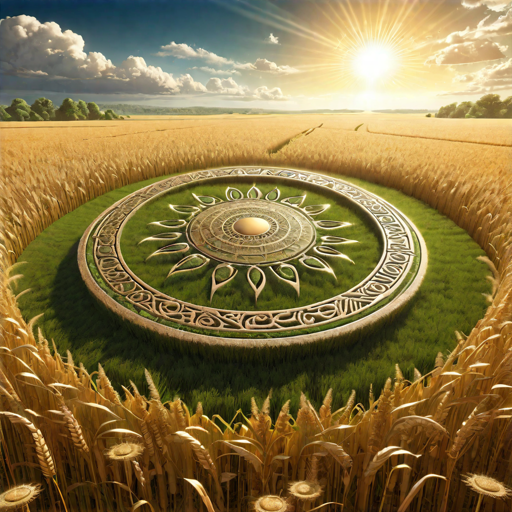
The history of crop circles stretches back centuries, with accounts of similar phenomena documented throughout the ages.
In the 17th century, reports of circular patterns mysteriously appearing in fields were attributed to supernatural forces and often associated with folklore and superstition. These early manifestations, referred to as “mowing devils,” were depicted in woodcuts and engravings, capturing the imagination of the populace.
However, it was not until the latter part of the 20th century that crop circles gained widespread attention, particularly in regions like Wiltshire, England, where they became synonymous with the rolling countryside and garnered significant media coverage.
As with most alleged phenomena, theories abound…
One prevailing theory posits that crop circles are the result of natural phenomena, such as whirlwinds, atmospheric conditions, or even geological processes. Whirlwinds, commonly known as “dust devils,” are capable of producing the swirling winds necessary to flatten crops in intricate patterns. Similarly, unusual atmospheric conditions, such as plasma vortices or electrostatic discharges, have been proposed as potential explanations for the formation of crop circles. The interaction of these atmospheric forces with crops, combined with the unique topography of certain regions, may contribute to the creation of complex patterns resembling crop circles. While these explanations may account for some simpler formations, they often fall short in explaining the complexity and precision of many crop circles observed worldwide.
Another widely discussed explanation (and my personal favourite) attributes crop circles to elaborate hoaxes perpetrated by human pranksters or artists. Indeed, there have been numerous instances where individuals have come forward claiming responsibility for creating crop circles using nothing more than planks of wood, ropes, and basic surveying equipment. These circle makers, or ‘Plankers’ as they are sometimes called, employ sophisticated techniques to design and execute intricate patterns under the cover of darkness, often leaving farmers and researchers baffled by the precision and scale of their creations.
While this theory may explain some formations, it fails to address the intricacy and scale of many others, leading some researchers to question its validity and prompting further investigation into alternative explanations.
Arguably the most sensationalized theory surrounding crop circles suggests that they are the result of extraterrestrial activity. Proponents of this hypothesis believe that the intricate patterns are messages or symbols left by advanced civilizations attempting to communicate with humanity. Reports of anomalous lights or objects observed in proximity to crop circle sites are often cited as evidence in support of this theory, leading to speculation about the existence of “alien glyphs” encoded within the formations. The allure of the extraterrestrial hypothesis lies in its ability to evoke wonder and fascination, offering a tantalizing glimpse into the possibility of contact with intelligent beings from beyond our world. However, despite its popularity in popular culture, empirical evidence substantiating the extraterrestrial hypothesis remains elusive, leaving it firmly entrenched in the realm of speculation and conjecture.
For some, crop circles hold deeper spiritual significance, representing manifestations of sacred geometry or energy points along ley lines—the hypothetical alignments of ancient sites and landmarks believed to carry mystical significance. Proponents of this perspective interpret the intricate patterns as symbolic representations with hidden meanings or transformative properties, reflecting the interconnectedness of humanity with the natural world and the cosmos. They view crop circles as expressions of a higher intelligence or consciousness, serving as portals to higher realms of understanding and enlightenment. While this interpretation resonates with certain individuals, its empirical basis remains speculative, and it is often dismissed by sceptics as pseudoscience or New Age mysticism.
All in all, the phenomenon of crop circles continues to defy easy explanation, captivating the imagination and challenging our understanding of the natural world.
While some formations may be attributed to natural causes or human activity, others remain unexplained, serving as reminders of the mysteries that still exist within our world. As researchers continue to investigate and explore the phenomenon of crop circles, they highlight the importance of remaining open-minded and curious in the face of the unknown, recognizing that the pursuit of knowledge often leads to unexpected discoveries and new avenues of inquiry. Whether the result of natural forces, human ingenuity, extraterrestrial intervention, or spiritual significance, crop circles remain a testament to the enduring enigma of the universe and our place within it.