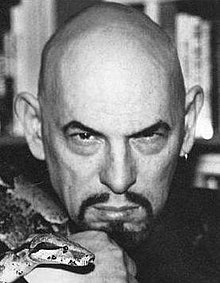
Anton Szandor LaVey, originally Howard Stanton Levey, born on April 11, 1930, in Chicago, Illinois, emerged as a pivotal figure in the 20th-century cultural landscape.
His journey from a humble upbringing to the founding of the Church of Satan in 1966 in San Francisco, California, reflects a complex interplay of personal experiences, intellectual influences, and societal currents.
LaVey’s upbringing in a secular Jewish household laid the groundwork for his early fascination with the occult and fringe philosophies. As a young man, he immersed himself in the works of Friedrich Nietzsche, Aleister Crowley, and H.P. Lovecraft, finding resonance in their ideas of individualism, self-empowerment, and the rejection of societal norms.
These formative influences would later coalesce into the distinct philosophy of Satanism that LaVey propagated.
In 1966, LaVey formalized his beliefs by establishing the Church of Satan, an organization that served as a platform for disseminating his Satanic philosophy to a wider audience. Central to this philosophy was the rejection of traditional religious dogma and the exaltation of human nature in all its carnal glory.
LaVey’s magnum opus, “The Satanic Bible,” became the cornerstone of Satanic literature, outlining principles of self-indulgence, individualism, and pragmatic hedonism.
LaVey’s charismatic persona, often adorned in elaborate Satanic regalia, captured the imagination of the public and media alike. Dubbed the “Black Pope” of Satanism, he cultivated an aura of mystique and intrigue, appearing on television talk shows and granting interviews to journalists eager to uncover the secrets of his enigmatic worldview.
His theatrical flair and provocative rhetoric ensured that he remained a polarizing figure, revered by some as a visionary iconoclast and reviled by others as a dangerous charlatan.
Throughout his life, LaVey faced vehement opposition from religious groups, moral crusaders, and conservative elements of society. Accusations of promoting immorality, hedonism, and even criminal behavior dogged him at every turn. Despite these challenges, LaVey remained steadfast in his defense of Satanism, arguing that it offered a rational and empowering alternative to traditional religion’s constraints.
Anton LaVey’s legacy extends far beyond the confines of the Church of Satan. His influence permeates various facets of popular culture, from music and literature to film and fashion. Numerous artists and creators have drawn inspiration from LaVey’s aesthetic and philosophy, incorporating Satanic imagery and themes into their work as a means of challenging societal taboos and exploring the darker recesses of the human psyche.
Anton LaVey’s life and legacy defy easy categorization. He was a provocateur, a philosopher, and a showman, whose ideas continue to resonate with those who seek liberation from conventional morality and religious orthodoxy.
Love him or loathe him, Anton LaVey’s impact on the cultural landscape is indelible, ensuring that his name will be remembered as long as the human impulse to rebel and question endures.

Leave a Reply