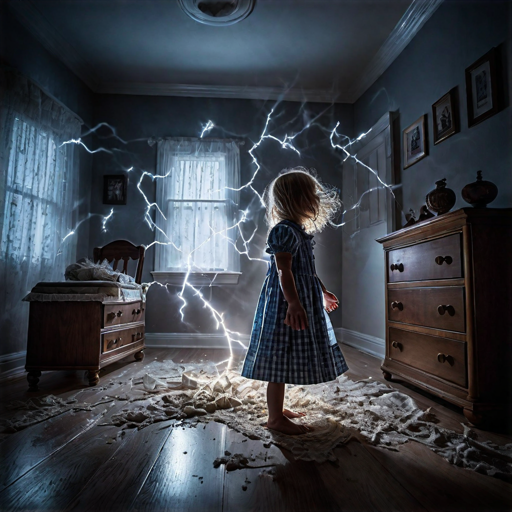
Poltergeist phenomena, characterized by unexplained disturbances such as objects moving seemingly of their own accord, strange noises, and physical manifestations, have long fascinated and perplexed researchers and the general public alike.
Often associated with hauntings and paranormal activity, poltergeist cases challenge our understanding of the natural world and raise intriguing questions about the potential influence of the human mind on the environment. In recent years, researchers have proposed the concept of recurrent spontaneous psychokinesis (RSPK) as a possible explanation for poltergeist phenomena, suggesting that they may arise from the unconscious psychokinetic abilities of certain individuals.
Poltergeist phenomena have been documented throughout history, with accounts dating back centuries across various cultures and civilizations. Early reports often attributed these disturbances to malevolent spirits or supernatural entities, leading to widespread superstition and fear. However, as scientific understanding advanced, researchers began to explore alternative explanations for poltergeist activity, including psychological and psychosocial factors.
One of the popular theories proposed to explain poltergeist phenomena is that they may be manifestations of unconscious psychological processes within individuals experiencing high levels of stress or emotional turmoil. According to this view, the mind may unconsciously produce psychokinetic effects, such as objects moving or levitating, as a form of unconscious expression or release of pent-up emotions. Studies have shown that poltergeist cases often coincide with periods of psychological distress or upheaval in the lives of those involved, lending support to this hypothesis.
The concept of recurrent spontaneous psychokinesis (RSPK), first introduced by parapsychologist William G. Roll in the 1950s, posits that poltergeist phenomena may arise from the unconscious psychokinetic abilities of certain individuals, often referred to as “agents.” According to this theory, individuals experiencing high levels of emotional distress or psychological instability may unwittingly generate psychokinetic effects in their environment, leading to the observed disturbances characteristic of poltergeist cases.
While the existence of psychokinesis remains controversial within the scientific community, researchers have conducted experiments to investigate the potential for unconscious psychokinetic effects in controlled settings. Studies involving random number generators (RNGs) and other sensitive equipment have reported statistically significant deviations from chance in the presence of individuals purported to possess psychokinetic abilities, providing tantalizing hints of the phenomenon’s potential validity.
Recent advancements in neuroscience have led some researchers to explore potential neurobiological correlates of poltergeist phenomena and psychokinesis. Studies using neuroimaging techniques such as functional magnetic resonance imaging (fMRI) and electroencephalography (EEG) have attempted to identify brain regions and neural processes associated with altered states of consciousness and anomalous experiences.
For example, research has suggested that alterations in brain activity within regions implicated in emotional processing, such as the amygdala and prefrontal cortex, may play a role in mediating the psychophysiological responses observed in individuals experiencing poltergeist phenomena. Additionally, studies investigating the role of neurotransmitters and neuromodulators, such as dopamine and serotonin, have proposed links between altered neurotransmitter levels and heightened states of suggestibility and altered perception.
In addition to psychological and neurobiological explanations, researchers have also emphasized the importance of psychosocial factors in understanding poltergeist phenomena. Social dynamics within families or groups experiencing poltergeist disturbances, such as interpersonal conflicts, family stressors, and cultural beliefs, may contribute to the manifestation and perpetuation of the phenomena.
Furthermore, the role of suggestion, expectation, and belief systems in shaping individuals’ experiences of anomalous phenomena cannot be understated. The power of suggestion, coupled with heightened emotional states, may create a fertile ground for the emergence of poltergeist activity, as individuals subconsciously project their thoughts and emotions onto the external environment.
Despite decades of research, poltergeist phenomena and psychokinesis remain controversial topics within the scientific community. Sceptics argue that many purported cases of poltergeist activity can be explained by natural or psychological factors, such as misinterpretation of ordinary events, environmental influences, or deliberate hoaxes. Furthermore, the lack of reproducible experimental evidence for psychokinesis has led many scientists to remain sceptical of its existence.
However, proponents of the RSPK hypothesis contend that anomalous phenomena such as poltergeist activity may represent genuine expressions of unconscious psychokinetic abilities in certain individuals. They advocate for further interdisciplinary research combining parapsychology, psychology, neuroscience, and anthropology to unravel the complexities of these phenomena and elucidate their underlying mechanisms.
In conclusion, the study of poltergeist phenomena and recurrent spontaneous psychokinesis remains a multifaceted and intriguing field of inquiry, blending scientific rigor with the exploration of the unknown.
While sceptics may remain unconvinced, the persistence of reported anomalous experiences and the popular fascination with the paranormal underscore the importance of continued research and open-minded inquiry into this mysterious phenomena.





Leave a Reply