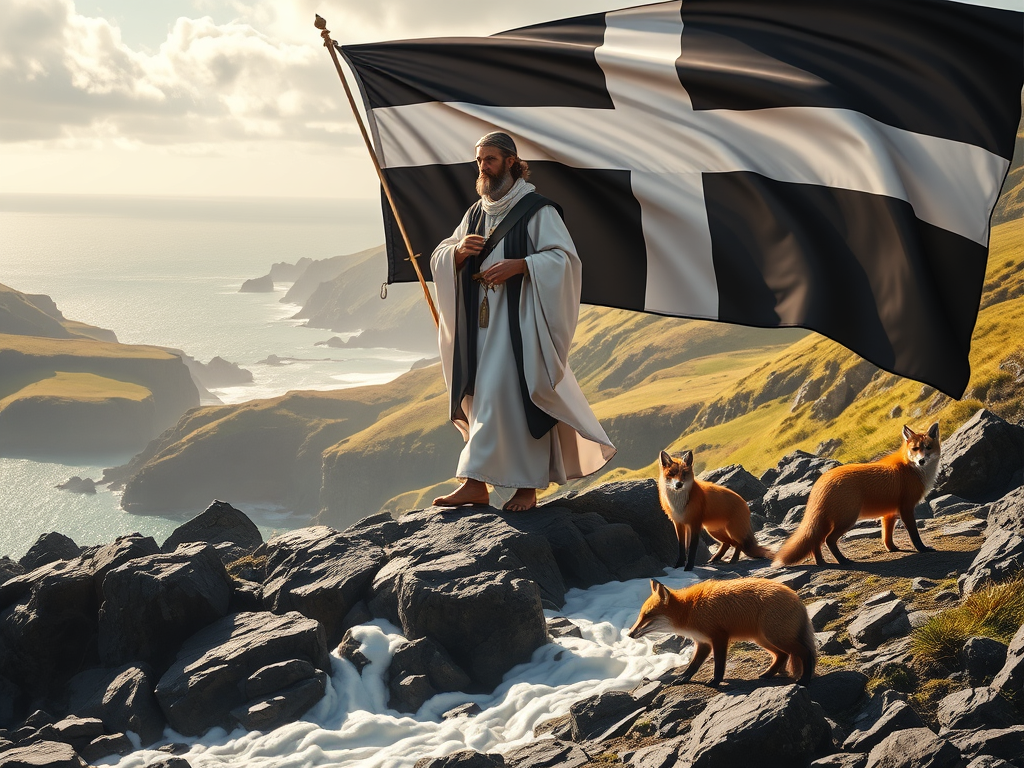
Let me tell you about Saint Piran.
If you’ve ever been to Cornwall, you’ll have seen his flag -the black one with a white cross – flying just about everywhere. And if you haven’t been to Cornwall, well, you should go. It’s stunning. But back to Saint Piran.
He’s the patron saint of tin miners, which makes perfect sense because Cornwall and tin mining go hand in hand. For centuries, the Cornish landscape was shaped by the industry, and Saint Piran became a symbol of the people who toiled underground, pulling that precious metal from the earth.
His story is a bit of a wild one, though, as all the best saintly stories tend to be.
So, Piran wasn’t actually Cornish. He was an Irishman, a Christian priest who managed to annoy his own people so much that they strapped a millstone around his neck and chucked him into the sea.
Bit dramatic, really.
But instead of sinking like a stone (literally)he miraculously floated across the water, washing up on the Cornish coast.
Whether you believe in divine intervention or just really strong Atlantic currents, he made it. And he set up camp there, becoming a hermit and eventually a beloved figure among the locals.
Now, the tin mining link comes from one of his more famous miracles. The legend goes that one day, while Piran was doing whatever it is saints do in their spare time, he built a fire on a black rock. As the flames burned, something remarkable happened – pure white tin began to flow out of the stone, forming little streams across the surface. That’s why the Cornish flag is black and white: the black for the ore, the white for the tin.
Miners took it as a sign that he was their guy, their protector, the one watching over them as they dug deep beneath the ground.
Cornwall being Cornwall, there are plenty of traditions associated with him. The biggest one is St Piran’s Day, celebrated every year on the 5th of March. It’s a proper Cornish affair – parades, pasties, plenty of cider, and a good excuse for a knees-up. In Perranporth, there’s a tradition where people march across the dunes to an ancient oratory said to be built by the saint himself.
You’ll hear a lot of Cornish spoken that day too -“Kernow Bys Vyken!” -Cornwall forever.
There’s also a great little legend that says Piran had a fondness for animals, especially a badger, a fox, and a boar that were his constant companions. Makes sense. If you’re going to live out in the wilds of Cornwall, you might as well have some furry friends to keep you company.
His influence hasn’t faded over the centuries. Miners carried his story far and wide, wherever Cornishmen went, they took their traditions with them. You’ll find Piran’s flag flying in places with strong Cornish ties, like parts of Australia and the USA. He’s a symbol of strength, resilience, and maybe just a bit of luck because, let’s be honest, floating to safety on a millstone takes some serious divine intervention.
So, next time you see that black-and-white flag, you’ll know the story behind it. And if you’re in Cornwall on the 5th of March, raise a pint to Saint Piran – the man, the myth, the miner’s saint.