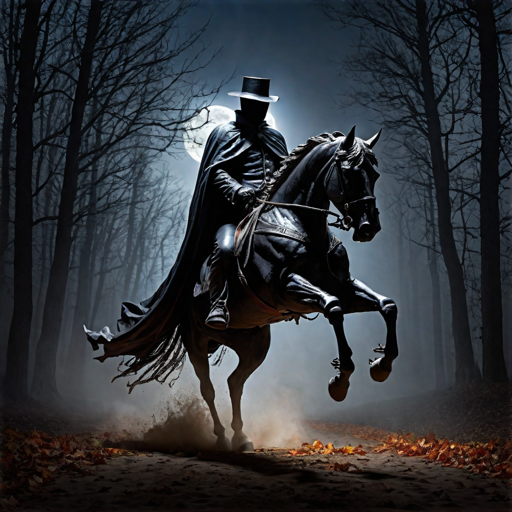
For centuries, tales of spectral riders haunting the night have captivated imaginations around the world. Among the most enduring and spine-chilling of these legends is that of the Headless Horseman. From ancient folklore to modern interpretations, the Headless Horseman has galloped through the annals of history, leaving a trail of mystery and fear in his wake.
The legend of the Headless Horseman finds its roots in diverse cultures and traditions. One of the earliest known references to a headless rider can be found in Celtic mythology, where the figure is often associated with death and the Otherworld. Similarly, Norse folklore features tales of the “Dullahan,” a malevolent spirit who rides a headless horse and carries a human head under its arm.
In American folklore, the legend of the Headless Horseman is most famously associated with Washington Irving’s short story “The Legend of Sleepy Hollow,” published in 1820. Set in the Dutch settlement of Tarry Town, New York, the story follows Ichabod Crane, a superstitious schoolteacher who encounters the spectral figure of a headless Hessian soldier believed to haunt the area.
The legend of the Headless Horseman has evolved over time, with various cultures and regions adding their own unique twists to the tale. In Ireland, the Dullahan is said to appear on dark nights, riding a black horse and carrying a whip made from a human spine. In England, stories of headless horsemen are often associated with ancient burial grounds and sites of tragedy.
Throughout Europe and the Americas, the Headless Horseman is often depicted as a harbinger of doom, appearing to those who dare to venture out after dark. Some legends describe the rider as a vengeful spirit seeking revenge on those who wronged them in life, while others portray them as guardians of the underworld, escorting the souls of the departed to their final resting place.
The legend of the Headless Horseman continues to captivate audiences in the modern era, inspiring countless adaptations in literature, film, and popular culture. From Tim Burton’s whimsical adaptation of “Sleepy Hollow” to the iconic imagery of Disney’s “The Legend of Sleepy Hollow,” the Headless Horseman remains a fixture of Halloween lore and horror.
In addition to its fictional portrayals, the Headless Horseman legend has also been the subject of paranormal investigations and urban legends. Numerous purported sightings of headless riders have been reported around the world, with some claiming to have encountered the spectral figure first hand.
Whether viewed as a mythical spectre or a symbol of primal fear, the legend of the Headless Horseman endures as a testament to the power of storytelling.
As Halloween approaches each year, the legend of the Headless Horseman is resurrected once more, captivating audiences with its eerie and timeless appeal. Whether encountered in the pages of a book, on the silver screen, or in the depths of the imagination, the Headless Horseman continues to haunt the collective consciousness, a spectral reminder of the darkness that lurks in the shadows.




Leave a Reply