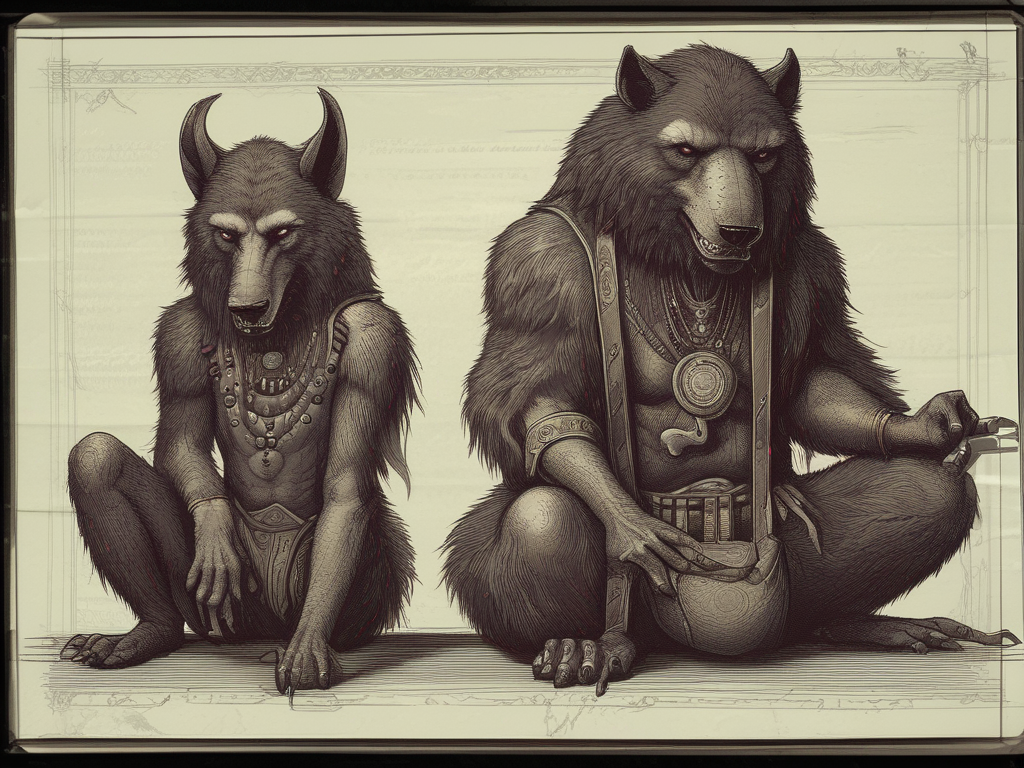
Werewolf legends, deeply ingrained in global folklore, weave tales of individuals endowed with the mysterious ability to transform into wolves or wolf-like creatures, a phenomenon often associated entwined with the full moon.
In French folklore, the saga of Bisclavret narrates the metamorphosis of noble individuals into werewolves, a transformation only halted by the cunning pilfering of their clothes.
Germanic lore, on the other hand, portrays werewolves as bearers of dark magic, their shape-shifting prowess often initiated by the donning of enchanted wolf belts or the application of mystical ointments, adding an element of enchantment to their ominous existence.
Norse mythology introduces the fearsome berserkers, warriors whose battle frenzies invoke animalistic traits, potentially culminating in a mystical transformation into wolves.
In Grecian lore, the tragic fate of King Lycaon serves as an early exploration of werewolf mythology, as Zeus punishes him for serving human flesh by condemning him to a life of lycanthropy.
Slavic folklore contributes the haunting figure of the Vlkodlak, a creature with werewolf-like attributes often associated with curses or magical metamorphoses.
Native American stories echo with the presence of skinwalkers, figures capable of werewolf-like transformations, embodying an intricate fusion of spirituality and shape-shifting, rooted in a deep connection with nature.
The history of Medieval Europe is marked by a pervasive belief in werewolves, a belief that materialized in trials and executions as individuals faced accusations of harboring this supernatural affliction. These trials reflect a historical convergence of folklore, superstition, and societal anxieties, highlighting the complex interplay of myth and reality.
Beyond folklore, werewolf myths have transferred into the literary domain, providing fertile ground for exploration of the human psyche.
Works such as “The Werewolf” by Clemence Housman and “The Wolfman” by Jonathan Maberry delve into the psychological and moral struggles of characters grappling with their lycanthropic transformations, unveiling layers of symbolism and introspection.
In contemporary culture, werewolves appear as iconic figures, leaving their metaphorical teeth marks in movies, books, and television series.
Often portrayed as conflicted beings, these creatures embody the eternal conflict between human and primal instincts, invoking empathy and fear in equal measure.
Amidst these diverse cultural expressions, werewolf legends consistently explore profound themes: the symbolism of transformation, the enduring struggle between human and animal instincts, and the collective unease rooted in the fear of the unknown.
In their varied incarnations, werewolves serve as captivating conduits, reminding us of the enduring power of mythical narratives to reflect and shape the human experience. The lycanthropic chronicles continue to expand, inviting us to contemplate the mysteries that lie beneath the surface of our shared folklore.




Leave a Reply