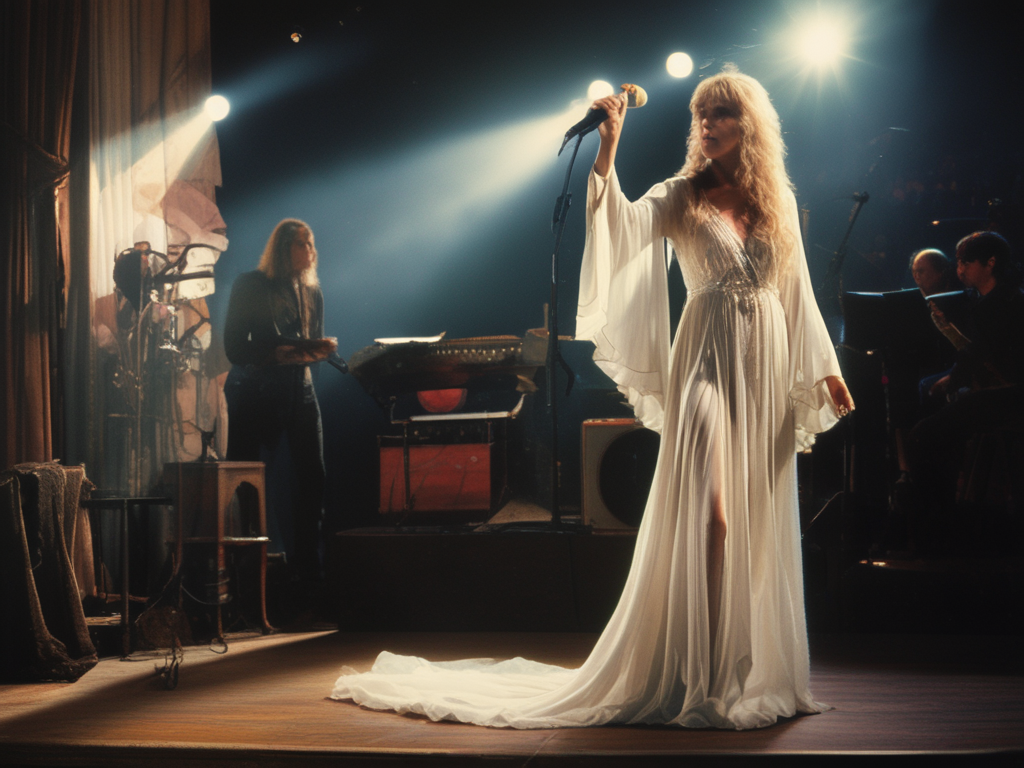
We were so excited for tonight because we had tickets to see Stevie Nicks perform in Manchester, a dream come true for us. Unfortunately, the concert has been cancelled because Stevie has injured her leg.
It’s heartbreaking news… we’ve been looking forward to this night for months. Her music has been such a big part of both our lives, and seeing her live was something we were really looking forward to.
We hope she has a speedy recovery and that we’ll have another chance to experience her magic on stage soon. Meanwhile, here’s a little piece I’ve put together to celebrate the White Witch of Rock ❤️
Stevie Nicks, born Stephanie Lynn Nicks on May 26, 1948, in Phoenix, Arizona, has enchanted the world with her ethereal voice, poetic lyrics, and enigmatic persona.
Growing up in a close-knit family, Stevie’s grandfather introduced her to music at a young age, teaching her to sing duets. This early exposure planted the seeds for what would become a legendary career.
In the late 1960s, Stevie joined forces with her then-boyfriend, Lindsey Buckingham, to form the band Buckingham Nicks. Despite their initial struggles, their work caught the attention of Mick Fleetwood, the drummer of Fleetwood Mac. In 1975, Stevie and Lindsey joined the band, a move that would catapult them all to international fame.
Fleetwood Mac’s eponymous album, featuring Stevie’s haunting “Rhiannon,” became a massive hit, and the band’s dynamic was forever changed.
The peak of Fleetwood Mac’s success came with the release of “Rumours” in 1977, an album born out of personal turmoil and intricate relationships within the band. Stevie’s contributions, such as “Dreams,” highlighted her ability to translate emotion into music. “Rumours” went on to become one of the best-selling albums of all time, cementing Stevie’s place in rock history.
Despite the band’s success, Stevie felt a deep need to explore her own artistic identity, and I, for one, am so happy she did.
In 1981, Stevie released her solo debut, “Bella Donna,” which was a commercial triumph. The album showcased her distinctive voice and songwriting prowess, with hits like “Edge of Seventeen” and “Stop Draggin’ My Heart Around,” a duet with Tom Petty. This success marked the beginning of a fruitful solo career that ran parallel to her work with Fleetwood Mac.
Stevie’s life has not been without its struggles. The intense pressure of fame, along with personal and professional turmoil, led her down a path of substance abuse. She entered rehab in the mid-1980s to overcome her addiction to cocaine, a turning point that she speaks about openly, emphasizing the importance of health and well-being.
Throughout her career, Stevie Nicks has been a figure of mystery and fascination. Her lyrics often draw on themes of love, heartbreak, and dreams, weaving a tale that invites listeners into her world. Songs like “Gypsy,” “Landslide,” and “Silver Springs” reveal a deeply introspective artist who has lived through and learned from her experiences.
A significant part of Stevie’s mystique is her association with witchcraft and the supernatural. Her interest in the mystical is evident in both her fashion and her music. The song “Rhiannon,” for example, is said to be inspired by the Welsh witch-goddess of the same name. Stevie has often described feeling a connection to Rhiannon’s story and her own persona, embracing a kind of witchy archetype that fascinates fans and critics alike.
Stevie’s witchy image is further amplified by her appearance. Her wardrobe often includes flowing gowns, velvet capes, and layers of lace, giving her an otherworldly presence. This style, combined with her enigmatic stage performances, has solidified her status as a rock and roll sorceress. Despite the mystical persona, Stevie has clarified that she does not practice witchcraft but rather draws inspiration from its imagery and symbolism.
Her influence extends beyond her music. She has inspired countless artists across genres and has maintained a loyal fan base. Her induction into the Rock and Roll Hall of Fame twice—once with Fleetwood Mac in 1998 and as a solo artist in 2019—underscores her significant impact on the music industry.
In recent years, Stevie’s “witchy” reputation was revitalized through her appearance on the television series “American Horror Story: Coven,” where she played an exaggerated version of herself, further cementing her place in pop culture as the ultimate rock witch. This portrayal delighted fans and introduced her to a new generation.
Despite the challenges and changes in the music landscape, Stevie Nicks remains a beloved and relevant artist. She continues to tour and release new music, her voice as captivating as ever. Her journey from a young girl singing duets with her grandfather to a rock ‘n’ roll icon is a testament to her talent, resilience, and enduring mystique. Stevie Nicks’ legacy is not just in the songs she has given the world but in the way she has inspired and connected with generations of listeners.
Get well soon, Stevie ❤️


