Deep in the Peak District, Glossop is a charming market town that seems straight out of a storybook, but beyond its picturesque landscapes and quaint streets hides an intriguing history of ghostly tales that have been passed down through generations. The ghosts of Glossop add a spooky charm to the town’s historic beauty, making it a fascinating place for both residents and visitors.
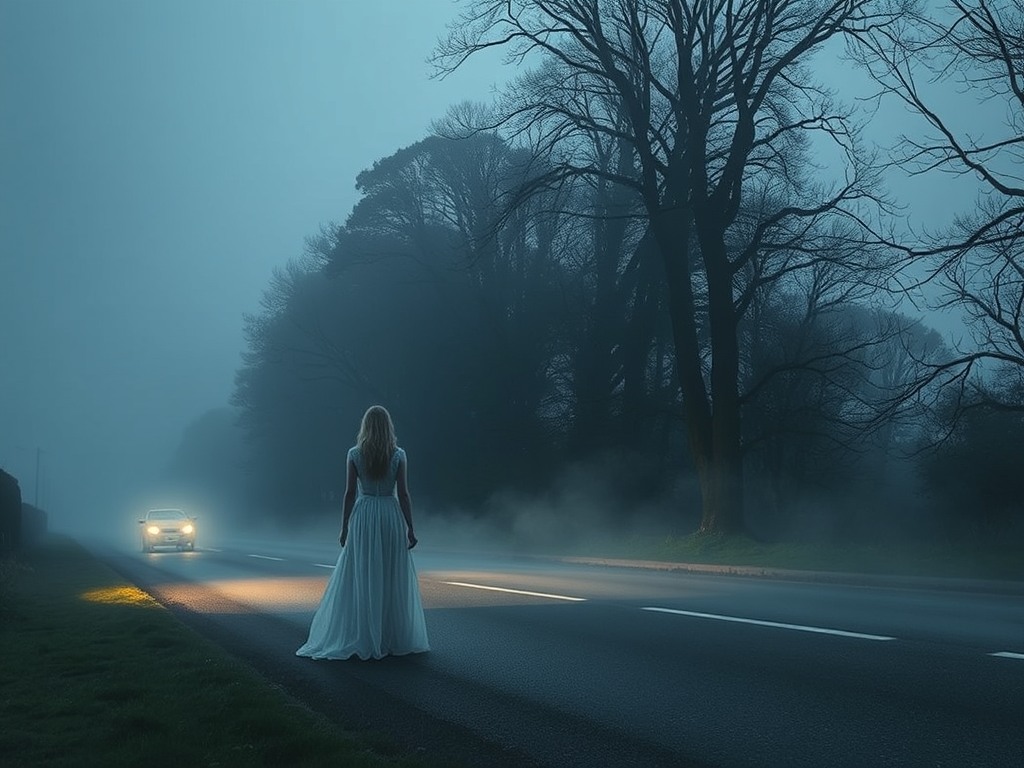
Let’s start with the most famous of Glossop’s spectral residents: the Lady in White. There is always a Lady in White and as always her story is one of timeless love and heartbreak. Legend has it that she was a young bride who met a tragic end on her wedding day in the early 19th century. The Lady in White is often seen wandering near the old ruins of Melandra Castle, a Roman fort just outside the town. Dressed in her flowing wedding gown, she is said to search for her lost groom, who never made it to the altar. Those who have encountered her describe a sense of profound sadness in the air, as if the very stones of the old fort mourn with her.
Next up there’s the mischievous spirit known as the Peddler. This ghost is said to haunt the area around Old Glossop, particularly near the 16th-century Manor House. The Peddler was a traveling merchant who met an untimely demise, possibly at the hands of bandits or due to an unfortunate accident on the treacherous roads. Unlike the sombre Lady in White, the Peddler is known for his playful antics. Locals report hearing the jingle of coins and the sound of a wooden cart rolling along cobbled streets, only to find nothing there. Sometimes, objects in homes mysteriously move or disappear, believed to be the Peddler’s doing. It’s said he means no harm; he’s just continuing his eternal trade route, forever bound to the town he loved.
The old Glossop Workhouse, which now stands abandoned, is our next destination – home to another sombre spirit: the Grey Child. The workhouse, like many others of its time, was a place of hardship and sorrow. The Grey Child is believed to be the ghost of a young girl who perished during the harsh winters of the 19th century. She is seen most often on cold, foggy nights, her small, shadowy figure huddled against the chill. Those who have seen her describe an overwhelming sense of sadness, as if the weight of her short life of suffering is palpable in her presence. Some visitors to the old workhouse site have reported hearing the faint sound of a child crying or the soft patter of footsteps echoing in the empty halls.
Moving on to the Howard Park area, there’s the ghostly gardener, a figure who seems dedicated to his craft even in the afterlife. This spirit is believed to be that of a Victorian-era groundskeeper who took great pride in maintaining the park’s beautiful gardens. People often report seeing a shadowy figure tending to the flower beds or hear the faint sound of a spade digging into the earth. Some even claim to have seen flowers bloom overnight or find the gardens unusually well-kept despite no visible signs of recent work. The ghostly gardener’s dedication to his post-mortem duties adds a touch of spectral charm to this already beautiful park.
Another notable ghostly figure is the Phantom Coachman, who haunts the roads around the Snake Pass, a famously winding and treacherous route that links Glossop to Sheffield. The Phantom Coachman is said to appear on stormy nights, driving a spectral horse-drawn carriage through the fog. Travelers along the Snake Pass have reported seeing the eerie apparition, often accompanied by the sounds of hooves clattering and a coach creaking ominously. Legend has it that the coachman met his end during a fierce storm, losing control of his carriage and plunging down the steep ravine. Ever since, he has been doomed to travel the pass, warning others of the dangers that await on stormy nights.
Last but not least is the tale of the Singing Spectre of the Glossop Parish Church. The church, with its history dating back to the 12th century, has seen countless weddings, funerals, and services. The Singing Spectre is believed to be the ghost of a choirboy from the Victorian era. It’s said that he had a voice of an angel and loved nothing more than to sing in the church choir. Tragically, he died young, but his love for singing was so strong that his spirit lingered. Visitors and parishioners sometimes hear a beautiful, unearthly voice singing hymns during quiet moments in the church, even when no one is there. This ghostly serenade is often described as both haunting and uplifting, a spectral reminder of the boy’s enduring passion for music.
The ghosts of Glossop, each with their unique stories and characteristics, add a layer of mystery and charm to this historic town. Whether you’re a believer in the supernatural or simply enjoy a good ghost story, the tales of the Lady in White, the Peddler, the Grey Child, the ghostly gardener, the Phantom Coachman, and the Singing Spectre are sure to captivate your imagination. So, the next time you find yourself in Glossop, keep an eye and ear out—you might just have a spectral encounter of your own.