As I was pottering about the house this morning, tidying up the many piles of discarded books and research papers that have accumulated over the last few days, one sheet of A4 caught my eye.
On it was printed one of our short, spooky stories that we like to tell each other when we are driving dark, country roads on road trips or relaxing after an evening working on books or articles.
This particular article first glided spookily into existence about a year ago, ad – libbed as we drove slowly through driving rain in the Mach Valley in Wales. Later recorded and printed out, earmarked for a collection of spooky stories we would later publish, then forgotten.
The book came out last week and it wasn’t included.
It does, however, seem to want to be seen..
So here it is. Enjoy!
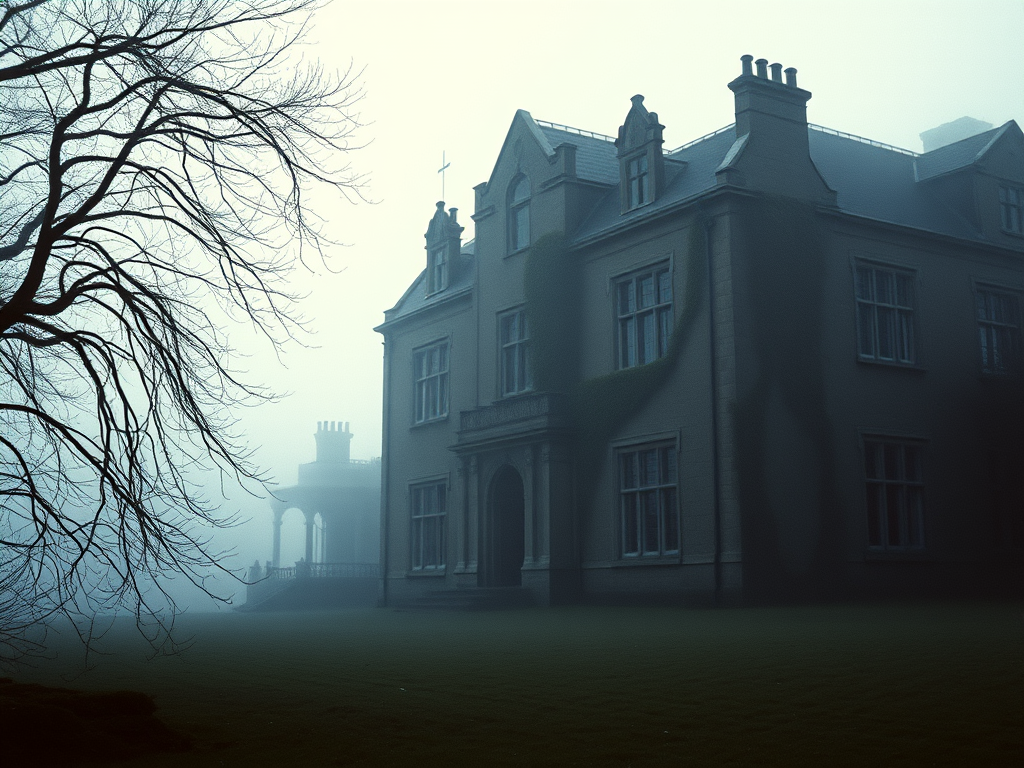
In the small, isolated village of Prestwick, nestled in the English countryside, there was a house known to all as The Ironclad. Standing at the edge of the moors, this lonely manor had a dark reputation, one that had lingered for centuries like a shadow over the village. From a distance, it was just a stone building with ivy crawling up its walls, its windows perpetually closed to the world outside. But anyone who had ever stayed within its cold, crumbling walls knew that something unnatural resided there.
It began in the winter of 1863, when Thomas Blackwood, a wealthy businessman from London, purchased The Ironclad as a retreat. He had heard the rumours from the villagers, of course. How the house had been abandoned for years after the sudden and mysterious deaths of its previous owners, the Alcott family. They had been a large and prosperous family once, known for their gatherings, their parties, their deep connection to the land. Until one by one, each member had succumbed to strange illnesses, and their once-glowing home had grown dark and empty. Local gossip spoke of ghostly figures in the windows, strange lights seen through the mist on the moors, and a presence.. something unseen but always felt.. that stalked the halls.
But Blackwood, being a man of reason, dismissed the tales as nothing more than peasant superstition. He sent word to his wife, Margaret, and their two children to join him in the countryside, excited at the prospect of a new life away from the smoke and noise of the city. Margaret arrived in Prestwick two weeks later, with the children – Alice, aged twelve, and Edmund, only nine – in tow.
From the moment they arrived, something felt wrong. The air around The Ironclad was thick with unease, as though the house itself resented their presence. Margaret noticed it first. The moment she stepped over the threshold, a shiver ran down her spine, and she couldn’t shake the feeling that something was watching her from the shadows. Blackwood, however, brushed aside her concerns. He was too busy setting up his office in the grand study to worry about the creaking floorboards or the strange drafts that seemed to come from nowhere.
It wasn’t long before the children began to speak of unusual things. Alice, always a bright and observant girl, mentioned seeing a woman in a white dress standing at the end of the upstairs hallway, just beyond the candlelight. She said the woman never moved, only stood there, her face hidden in shadow, her hand resting on the banister. At first, Margaret thought it was merely a child’s imagination running wild in their new, unfamiliar surroundings. But when Edmund, timid and quiet, began to wake in the night, crying and insisting that someone had whispered his name in the darkness, she started to grow uneasy.
The servants, who had come from the village, refused to stay after dark. They would come in the mornings, perform their duties with stiff-lipped efficiency, and leave well before the sun set behind the moors. Margaret asked them about the house, about the Alcotts, but they were tight-lipped, avoiding her gaze. One of the older maids, a wrinkled woman by the name of Agnes, would only mutter under her breath,
“Best leave the past to the dead.”
One cold October evening, as the wind howled against the windows, Blackwood was in his study, poring over his ledgers. Margaret sat by the fire with her needlework, trying to focus on the task at hand, though her thoughts kept drifting to the strange occurrences that had been plaguing the household. The children were upstairs in their rooms, already tucked into bed. The house was unnervingly still.
And then she heard it. The faintest sound. A child’s laughter.
At first, she thought it was Alice or Edmund, perhaps playing some game in the upstairs corridor. But the laughter was strange, unnatural. It echoed through the house, growing louder, yet she could hear no footsteps, no movement. Her heart began to race. She set her needlework down and stood, straining to listen.Then came a whisper.
“Maaargaret…”
The voice was soft, almost like a breeze, but unmistakable. It called her name, drawn out in a rasping breath. She glanced toward the stairs, her heart pounding in her chest.
Thomas was still in his study, oblivious. She knew she should go to him, tell him what she had heard, but something stopped her. It was as if a cold hand had gripped her, holding her in place. The house felt alive, as though it were watching her, waiting for her to make the wrong move.
The wind picked up, rattling the windows. The fire in the hearth flickered and dimmed, casting long, dancing shadows across the room. And then, from the corner of her eye, she saw it – movement. A figure, pale and indistinct, standing in the doorway to the hall. Her breath caught in her throat. It was a woman. Dressed in white. Just like Alice had described.The figure didn’t move. It stood motionless, its face shrouded in darkness, watching. Margaret felt a cold sweat break out across her skin. She opened her mouth to scream, but no sound came out. The figure slowly raised its arm, pointing a long, skeletal finger toward the stairs.
“Maaargaret…”
This time, the whisper came from the figure. A low, guttural rasp that sent shivers down her spine. The woman’s face, still hidden in shadow, began to twist and contort, the darkness swirling around her like smoke.
Margaret turned and ran. She burst into the study, her heart pounding in her chest, and found Thomas at his desk, completely absorbed in his work. She gasped for breath, her voice trembling as she tried to explain what she had seen. But Blackwood, ever the sceptic, dismissed her claims with a wave of his hand. He had no patience for ghost stories, and he certainly wasn’t going to let some superstitious nonsense disrupt his plans.
That night, however, things grew worse.The children were awakened by the sound of footsteps outside their doors. Heavy, deliberate steps, as if someone was pacing the hallway. Alice, ever brave, crept to her door and peeked out, but there was no one there. Yet the footsteps continued, growing louder, closer. She slammed the door shut, her heart racing, and climbed back into bed, pulling the covers over her head. But the footsteps didn’t stop. They circled her bed, slow and methodical, until she could hardly bear it.
In the room across the hall, Edmund lay frozen in his bed, tears streaming down his cheeks. He had heard the footsteps too, and something else – a voice. A woman’s voice, calling his name, sweet and coaxing.
By morning, both children were pale and trembling, too frightened to leave their rooms. Margaret tried to console them, but there was little she could do to ease their fears when she shared them herself.
That evening, as the shadows deepened and the house grew cold, Thomas Blackwood decided to prove once and for all that there was nothing to fear in The Ironclad. He took a lantern and marched upstairs, determined to find whatever was frightening his family. Margaret pleaded with him not to go, but he ignored her, resolute.
He searched every room, every closet, every shadowed corner. But he found nothing. No signs of intruders, no strange figures lurking in the dark. Yet, as he stood in the middle of the upstairs hallway, he felt it – a presence. Cold and oppressive. The air grew thick, and the light from his lantern dimmed as if swallowed by the darkness.
Then, from the end of the hall, he heard it.
The soft, unmistakable sound of a woman’s sobs.
Thomas’s heart quickened, but he pressed forward, following the sound to a door he had not noticed before. It was small, tucked away in a corner, as though hidden from view. He hesitated for a moment, but then, with a deep breath, he turned the handle and pushed the door open.
Inside was a small, dusty room, bare except for a single object – a rocking chair, positioned in the centre of the floor. And in the chair sat a woman. Her back was to him, her long, dark hair cascading over her shoulders. She wore a white dress, stained and tattered. Her shoulders shook with silent sobs.“Who are you?” Thomas demanded, his voice trembling slightly.
The woman didn’t answer. She continued to rock back and forth, back and forth, her sobs growing louder, more anguished.
Thomas stepped closer, his lantern held high. “I said, who are you?”
The woman stopped rocking. The room fell deathly silent.
Slowly, she began to turn her head, just enough for him to glimpse her face in the dim light.
It was then that Thomas Blackwood realised he had made a terrible mistake.The face staring back at him was not that of a living woman. It was gaunt, pale, and hollow, the skin stretched tight over bone, the eyes sunken and black as coal. Her mouth twisted into a grotesque grin, revealing rotted teeth.
With a sudden, inhuman screech, the figure lunged at him, and the lantern fell from his hand, plunging the room into darkness.
The next morning, when the servants arrived, they found the Blackwood family gone. The house was empty, the hearth cold, the windows wide open as if the house itself had exhaled a long, weary breath. The villagers whispered of their fate, but no one dared approach The Ironclad. Over the years, it fell into ruin, consumed by the moors and reclaimed by the creeping ivy, until it was little more than a crumbling monument to the horrors that had occurred within.
The Blackwood family were never seen again, and no trace of them was ever found. Some claimed they had fled in the night, driven mad by whatever haunted the house. Others believed they had been taken by the spirits that lingered in those dark halls, consumed by the same malevolent force that had claimed the Alcotts.
For years after their disappearance, the villagers spoke in hushed tones of the strange things that still happened around The Ironclad. Shepherds reported hearing voices carried on the wind when they passed by the old house, whispers that seemed to come from the ground itself. Others claimed to have seen lights flickering in the windows at night, though the house had been abandoned for decades.
One particularly cold autumn, a group of daring young men from the village, eager to test their courage, decided to venture into the house. They arrived at dusk, laughing and joking, but their bravado quickly faded as they stepped through the heavy oak door and into the darkened hallway.
The air inside was damp and cold, carrying the scent of mildew and decay. Cobwebs hung in thick curtains from the ceiling, and the wooden floor creaked beneath their feet. But worse than the oppressive silence was the feeling that pressed down on them, the unmistakable sense that they were not alone.
As they explored the lower rooms, one of the young men, James Pritchard, noticed something odd. Every mirror in the house—whether cracked, broken, or still intact—was covered with a thick layer of dust, as though no one had looked into them for years. He rubbed at one with his sleeve, trying to clear it, but the glass remained clouded, offering only a distorted reflection of the room behind him.
They made their way upstairs, their lanterns casting flickering shadows on the walls. The house groaned and shifted around them as if it were alive. By the time they reached the upper hallway, even the bravest among them had grown quiet, their earlier jokes lost in the oppressive atmosphere of the place.
Then, suddenly, one of them – Richard Granger – froze. His face went pale, and his eyes widened in terror. “Did you see that?” he whispered, pointing down the hall.
The others followed his gaze, but saw nothing. The hallway was empty, save for the dust and shadows. But Richard insisted. He swore he had seen a figure standing at the end of the corridor, watching them from the darkness.
They moved forward cautiously, their footsteps echoing loudly in the stillness. The air grew colder as they approached the door at the end of the hall, the same door Thomas Blackwood had opened all those years ago. It was ajar, just as it had been then.
James hesitated, but the others urged him on. They had come this far, they reasoned, and turning back now would only fuel the rumours that the house still held power over those who dared enter.
He pushed the door open, the old wood creaking on its hinges.The room beyond was just as Blackwood had found it.. small, dusty, and dominated by the same rocking chair in the centre of the floor. It moved gently, as though recently disturbed, its slow creak breaking the silence.
None of them spoke. They stood there, staring at the chair, afraid to move, afraid to breathe.
Then, without warning, the door behind them slammed shut.
Panic surged through the group. James lunged for the door, pulling at the handle, but it wouldn’t budge. It was as though the house itself had sealed them inside. The others rushed to his side, pounding on the door, shouting for help, though they all knew no one would hear them.
And then they heard it – the unmistakable sound of a woman sobbing.
It came from the corner of the room, though when they turned, there was no one there. The sobs grew louder, filling the room, echoing off the walls, until it was deafening.
James felt a cold hand brush against his arm, and he recoiled, his heart pounding in his chest. The others, too, began to feel it – the icy touch of something unseen, something unnatural.
Richard, pale and trembling, pointed toward the rocking chair.
“Look…”
The chair had stopped moving. But in its place, they could now see a figure. A woman, dressed in white, her face hidden behind a veil of dark hair. She sat silently, her hands folded in her lap, her body unnaturally still.
For a long moment, no one moved. Then, slowly, the woman lifted her head, revealing the same hollow, sunken face that had greeted Thomas Blackwood all those years ago.
Her eyes were black pits, her mouth twisted into a grotesque grin. And when she spoke, her voice was a harsh whisper, barely audible over the pounding of their hearts.
“Why did you come?”
The room seemed to close in around them, the walls pressing inward, the air growing colder still. Richard screamed, bolting for the door, but as he reached it, the figure rose from the chair with inhuman speed, crossing the room in a blur of white.
The door flew open, and the men stumbled out into the hallway, their lanterns flickering wildly as they ran for their lives.
They didn’t stop until they were outside, gasping for breath under the cold night sky.
The house loomed behind them, silent and still, as though it had never moved, never changed. But they knew better. They had felt it. They had seen it.
None of the men ever returned to The Ironclad. In fact, no one from the village ventured near the house again, not even the bravest or most foolish. The house stood abandoned, its windows dark, its doors closed, but the stories persisted.
The villagers whispered of the Blackwoods, of the Alcotts, and of the pale woman who still waited in the shadows, mourning the souls she had taken and the ones she still yearned to claim.
Over time, The Ironclad became a place of legend, a name spoken only in fearful tones. The land around it grew wilder, the moors reclaiming what the house had once dominated.
And though the house itself still stood, crumbling and broken, its windows forever dark, those who passed by swore they could hear, on certain nights, the faintest sound of a rocking chair creaking… and a woman softly weeping.

The Lantern Keeper and Other Tales From the Twilight is available on Kindle now. Click the image for more details.



Leave a Reply