The Orionid meteor shower is one of the most spectacular annual celestial events, peaking in late October, and in 2024, sky-watchers will once again have the chance to witness its dazzling display.
The Orionids are often regarded as one of the most reliable and accessible meteor showers, providing a stunning opportunity for people to look up at the night sky and see something truly extraordinary. Let’s take a deep dive into everything that makes this meteor shower special, from its origins to the best way to enjoy it in 2024.
The Orionid meteor shower has its roots in one of the most famous celestial bodies known to humankind -the Halley’s Comet. Halley’s Comet is probably the most well-known comet, largely because of its regular visits to our inner solar system. It appears roughly every 76 years, and the last time it was visible from Earth was in 1986.
It will return in 2061, but despite its long absence, Halley’s Comet leaves a lasting mark on our skies twice a year. The first time is during the Eta Aquarids meteor shower in May, and the second is during the Orionids in October.
Halley’s Comet, like many comets, sheds particles as it passes through space. As it orbits the Sun, its icy surface heats up and releases gas and dust. These particles remain scattered in space long after the comet has moved on. The Earth, in its own orbit around the Sun, passes through this trail of debris twice a year. When it does, the dust and particles from Halley’s Comet collide with our atmosphere and burn up, creating the beautiful streaks of light that we call meteors. In the case of the Orionids, the Earth passes through this stream of comet debris every October.
The Orionids get their name from the constellation Orion. If you trace the paths of the meteors backward, you will find that they seem to originate from a point in the sky near Orion’s Belt, specifically near one of the brightest stars in that constellation, called Betelgeuse. This point is known as the radiant, and though the meteors can appear anywhere in the sky, they all seem to come from this area, which is why they are called the Orionids.
The history of the Orionid meteor shower is intertwined with the long human fascination with meteors. However, its formal discovery is credited to astronomers in the 19th century. The Orionids were first noted in the 1830s, and over the following decades, astronomers worked to observe and understand this annual event.
It wasn’t until later that scientists connected the shower to Halley’s Comet. The recognition that the Orionids were part of the debris left behind by the comet was a significant breakthrough in understanding the broader mechanics of meteor showers and how they are tied to cometary orbits.
Today, the Orionids remain one of the most studied meteor showers because of their connection to Halley’s Comet.
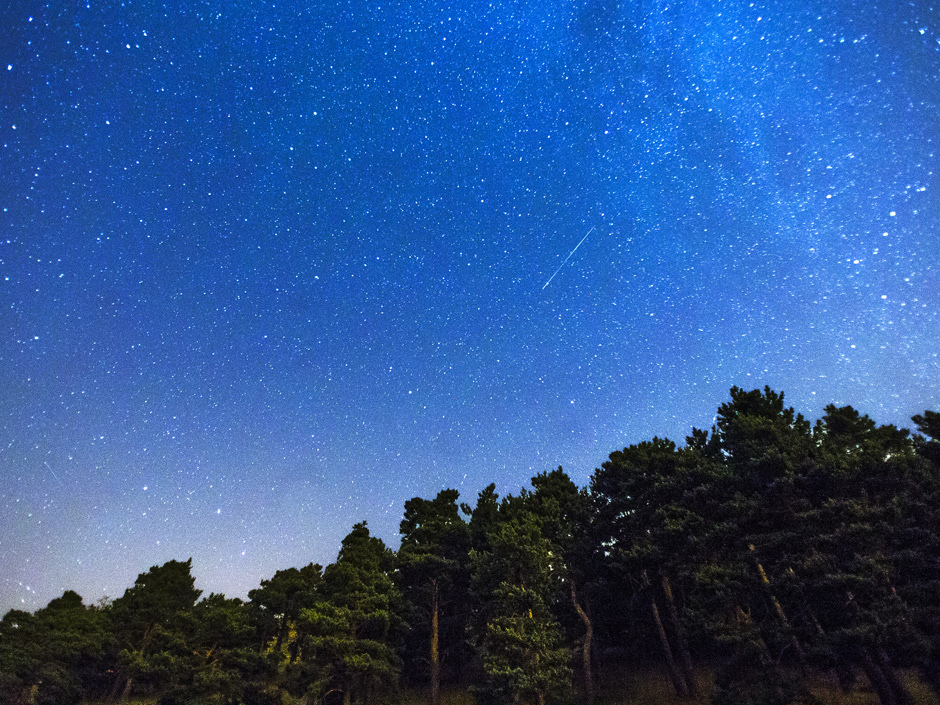
In 2024, the Orionid meteor shower is expected to peak around the nights of October 21st and 22nd, though meteors will be visible for several days on either side of this peak. The best time to view the meteor shower is after midnight and before dawn when the sky is darkest and the radiant in the constellation Orion is highest in the sky.
At its peak, the Orionids typically produce about 20 to 30 meteors per hour, though in exceptional years, this number can be higher.
One of the most striking characteristics of the Orionids is their speed. These meteors are known for being particularly fast, traveling at around 66 kilometers per second as they streak through the atmosphere. This high velocity means that Orionid meteors often leave persistent trails, or glowing “trains,” that can last for several seconds or even longer. These trains are caused by the ionization of the air as the meteor burns up, leaving a glowing path that slowly fades as the charged particles in the atmosphere recombine.
The Orionids are also known for producing bright fireballs. While most of the meteors are faint, with the average being around magnitude 3, it’s not uncommon for some particularly large meteoroids to create much brighter flashes of light. These fireballs can be incredibly bright and long-lasting, adding an extra layer of excitement to an already thrilling display.
One of the great things about the Orionid meteor shower is that you don’t need any special equipment to view it. Unlike some celestial events that require a telescope or binoculars, meteor showers are best viewed with the naked eye. This is because the meteors move too fast to follow with a telescope, and a wide field of view is necessary to catch as many as possible.
That being said, it’s important to find a good spot for viewing. Light pollution from city lights can drastically reduce the number of meteors you see, so it’s best to head out to a dark location, far from artificial lights. A wide-open space, like a field or a park, is ideal. It’s also important to give your eyes time to adjust to the darkness, which can take around 20 to 30 minutes.
Once you’ve found your viewing spot, it’s just a matter of patience. Meteor showers can be unpredictable, with long lulls between sightings followed by bursts of activity. Bring a blanket or reclining chair, so you can lie back comfortably and take in the whole sky. While the meteors may seem to come from the direction of Orion, they can appear anywhere in the sky, so it’s best to keep your eyes roaming and not fixate on one particular spot. The hours after midnight are typically the most active, as the Earth is facing into the stream of debris, increasing the number of collisions with comet particles.
In 2024, the Moon will be in its first quarter during the peak of the Orionid meteor shower, which means it will set relatively early in the evening, leaving the skies nice and dark for optimal viewing. The darker the sky, the more meteors you are likely to see, as the faintest ones can easily be drowned out by moonlight or city lights.
For those willing to travel, there are often special meteor-watching events hosted at observatories or in national parks, where light pollution is minimal, and expert guides can help you make the most of the experience.
Although meteor showers are primarily visual phenomena, there’s a fascinating science behind what’s happening when these streaks of light blaze across the sky.
Meteors are tiny particles, often no bigger than a grain of sand, though occasionally larger meteoroids can be the size of pebbles or even small rocks. These particles enter the Earth’s atmosphere at high speeds, and the friction with the air causes them to heat up and vaporize, producing the bright streaks of light we see. Most meteors burn up completely before they reach the ground, but in rare cases, larger fragments can survive the journey through the atmosphere and fall to Earth as meteorites.
The Orionids provide a perfect opportunity to appreciate this blend of beauty and science. While watching the meteors, you’re not just enjoying a spectacular show; you’re witnessing the remnants of a comet that last passed through the inner solar system decades ago and won’t return for another 37 years. Each meteor is a tangible link to Halley’s Comet, a reminder of the vastness and interconnectedness of our solar system.
The wonder of meteor showers like the Orionids is not just in the visual spectacle but also in the sense of connection they provide—to the past, to the movements of our solar system, and to the enduring curiosity of humanity. For centuries, people have looked up at the night sky, searching for meaning in the stars, and meteor showers have been a part of that. The predictability of the Orionids offers a comforting regularity in a universe that can sometimes seem random and chaotic. We know that, every October, we will have this chance to witness something extraordinary.
So, whether you’re a seasoned stargazer or someone who rarely looks up at the night sky, make sure to carve out some time in October 2024 to experience the Orionid meteor shower. It’s a simple but awe-inspiring reminder of the beauty and mystery that exist beyond our daily lives, a reminder that we are part of a much larger cosmos, one that still has the power to surprise and delight us if we take the time to watch.
As you lie back and watch the meteors streak across the sky, you might feel a sense of wonder, knowing that these tiny particles have travelled across the solar system, carrying with them a story that spans millions of years.