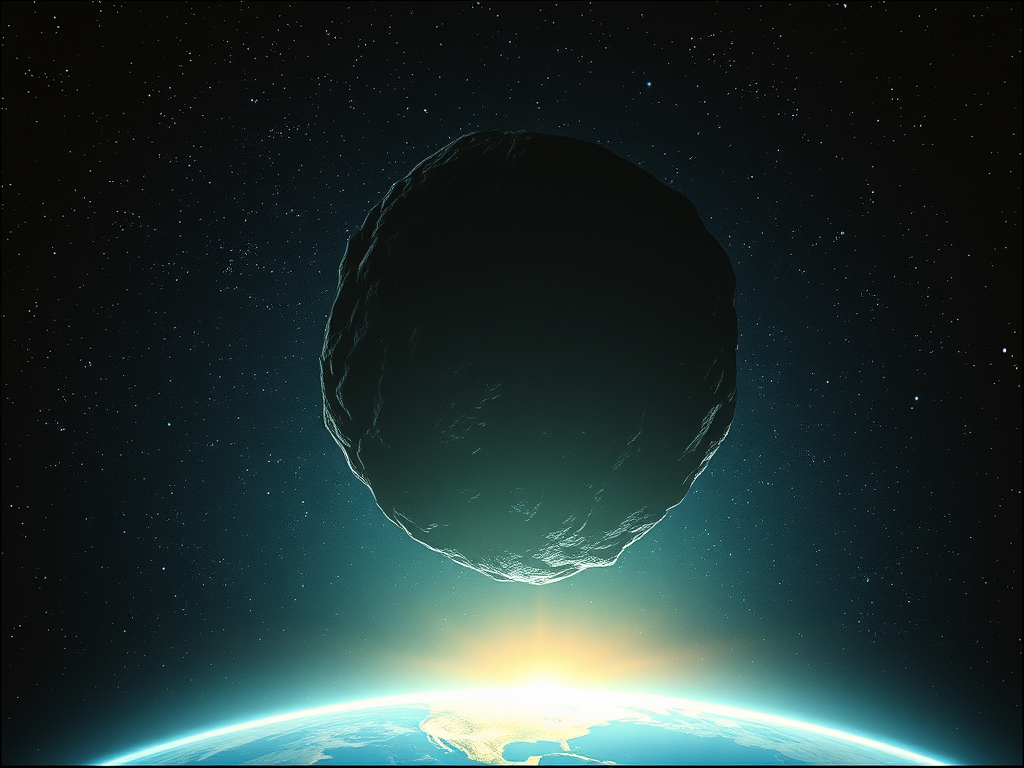
Imagine, for a moment, that scientists spot an asteroid on a collision course with Earth. It’s not an abstract thought experiment, but a real and unfolding crisis. The asteroid, a chunk of rock and metal measuring several kilometres wide, is hurtling toward our planet at speeds that defy comprehension. It’s impossible to stop thinking about the catastrophic possibilities: an impact powerful enough to obliterate entire cities, trigger tsunamis, and set off chain reactions that could upend life as we know it. Though humanity has made strides in understanding our place in the universe, the threat of an asteroid strike still lurks in the back of our collective consciousness. It’s not just the stuff of sci-fi films or distant nightmares; history and science show us that it’s not a question of “if” an asteroid will hit Earth again, but “when.”
In this hypothetical scenario, imagine the discovery of such an asteroid – dubbed 2024-ZX – by astronomers peering through telescopes. Initial observations show it is heading in our direction, and further calculations reveal an impact is imminent. It’s not a planet-killer like the one that wiped out the dinosaurs 66 million years ago, but it’s large enough to cause regional devastation. The moment this realisation sets in, a clock starts ticking. Governments, space agencies, and scientists across the globe are now faced with the daunting task of responding to a disaster that may already be inevitable.
The early days after the discovery would be fraught with uncertainty. At first, there would be hope that the asteroid’s trajectory could change, or that there might be a miscalculation. But as astronomers refine their measurements and trajectory models, the sobering truth would settle in: the asteroid is coming, and it’s going to hit. Within a matter of weeks or months, Earth would be in a collision course with an object capable of releasing energy equivalent to hundreds of nuclear bombs.
One of the first priorities in the face of such a disaster would be communication. Governments would face the unenviable task of balancing the need to inform the public with the desire to avoid widespread panic. Emergency meetings would be held behind closed doors, involving world leaders, top scientists, and military officials. They would have to answer difficult questions: What should be done? Could we evacuate entire cities? Should we attempt to destroy or deflect the asteroid? The problem with asteroids is that, unlike hurricanes or earthquakes, their threat is both too far away and too sudden at the same time. There may be months of warning, but any large-scale interventions would need time and resources that may not be readily available.
As word of the asteroid inevitably leaks out, the public response would be mixed. Some people might dismiss the threat as exaggerated or fearmongering, while others could start preparing for the worst. Shelters would be stocked, supplies hoarded, and conspiracy theories would proliferate. Social media would explode with information, both credible and false, further complicating the challenge for authorities to maintain order and keep the public informed. The asteroid’s impending arrival would dominate news cycles, overshadowing every other global issue. It would be all anyone could talk about.
In the scientific community, efforts to avert the disaster would intensify. Asteroid deflection technologies, long theorised but never fully tested, would become the focus of frantic development. NASA, the European Space Agency, and other space programs would collaborate on unprecedented missions to try to push the asteroid off course. Some would advocate for using nuclear weapons to break the asteroid into smaller, less dangerous fragments, though this would carry its own risks. Fragmentation could result in multiple impacts scattered across a wider area, or worse, parts of the asteroid could become impossible to track, turning it into a more chaotic threat.
Even if a deflection or destruction plan were put into action, there’s no guarantee of success. The challenges of space travel, combined with the asteroid’s velocity and size, would leave little room for error. Some plans might focus on using “kinetic impactors” – high-speed spacecraft designed to collide with the asteroid and alter its course slightly. But even a small miscalculation could render these efforts useless. The reality would sink in: humanity might be technologically advanced, but it is still vulnerable to forces far beyond our control.
As the asteroid draws closer, the physical effects on Earth would begin even before impact. The gravitational pull of the asteroid could cause subtle shifts in the atmosphere and oceans, affecting tides and weather patterns. Earthquakes might become more frequent in the days or weeks leading up to the impact. The stress on the planet’s geological systems would become apparent, as if Earth itself were bracing for the collision.
When the asteroid finally enters the atmosphere, the skies would light up with an intense, fiery display. To those watching from the ground, it would look like a massive fireball streaking across the sky. This sight would last only a few seconds, but it would be enough to burn itself into the memory of anyone who witnessed it. The asteroid, superheated by the friction of the atmosphere, would become a glowing, destructive force as it hurtled toward its target.
Depending on where the asteroid hit, the immediate effects would differ. An ocean strike would cause enormous tsunamis, with waves hundreds of feet high crashing into coastal regions. Entire cities could be submerged, with millions of lives lost in an instant. A land impact would unleash an explosion equivalent to thousands of nuclear bombs. The blast radius would level anything in its path – buildings, forests, mountains. The heat from the explosion could ignite wildfires, which would spread rapidly across the landscape, adding to the chaos. Those within hundreds of miles of the impact site would feel the shockwave, as windows shattered and buildings shook.
Beyond the immediate destruction, the environmental consequences would be profound. Dust, ash, and debris would be thrown into the atmosphere, blocking sunlight and plunging the planet into a temporary but severe winter. This phenomenon, known as an “impact winter,” could last for months or even years, depending on the size of the asteroid and the location of the impact. Crops would fail, leading to widespread food shortages and famine. The disruption to the global climate could trigger mass extinctions, as species struggle to adapt to the sudden changes.
The planet would, in essence, be hit by a double disaster: first the asteroid itself, and then the slow, suffocating consequences of its aftermath.
For the survivors, life in the post-impact world would be a grim challenge. Cities near the impact zone would be reduced to rubble, with millions dead or missing. Rescue and relief efforts would be slow, hampered by the scale of the destruction and the breakdown of infrastructure. Power grids, communication networks, and transportation systems would be crippled. Governments would scramble to maintain order, as civil unrest and desperation spread. In some regions, law and order might collapse entirely, leaving communities to fend for themselves in a fight for scarce resources.
The psychological toll would be immense. For those who lived through the impact, the trauma of losing loved ones, homes, and entire ways of life would weigh heavily. Anxiety about the future would be ever-present, as people struggled to adapt to a world changed by the catastrophe. For some, there might be a grim determination to rebuild, to salvage what remained and begin again. Others, however, might see the asteroid strike as a sign of humanity’s fragility, a reminder that despite our technological advancements, we remain at the mercy of the universe.
Yet, even in the face of such overwhelming devastation, there would be hope. Humans have an extraordinary capacity for resilience, and history has shown that in the wake of disaster, people often come together to rebuild and support one another. Aid organisations, governments, and everyday citizens would rally to help those affected, providing food, shelter, and medical care to the survivors. Communities would form, united by the shared experience of the disaster, and a new global order might emerge from the ruins.
The asteroid strike would also likely spur a renewed interest in space exploration and planetary defence. The lessons learned from the disaster would drive efforts to prevent such an event from ever happening again. Space agencies would invest heavily in asteroid detection and deflection technologies, determined to ensure that humanity would never again be caught unprepared. The dream of colonising other planets might take on a new urgency, as people realise that Earth, for all its beauty, is not invulnerable.
In time, the planet would recover. The skies would clear, the ash and dust would settle, and life, as it has done for billions of years, would slowly begin to heal. Plants would grow, animals would adapt, and the human survivors would rebuild. It would take years, even decades, for the scars of the impact to fade, but eventually, Earth would move on.
The hypothetical asteroid strike is a reminder of both our vulnerability and our resilience. It forces us to confront the possibility that, despite all our advancements, we are still a small, fragile species in a vast, unpredictable universe. Yet, it also highlights the strength of the human spirit – the ability to face unimaginable challenges and find a way forward. In the aftermath of such a disaster, the world would be changed forever, but humanity, as it has always done, would endure.




Leave a Reply