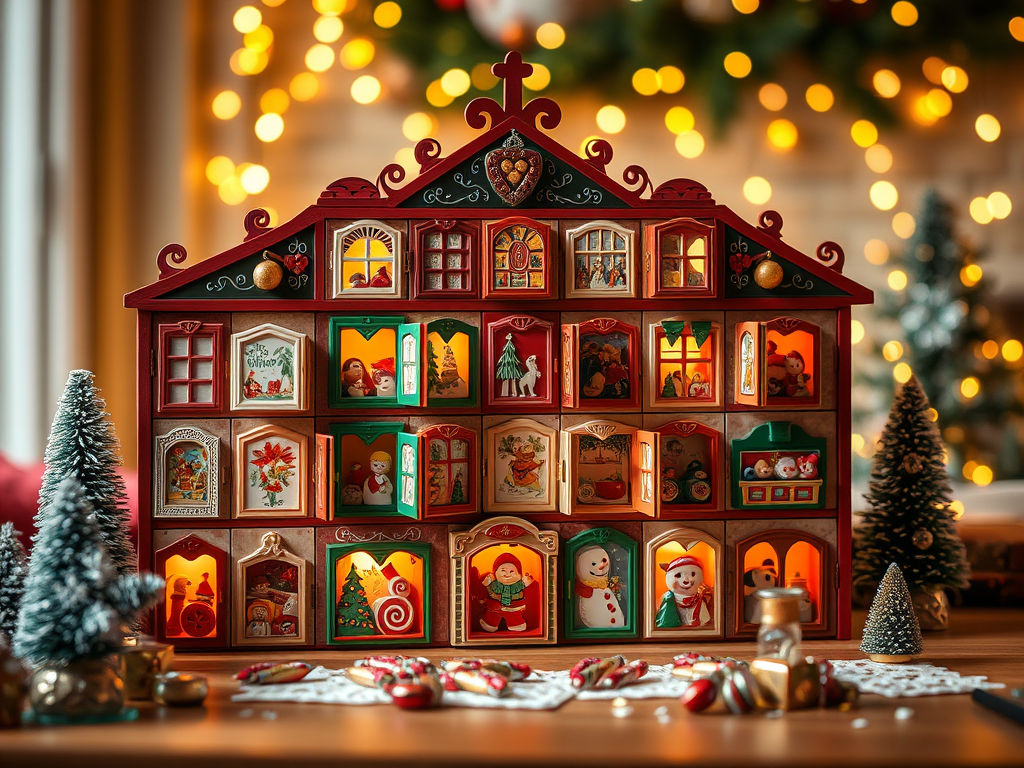
Advent calendars are one of those delightful traditions that blend anticipation and festivity, marking the countdown to Christmas in a way that feels personal, exciting, and meaningful.
Originating from a combination of religious customs and cultural creativity, advent calendars have evolved over centuries to become an essential part of many households’ holiday celebrations. They are not merely tools for counting days; they are a reflection of how we experience the magic of waiting and the joy of small surprises
.The concept of marking the days leading up to Christmas isn’t new. In fact, it has roots in 19th-century Germany, where Lutherans would light candles or make chalk marks on doors to count the days from December 1st until Christmas Eve. This practice was born out of a desire to focus on the spiritual preparation for the holiday, creating a rhythm of reflection and expectation.
Over time, these simple customs began to take on physical forms, eventually leading to the creation of what we now know as advent calendars.
The earliest printed advent calendar appeared in the early 20th century. Gerhard Lang, a German printer, is often credited with popularising this idea. Inspired by a childhood memory of his mother making him a handmade calendar with 24 tiny sweets stuck onto cardboard, Lang commercialised the concept, combining colourful illustrations with little doors to open each day.
These first calendars didn’t have chocolate or other treats inside, just small pictures or Bible verses that reflected the nativity story.
The concept spread across Europe, eventually gaining traction in other parts of the world. By the mid-20th century, the advent calendar had become a household staple, especially after the chocolate industry began incorporating tiny pieces of confectionery behind the windows.
It was an irresistible idea, each day brought a small, tangible delight. As manufacturing grew more sophisticated, advent calendars started featuring toys, trinkets, and even personalised surprises. Today, they are as varied as the cultures and traditions they’ve touched.
Modern advent calendars offer a window into our consumerist tendencies, but also our creativity and desire for connection. They’ve become far more than a countdown tool for children. In recent years, companies have pushed the boundaries of what an advent calendar can be. There are beauty advent calendars stocked with mini lipsticks and serums, luxury wine advent calendars with small bottles of rare vintages, and even gourmet food calendars with cheeses or spices from around the world. Each type speaks to a specific kind of joy, the joy of discovery, indulgence, or even nostalgia.
For children, the pullof an advent calendar often lies in the simple act of opening a door each day. That tiny hinge, revealing a surprise, becomes a daily ritual that breaks through the monotony of December’s long, dark evenings. There is something profoundly satisfying about a ritualised countdown, especially when paired with tactile or visual rewards.
For adults, however, advent calendars are often about indulgence. The rise of adult-oriented calendars says a lot about the way our relationship with Christmas evolves over time. While children may focus on the promise of a singular, spectacular Christmas morning, adults often find joy in the quiet build-up, savouring small moments amid the chaos.
Advent calendars can also serve as a creative outlet. Many people now make their own, crafting them with personal touches like handwritten notes, family photos, or bespoke gifts. These handmade calendars are particularly special because they become a labour of love, reflecting the giver’s thoughtfulness. They remind us that at its core, Christmas is about connection and generosity.
Of course, the advent calendar is not without its critics. Some argue that its transformation into a product-heavy, consumer-driven tradition reflects the broader commercialisation of Christmas.
The growing prevalence of expensive, luxury calendars does raise questions about accessibility and inclusivity. If advent calendars are meant to instil joy and anticipation, should they require hefty price tags to be meaningful? For some, a simple calendar with heartfelt messages or small tokens can be just as impactful as one filled with high-end goods.
Beyond the material aspects, advent calendars also have a spiritual dimension that still resonates. For many, they are a way to reflect on themes of hope, patience, and joy during the lead-up to Christmas. While religious imagery has become less common in mainstream advent calendars, the underlying idea of preparation, both physical and spiritual, remains relevant. The calendar becomes a metaphor for life itself: a series of small, daily actions that build toward something larger.
One of the most beautiful things about advent calendars is their adaptability. They are not bound by a single narrative or tradition but can be tailored to fit any family, culture, or interest. Some families use them to teach values, including acts of kindness or charitable giving. Instead of chocolates or toys, each day might reveal a note encouraging the recipient to perform a small act of generosity, such as donating to a food bank or helping a neighbour. These variations show how the advent calendar, despite its evolution, retains its essence as a tool for creating meaning and connection.
As we move further into the 21st century, advent calendars continue to thrive, evolving with technology and culture. Digital advent calendars, for instance, have gained popularity, offering interactive experiences online. These often combine storytelling, music, or games to create a modern twist on the traditional countdown. They may lack the tactile pleasure of opening a physical door, but they offer something equally engaging: a sense of immersion in a shared narrative.
Advent calendars remind us of the power of anticipation. In a world increasingly obsessed with instant gratification, they encourage us to pause, savour, and build excitement gradually. They teach us to find joy in the small moments, whether it’s unwrapping a tiny chocolate or discovering a heartfelt message. This practice of measured delight feels particularly poignant in today’s fast-paced, often overwhelming world.
As December days grow colder and darker, the advent calendar serves as a beacon of light, both literally, in the case of candle-based traditions, and metaphorically, in its ability to spark joy and togetherness. It’s a small tradition, but one that carries enormous weight. Whether it’s a store-bought calendar filled with goodies, a lovingly crafted DIY version, or a digital countdown that brings families together online, the advent calendar represents the best of what the holiday season has to offer: creativity, generosity, and the magic of shared moments.
So as you open each little door this December, take a moment to appreciate what lies beyond the treat or the trinket. Behind those tiny hinges are centuries of tradition, a world of innovation, and a reminder that sometimes, the greatest joy is not in the big gestures, but in the small, daily acts of celebration.




Leave a Reply