It’s my birthday and I’ll write about whatever I want to 😊
Whenever I asked my mum about when I was born she never spoke about heavenly choirs of angels heralding my arrival. Rude, really…
She did, however tell about the radio being on in the delivery suite and about a rocket arriving on the moon as I arrived on Earth. It made little ADHD me feel very special. Oddly.
So, what better subject to cover today on the 54th anniversary of the Apollo 14 moon walk than this bio of Edgar Mitchell – Enjoy!
On February 5, 1971, Apollo 14 astronauts Alan Shepard and Edgar Mitchell made history when they landed on the Moon as part of the third successful manned mission to the lunar surface. The mission, a remarkable achievement in human space exploration, was marked by Shepard’s famous golf shot and Mitchell’s historic walk on the Moon.
However, decades later, Mitchell’s post-mission statements about UFOs, extraterrestrial life, and government secrecy would thrust him into the spotlight in an entirely different way.
Edgar Mitchell, the Lunar Module Pilot for Apollo 14, was the sixth man to walk on the Moon. His involvement in the space programme was not just a scientific endeavour; it became a profound spiritual and philosophical journey for him. As a trained scientist, he was intensely curious about the universe and life beyond our planet.
After the mission, Mitchell went on to pursue a career in studying the mind and consciousness, founding the Institute of Noetic Sciences in 1973. This institute focused on exploring the nature of human consciousness and its connection to the universe – a theme that Mitchell would later expand upon when discussing extraterrestrial life.
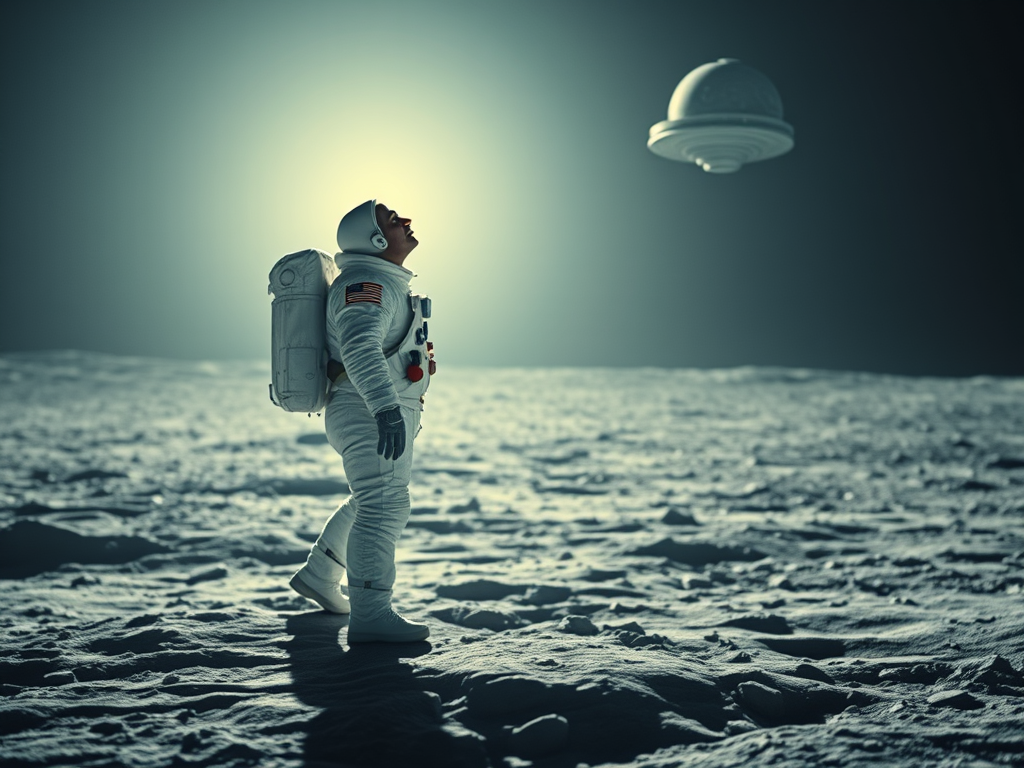
While Apollo 14 was a successful mission without any reported encounters with UFOs, Mitchell’s later comments and beliefs about extraterrestrial beings would spark widespread interest, especially after his retirement from NASA.
In the 1990s, he began speaking out about the possibility of UFOs and claimed that he had learned of government cover-ups regarding extraterrestrial encounters during his time at NASA and after his career.
He was adamant that UFOs had been visiting Earth for decades, if not longer, and that various governments, particularly the United States, had been involved in suppressing this knowledge.
Mitchell’s statements were not limited to mere speculation. He claimed to have had access to confidential sources within the military and intelligence communities who had informed him of sightings and contact with UFOs. In interviews and public appearances, Mitchell went as far as to say that certain alien species had made contact with Earth in the 1940s and that the government had been aware of these visits, though it had kept the information under wraps to avoid mass panic.
His statements were met with a mix of intrigue and scepticism, as many found it difficult to reconcile such bold claims with the scientific credibility he had earned as an astronaut.
One of the most notable claims made by Mitchell was that the U.S. government had been involved in a systematic cover-up of UFO sightings. According to Mitchell, this conspiracy had been going on since the 1940s, particularly around the time of the famous 1947 Roswell incident, where a mysterious object crashed in New Mexico.
Mitchell suggested that the government’s secrecy about UFOs was not to protect national security, as officially stated, but to prevent the public from learning about extraterrestrial life, which he believed could lead to significant shifts in human understanding of the universe.
While Mitchell was outspoken about these beliefs, he clarified that his statements were not based on personal experiences of UFO encounters during his time as an astronaut. In fact, he was very clear that, during the Apollo 14 mission itself, neither he nor his fellow astronauts had witnessed any UFOs or strange phenomena.
His beliefs were based on conversations he had with colleagues, military officials, and intelligence officers, some of whom, according to Mitchell, had firsthand knowledge of extraterrestrial encounters.
This distinction is important because it shows that Mitchell’s public statements were not rooted in the typical “sighting” experiences that often fuel UFO claims. Instead, he relied on the testimony of others, which made his assertions all the more controversial and difficult to verify.
NASA, for its part, has consistently denied that astronauts encountered UFOs during the Apollo missions. The space agency maintains that there is no evidence to suggest that any Apollo missions, including Apollo 14, had any contact with unidentified flying objects. In fact, NASA has stated on numerous occasions that any odd sightings or unexplained visual phenomena during the missions can be attributed to natural causes, such as reflections, camera malfunctions, or other easily explainable factors.
Despite the official stance from NASA, Mitchell’s claims continued to attract attention, particularly as they were amplified by the growing interest in UFOs and alien life in the late 20th and early 21st centuries. The 1990s and 2000s saw an explosion of documentaries, books, and media coverage of UFO phenomena, and Mitchell’s testimony became a high-profile part of this narrative. His statements were bolstered by other individuals, including former military personnel and intelligence officers, who also came forward to discuss their own alleged encounters with UFOs or knowledge of extraterrestrial contact.
Mitchell’s position on UFOs was not just a personal belief, but a passionate part of his public persona. He gave numerous interviews, appeared on television programs, and wrote articles discussing his views. In 2016, Mitchell even went as far as to claim that he had been told by individuals in positions of power that extraterrestrial beings had visited Earth and were still monitoring humanity’s progress. He even suggested that some of these beings had been involved in interactions with the U.S. government.
Mitchell’s claims, while extraordinary, were shared by many in the UFO community who believed that humanity was not alone in the universe and that the truth was being actively hidden from the public.
The intrigue surrounding Mitchell’s statements was compounded by the fact that he was not just a former astronaut, but someone with a scientific background and a credible career. As a result, his words carried weight, and many took his statements seriously, despite the lack of concrete evidence. While there were certainly sceptics, including many within the scientific community, who dismissed his claims as conspiracy theories or the result of a misinformed individual, others felt that Mitchell’s insights might have opened a door to a larger truth about the existence of extraterrestrial life.
As with many UFO-related claims, the debate around Mitchell’s statements continues to this day. Some view him as a whistleblower, courageously speaking out about government cover-ups and the suppression of knowledge that could forever alter our understanding of the universe. Others see him as a well-meaning but misguided figure, caught up in conspiracy theories and speculation that cannot be substantiated. Regardless of one’s stance, Edgar Mitchell’s claims about UFOs have left an indelible mark on the ongoing discussion of extraterrestrial life and the possibilities of life beyond Earth.
In the end, while there may never be definitive proof of extraterrestrial life or UFO encounters that satisfies all parties, Mitchell’s story is a reminder of the questions that still remain unanswered. Despite decades of space exploration and advancements in science, humanity still knows very little about what exists beyond our own planet. Perhaps the real mystery is not whether UFOs exist, but why the question continues to captivate us, inspiring curiosity, wonder, and the hope that one day we might learn the truth. Until then, Mitchell’s legacy, and the questions he raised, remain a key part of the UFO narrative – a story that continues to evolve, just like the mysteries of the universe itself.