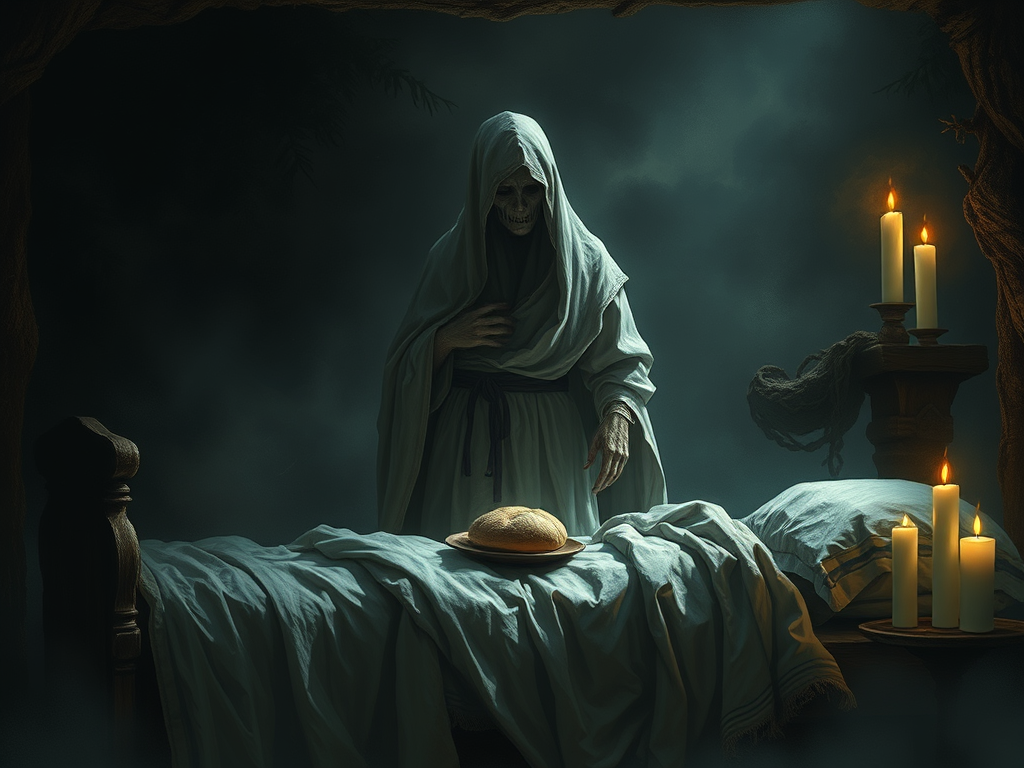
The tradition of the Sin Eater is one of the most haunting and – although I hate using this word – enigmatic folk customs to have ever emerged from the British Isles.
Shrouded in mystery, fear, and also a peculiar kind of reverence, the practice was both a necessity and a taboo – an unspoken bargain between the living and the dead.
At its heart, it was a ritual that sought to cleanse a soul before it departed this world, sparing it from the torments of the afterlife. But for the one who took on the role of Sin Eater, it was a lonely, cursed existence, burdened with the spiritual refuse of others.
This peculiar practice seems to have been largely confined to the Welsh Borders and parts of England and Scotland,and was a relic of a time when people feared the weight of their sins in death just as much as they did in life.
While the church had its own prescribed methods for absolution, not everyone had the means or the opportunity to receive them. In rural communities, where clergy were scarce or unaffordable, the role of the Sin Eater filled a desperate gap. It was a last resort for the soul’s salvation, one final chance to be unburdened before passing into the unknown.
The ritual itself was simple, almost deceptively so. When a person lay on their deathbed or had just passed, their family would arrange for a Sin Eater to be summoned. He or, in rare cases, she was an outcast, someone existing on the fringes of society, known but rarely acknowledged.
Often, this was a person of extreme poverty, someone who had little choice but to take on such grim work for the price of a meal and a few coins.
A piece of bread, often accompanied by ale or water, would be placed upon the chest of the deceased. The belief was that the sins of the departed would pass into the food, absorbed like a sponge. The Sin Eater would then consume it, taking the sins into themselves and, in doing so, allowing the dead to depart untainted.
Sometimes, a simple spoken formula would accompany the act, an incantation of sorts – an acknowledgment of the transaction taking place. The family would watch in uneasy silence, the weight of superstition thick in the air. They needed the Sin Eater, but they loathed them all the same.
For in taking on the sins of others, the Sin Eater became something less than human in the eyes of the community. They were tolerated but not welcomed, needed but never embraced. People avoided their gaze, refrained from speaking their name unless absolutely necessary.
It was believed that a Sin Eater accumulated an unbearable spiritual burden, a soul blackened by the sins they devoured over a lifetime. Their touch was considered unlucky, their presence a bad omen. Some believed that when a Sin Eater died, they would carry all those sins with them into the afterlife, ensuring their own damnation for the sake of others’ salvation.
There are echoes of similar beliefs in many cultures, but the figure of the Sin Eater is uniquely British in its bleakness. It was not an act of ritual purity or even one of sacred duty – it was an act of desperation, performed by the lowest of the low for those who could afford little else. It was transactional, crude, and grimly practical.
The practice began to fade in the 18th and 19th centuries, as religious structures became more firmly established in rural areas and the fear of an unshriven death lessened. Yet, stories persisted of Sin Eaters still being summoned in remote villages well into the 20th century, relics of an older world clinging to existence.
One of the last recorded instances took place in the early 1900s in Shropshire, where an elderly man, an outcast in his own right, was called upon to perform the ritual for an old farmer who had died unexpectedly. He accepted his payment, ate the bread in silence, and left without a word. When he died some years later, no one stepped forward to mourn him, and he was buried in an unmarked grave.
Perhaps that is the final tragedy of the Sin Eater. They were essential in death but forgotten in life, needed but never loved. They carried the sins of others, but who, in the end, would carry theirs?





Leave a Reply