We’d been driving for hours, the Scottish countryside unfolding in a blur of green fields and distant mountains, when we finally rolled into Dumfries.
It wasn’t exactly a planned stop – it was more of a “let’s see what we can find” kind of thing. We needed supplies, and Dumfries seemed like the perfect spot to stretch our legs and grab some essentials for the road ahead. Little did we know that this quiet town, nestled on the banks of the River Nith, would offer us far more than just a place to stock up.
We parked up in the heart of town, the cobbled streets winding their way around shops and cafés, the old buildings standing proudly as if time had barely touched them.
As we walked through the town, we couldn’t help but feel the weight of history here. Dumfries has been a crossroads for centuries, and it shows. It’s a town where the past lingers in the air, like the faintest trace of smoke from a long-dead fire.
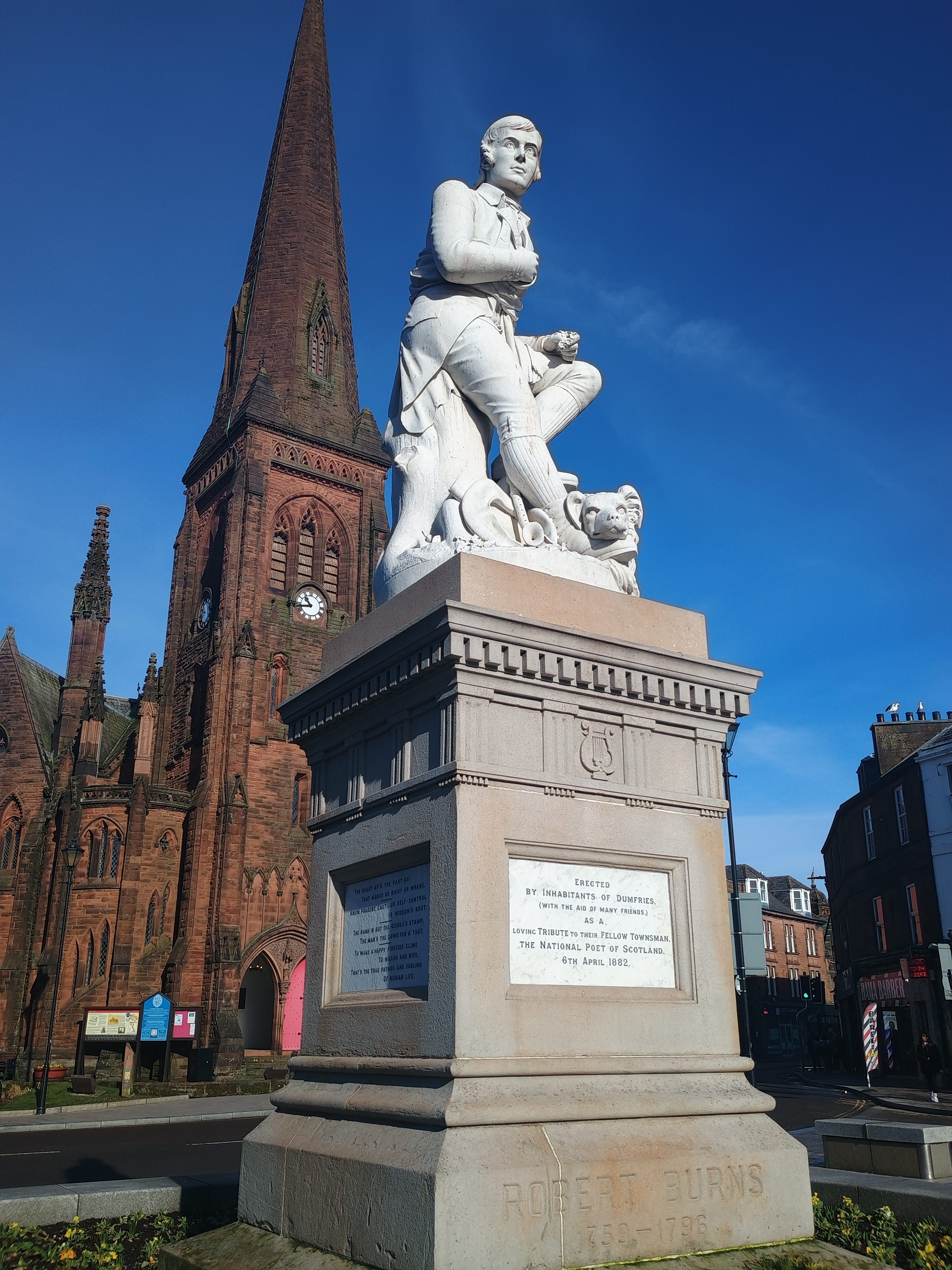
Our first stop was the statue of Robert Burns. We’d known about the poet, of course – who hasn’t? – but seeing his statue looming in the town square made him feel… real. The towering figure stands there as if overseeing the whole town, a tribute to the man who spent his final years in Dumfries, writing some of his most famous works.
There’s something about it – something humbling – standing in the presence of a man whose words have shaped the soul of a nation. As we stood there, it felt like the weight of Scotland’s literary heritage was pressing in around us.
But it wasn’t just Burns that kept pulling us in. As we wandered through the streets, We noticed the faint traces of something older – something darker – lurking beneath the surface.
We wandered towards Greyfriars Church, and we couldn’t help but feel a sense of anticipation as we approached. This was the site of one of the most infamous moments in Scottish history, the spot where Robert the Bruce murdered John “Red” Comyn in 1306. The betrayal, the bloodshed – it’s all part of the town’s story, and it felt strange to be standing here, in the very place where the fateful act took place.
The story goes that Bruce and Comyn were rivals for the Scottish throne, and when they met in the church to negotiate, things went horribly wrong. The two men argued, and Bruce, in a fit of rage, stabbed Comyn at the altar, leaving him to die in the very place where they had meant to settle their differences.
It’s said that Bruce’s actions sparked the Scottish War of Independence, and in a way, they’re what led to his rise as King of Scotland.
Standing outside Greyfriars Church, we could almost feel the tension, as if the ground beneath me still carried the echoes of that brutal moment. Some say Comyn’s ghost still haunts the church, seeking revenge for his death. I’m not sure I believe in ghosts, but the place definitely felt… heavy.
As we left the church, I couldn’t shake the feeling that Dumfries was a town of ghosts – both literal and figurative. The ghost of John Comyn might haunt Greyfriars, but there were other stories lurking around every corner.
We passed by the Robert Burns Centre, a museum dedicated to the poet’s life and work, and I felt compelled to take a quick detour.
Inside, we were greeted with displays of Burns’ personal belongings and manuscripts, a glimpse into the life of a man who shaped the very culture of Scotland. But as we roamed the exhibits, my mind kept drifting back to Burns’ dog, Luath. I had read that Luath, a loyal collie, had inspired some of Burns’ most famous works, including “The Twa Dogs”. The dog had been a constant companion to the poet, and I found myself wondering what it must have been like to walk alongside Burns, as he wrote his verses with his loyal friend at his side. I could almost hear the soft sound of paws on the ground as Burns composed his songs of love, freedom, and nature.
After soaking in the history, we found ourselves wandering along the River Nith. It was peaceful here, the water flowing calmly, as if in contrast to the tumultuous events of the past. We crossed one of the old stone bridges, looking out over the river, and it struck me how much Dumfries felt like a town at peace. Despite the layers of history, the violence, the political intrigue – it all seemed so distant now. The town had a certain calm about it, like a place that had found its way back to normalcy after the storms of history had passed.
As we stood on the bridge, I found myself reflecting on how far we had come on this roadtrip. Scotland’s history was so deeply woven into the fabric of its towns, its streets, its very stones. But Dumfries wasn’t just a place of the past, it was a town that had endured, that had grown, and that had found its own way forward.
We picked up our supplies and headed back to the Battlewagon, ready for the next leg of our journey. But Dumfries, with its ghosts and legends, its literary legacy, and its quiet charm, had left an impression on us. It wasn’t just a stop for fuel and snacks—it was a place where history had lived, and where it would continue to live on in the hearts of those who passed through.