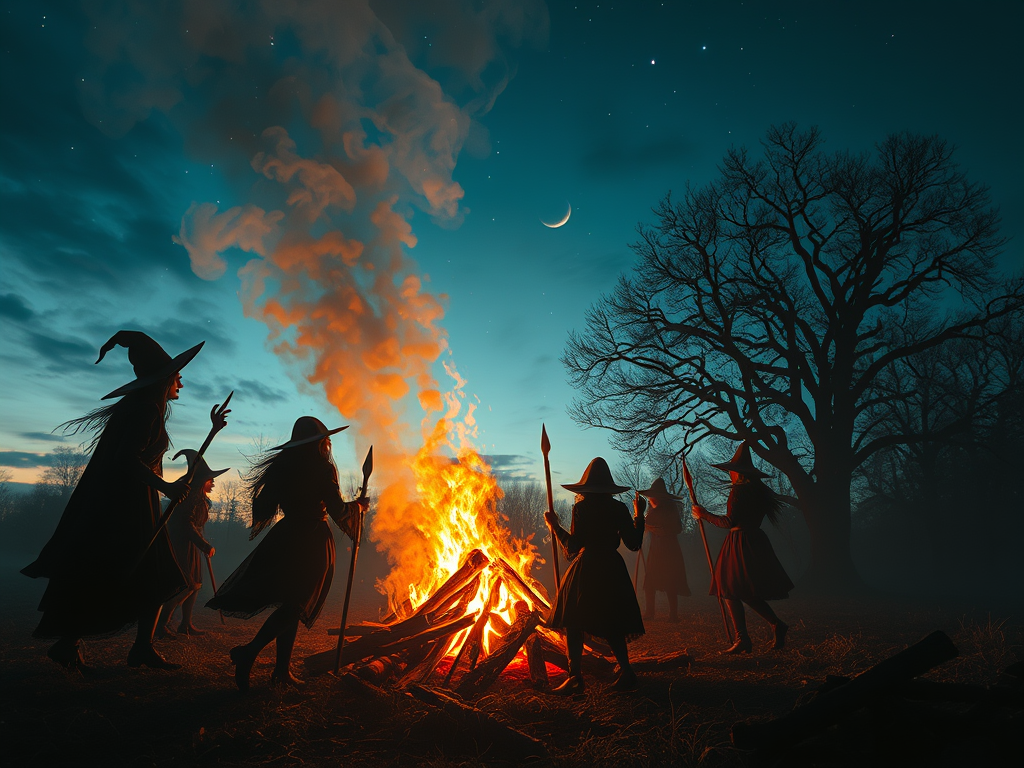
It’s a night woven through with threads of fear and festivity, of bonfires and superstition, of whispered incantations and raucous merriment.
Depending on where you stand – geographically, spiritually, or emotionally – Walpurgisnacht can mean many things. But for those of us who tread the liminal path, it’s one of those sacred hinges in the year when the veil is thin and the air tastes of potential.
Historically, Walpurgisnacht (or Walpurgis Night) is named after Saint Walpurga, an English missionary who travelled to what is now Germany in the 8th century. She was known for healing the sick and driving out evil spirits, her canonisation taking place on 1 May – hence the association with the spring date. Over time, her feast day became entangled with far older, wilder celebrations.
The eve before her commemoration, 30 April, became infamous not for her saintliness, but for what she had supposedly vanquished – witches, spirits, and sorcery. The Church’s desire to overwrite ancient pagan observances often led to this sort of irony: the saint who cast out demons became the figurehead of a night when demons and witches were believed to run riot.
But long before Walpurga’s name was ever uttered, people across Europe were lighting fires on hilltops to ward off misfortune, drive away spirits, and welcome in the fertile tide of summer. In the Germanic world, these were the last cold nights before May Day – the final defences against whatever lurked in the darkness. The fires served as both beacon and warning. You’d drive your cattle through the smoke for protection, you’d jump the flames for fertility, you’d leave offerings at the edge of the fields in hopes the land spirits would be kind.
It’s no accident that Walpurgisnacht shares a space with Beltane on the wheel of the year. Both are fire festivals. Both mark the turning toward light and life. And both are thick with magic.
In Sweden, bonfires still blaze across the countryside, music and dancing fill the air, and young people leap through the smoke just as their ancestors did.
In parts of the Czech Republic and Germany, the tradition persists of burning straw witches on the pyre – a remnant of the old ways, twisted by centuries of fear and misunderstanding, but still carrying the bones of something ancient.
Superstition clings to Walpurgisnacht like mist. It’s said that witches fly to mountaintops on this night – most famously the Brocken in the Harz mountains – to convene with the Devil himself. In some tales, they dance naked, cavort with spirits, feast on forbidden delicacies, and plot mischief for the coming months. It’s the kind of imagery that got people burned centuries ago – but there’s power in reclaiming those stories, in taking back the night as something holy rather than harrowing.
Some modern witches still mark Walpurgisnacht as a time for gathering, spellwork, and setting intentions. It’s a moment to sweep away the stagnant energy of winter, light fires (real or metaphorical), and celebrate the self unbound.
Not everyone throws on a cloak and heads into the woods, though. For many, modern observance is quieter. A candle lit at dusk. A floor swept with intention. Protective charms hung by the door, window frames dusted with salt and mugwort. Some make offerings to household spirits or ancestors, others spend time in deep meditation, asking what needs to be released and what is ready to be born.
It’s a good time to banish, to cleanse, to ward and welcome in equal measure. Protection and transformation walk hand in hand on Walpurgisnacht, like twin shadows cast by the same flame.
And there is something delicious about the timing, too. Just as the world begins to blossom and the air grows soft with promise, we’re invited to honour the darker undercurrents of our becoming. Before we dance in the May morning dew, we confront the lingering ghosts of winter. Before we crown the May Queen, we light the fires that keep the cold at bay. It’s the balance that makes the turning sacred.
Walpurgisnacht asks us to be bold. To look into the dark, call it by name, and dance anyway.
So whether you’re walking out into the wild with drums and torches, or sitting quietly with a single candle and a whispered spell, know that you are not alone. All across the world, in quiet corners and noisy gatherings, others are doing the same.
Marking the shift.
Calling in the change.
Letting the old stories rise like smoke to the stars.
Enjoy!



Leave a Reply