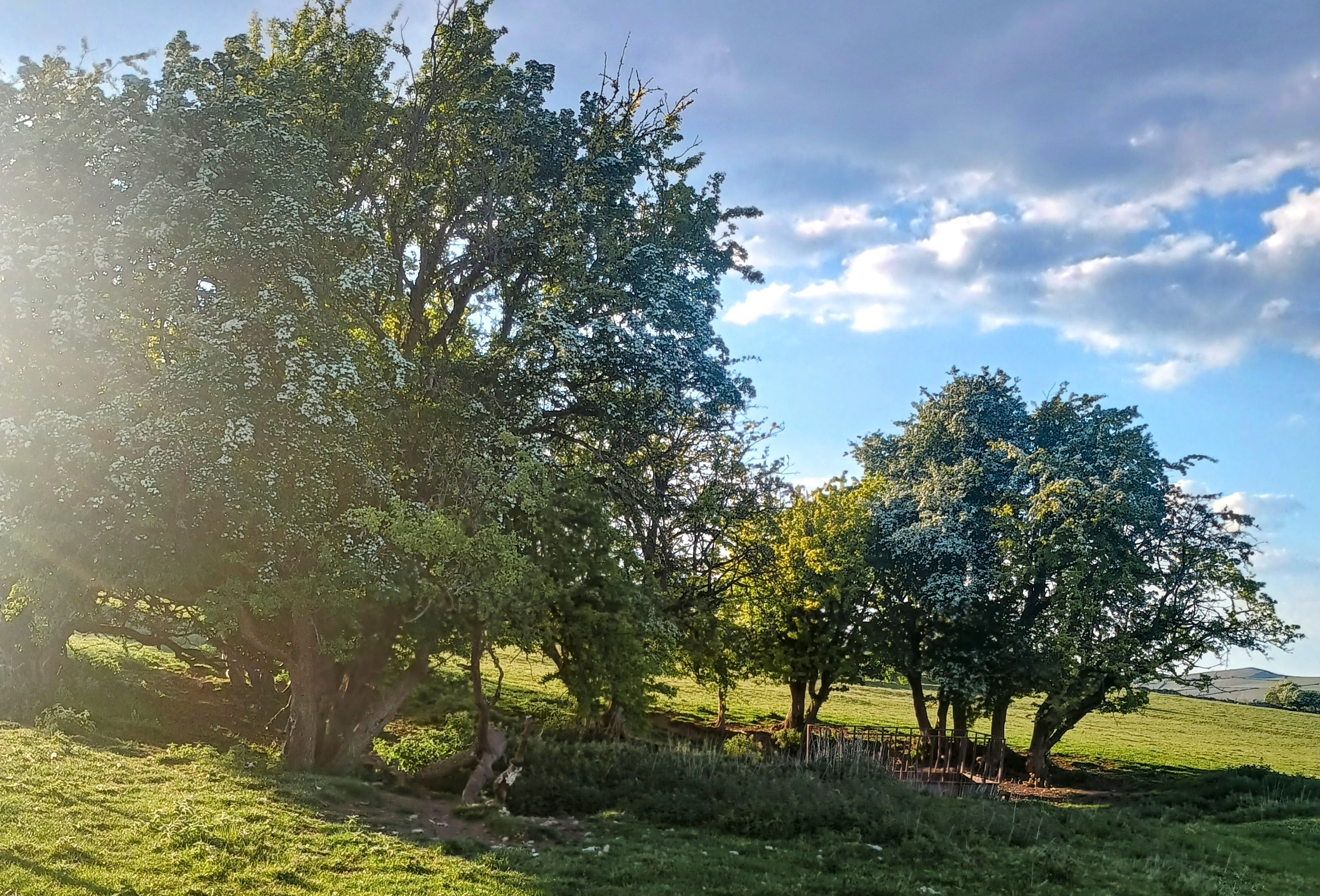
The hawthorn tree has always stood at the crossroads of magic, myth, and mystery. A familiar hedgerow companion in the British landscape, yes, but also an enduring sentinel in the deeper currents of folklore.
On the surface, it’s just a spiky little tree with delicate white or pink blossoms, found dotting the countryside and edging old fields. But delve even an inch beneath the bark and you’ll find a rich tangle of story, superstition, and ancient reverence that stretches from Neolithic rites to modern witchcraft, by way of fairies, saints, and standing stones. It’s no wonder the hawthorn has been called everything from the May Tree to the Faerie Thorn.
Its role in history is perhaps most famously linked with Glastonbury, the mythical resting place of King Arthur and a long-time cradle of British mysticism. According to legend, Joseph of Arimathea travelled from the Holy Land to Glastonbury carrying the Holy Grail, and when he arrived, he thrust his staff into the earth. That staff took root and bloomed into the Glastonbury Thorn – a variety of hawthorn said to flower twice a year, once in spring and once at Christmas. Whether or not you believe the tale, it’s a story that captured the imagination for centuries. Cuttings from this sacred tree were sent to the reigning monarch every Christmas well into the modern era, and though the original was destroyed by Puritans in the seventeenth century, descendants of the tree still flower today near the ruins of Glastonbury Abbey.
In earlier pagan times, the hawthorn had a very different reputation – one far more cautious, even fearful. It was considered a tree of powerful liminality, marking boundaries not just between fields but between worlds. To this day, lone hawthorn trees are often left untouched in Ireland and parts of the UK, especially if they’re found growing in the middle of a field or by a well. Farmers will plough around them, roads will bend to avoid them, and even major developments have been paused or rerouted to spare a so-called fairy tree. Why? Because hawthorns are known to be sacred to the fae folk – those mysterious, ancient beings who live parallel to our world, and who are not best pleased when mortals go disturbing their gateways. To cut down such a tree is to risk angering the fairies, and tales abound of misfortune, illness, even death befalling those who dared ignore the warning.
Its blooming is another point of fascination. The hawthorn is synonymous with May, as it typically bursts into flower right around Beltane, an ancient festival of fertility and fire marking the start of summer. You might know the rhyme: “Ne’er cast a clout till May is out.” Many take this to mean ’till the end of the month of May’, but in older usage, it likely meant ’till the may blossom is out’, referring to the hawthorn flowers.
Either way, it was a seasonal signpost. The blossoms were gathered and woven into garlands, crowns, and Maypoles, but with a caveat – while the hawthorn was welcome in the open air, bringing it into the house was seen as a dreadful omen. This may have stemmed from the fact that its scent, especially when cut, was said to resemble the smell of decay or death. Some say this comes from the chemical trimethylamine, which is also released from rotting tissue, adding an eerie layer to its folk associations.
Yet it wasn’t just fairies and fertility that clung to this tree. The hawthorn had religious connotations too. In medieval times, it was often planted around churchyards, possibly as a protective ward or to mark the sacred ground. In Christian folklore, its thorns were said to be the source of Christ’s crown of thorns, linking it to suffering, sacrifice, and divine endurance. But that connection goes both ways – the hawthorn’s fierce thorns and tenacious roots also made it a symbol of protection and strength in folk magic. It was believed to ward off evil spirits, curses, and even lightning, and so it was often used in charms or hung over doors and windows.In Scotland, it was one of the trees included in the “trinity of sacred woods” along with ash and oak.
For witches, both historic and modern, hawthorn has long held a special place in spellwork and spiritual practice. It’s often used in protective charms, love spells, and faery magic, due to its close links with the unseen world. Its wood is ideal for making wands – particularly for those who work with hedgecraft, ancestral rites, or spirit flight. Hedge witches, whose very name comes from the hedgerows where hawthorns thrive, often regard it as a liminal ally, helping them traverse the boundaries between the everyday and the otherworldly. The tree is also associated with heart healing, both emotional and physical, and modern herbalists still use its berries, or haws, to support cardiovascular health.
And those berries! After the heady riot of spring blossom comes the deep red flush of autumn fruit, feeding birds and small animals, but also finding a place in human tradition. The berries were used in syrups, wines, and preserves, and in some regions they were even said to help the soul of the departed find peace – placed in the hands or mouths of the dead, they acted as spiritual sustenance for the journey. They were also carried as amulets for courage and protection, and were especially powerful when gathered at dawn on May Day or Samhain.
Even the way hawthorn grows lends itself to mystery. Its gnarled, twisted limbs and sharp thorns can form dense thickets, ideal for nesting birds and hidden pathways. Walking among them, especially as dusk falls, it’s easy to feel you’ve slipped sideways into another realm. You can almost hear the rustle of cloaks or the whisper of unseen watchers. The tree doesn’t just stand, it broods, it shelters, and it remembers.
Stories of the hawthorn pop up in strange places too. There’s an Irish tale of a traveller who took shelter under a hawthorn bush and was whisked away to the faerie realm, only to return thinking a night had passed, when in fact years had gone by. In other legends, a hawthorn marks the burial place of treasure, or the spot where a portal opens on Midsummer’s Eve. Even modern ghost stories sometimes feature a hawthorn tree standing at the edge of vision, watching.
In magical correspondence, hawthorn is often linked to the element of air, though some practitioners also associate it with fire due to its Beltane ties. Planetarily, it’s aligned with Mars for its thorny nature, but also with Venus for its connection to love and desire. It’s a dual-natured tree – balancing the gentle with the fierce, the fragrant with the foul, the sacred with the wild. That duality makes it particularly powerful in magic, as it can both attract and repel, bless and banish.
So the next time you pass a hawthorn hedge in bloom, stop and look a little closer. There might be a charm tucked in its branches, a ribbon fluttering from a bough, or a silence that seems just a bit too still. The hawthorn isn’t just a tree, it’s a threshold. It stands on the borderlands of belief, where the old ways still whisper and the fair folk still dance, and it invites us… if we dare… to listen.




Leave a Reply