– Moorland Myths, Flickering Eyes, and Stone Sentinels
For centuries, the windswept moors surrounding Leek in Staffordshire have concealed many secrets. Among the rolling heather and jagged gritstone stands one of the region’s most curious and enduring mysteries: the Winking Man.
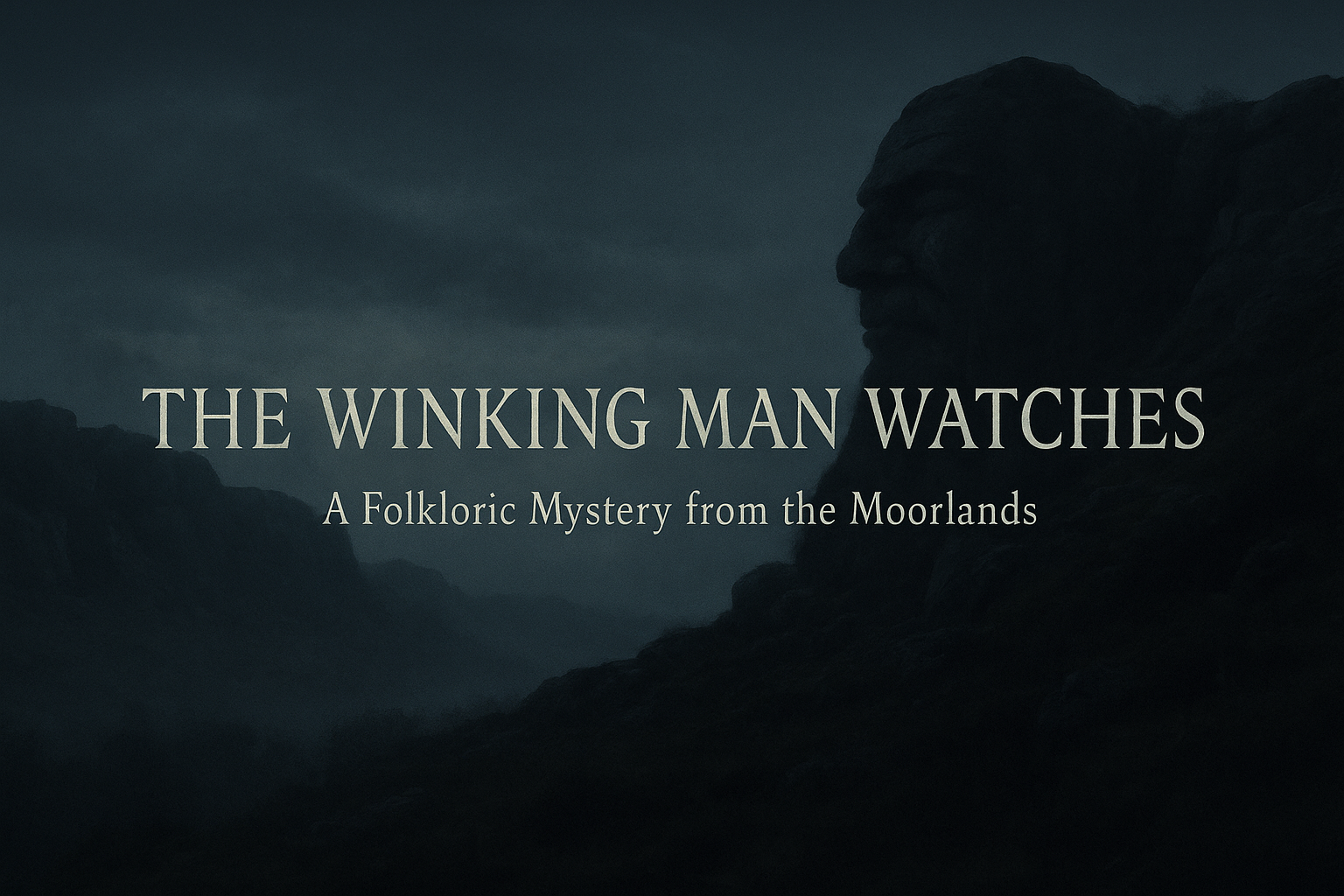
This immense natural rock formation, etched by time and weather, resembles a giant human face gazing out across the landscape – and legend has it, that face sometimes winks.
Known locally since at least the late 19th century as the Winking Man, this weather-beaten sentinel has been a focal point for folklore, superstition, and uneasy fascination. Early references, such as the 1880s journal of the Leek parish priest, recount an almost sentient presence in the stone. Reverend Amos Burleigh described passing Ramshaw Rocks at dusk and feeling as if the “eye closed and judged” him, an experience so unnerving that he vowed never to return.
The Roaches, a nearby series of imposing rocky outcrops, frame the scene with their dramatic silhouettes, which some say inspired Tolkien’s vision of the dark, forbidding lands of Mordor. While this connection is unproven, it speaks to the primal, almost otherworldly character of the terrain.
The Roaches also hold a curious secret: in the 1930s, Bennett’s wallabies escaped from a private collection at Roaches Hall and established a small wild population. Sightings of these marsupials bounding through the moorland heather add a dash of uncanny reality to the folklore stew — a reminder that the borders between the familiar and the strange are thin here.
Surrounding the Winking Man and its moor are ancient stones and burial mounds, remnants of a long-lost past. These stones, worn and moss-covered, still seem to hum in the silence after dark. Local whispers speak of fires lit under the moon, and cloaked figures gathering for rites that may stretch back to the Bronze Age – or further. The land remembers, even if we forget.
The Winking Man’s reputation has only deepened with time. In the 1950s, a lorry driver named Sidney Toller reported seeing a flickering red “eye” within the rock, a detail later corroborated by police who found no source of light or obstruction.
The local paper, Leek Post & Times, recounted how Toller was left shaken and convinced he’d witnessed something beyond the natural world. Similar stories recur: engines stopping suddenly, animals refusing to pass, and a heavy, almost palpable stillness settling over the area.
Even official channels have taken note. A curious police report from 1973 details a driver’s crash near Ramshaw Rocks after he claimed the “face winked and spoke without speaking.” While the authorities ultimately classified these incidents as unexplained phenomena, the consistent proximity and nature of the reports keep the mystery alive.
Historical warnings echo through time as well. A 17th-century pamphlet, printed crudely on yellowed paper, cautioned travellers to avoid lingering near the face. It spoke of a cursed ground where livestock fell ill, and a widow lost her mind after staring too long. This sinister heritage ties the rock not only to natural wonder but to the darker shadows of human fear and superstition.
> April 12th, 1883 – from the diary of Eleanor Whitcombe
Today I ventured once more along the high road past Ramshaw Rocks, drawn by a restless curiosity I scarcely understand. The face they call the Winking Man loomed before me, immense and weathered. I felt eyes upon me, though none could be seen. For a fleeting moment, as the clouds parted, I fancied the stone eye shifted, as if observing my very soul.
The local folk speak in hushed tones of curses and lost children, but none dare linger. There is a weight here, a silent breath that presses on the heart. I resolved to return at dusk, yet prudence stayed my hand. Some stones are better left untested.
Geologists have studied the formation with scientific detachment, noting unusual mineral effects that might explain some optical illusions. Yet even the most rigorous field reports admit that the local legend and psychological impact of the Winking Man are undeniable. The stone watches, in its own unyielding way.
1927 Natural History Museum Field Report
(anonymous geologist)
Subject: Ramshaw Rocks, Staffordshire
Observations: The rock formation locally known as the Winking Man exhibits unusual weathering patterns inconsistent with typical gritstone erosion. The apparent “eye” shape is likely a coincidental juxtaposition of two outcrops; however, slight movement noted under varying light angles suggests possible mineral expansion or contraction effects.
Unverified local accounts claim the face “winks” or “blinks” at passing travellers. While such phenomena are almost certainly psychological illusions compounded by shifting shadows, it is recommended further photometric study be conducted.
Recommendation: Continued monitoring during differing weather conditions advised. No evidence of unnatural origin detected.
Scattered throughout this eerie landscape are cryptic clues and veiled warnings. An anonymous letter, found tucked inside a dusty 19th-century volume, speaks of the face as a sentinel between worlds – a mark that chooses those who trespass to cross thresholds best left closed.
> To Whom It May Concern,
If you seek the truth of the Winking Man, be warned – it is no mere rock. I have walked those moors under moonlight and heard whispers in the wind, voices older than any living soul. The face is a sentinel, watching over secrets buried beneath centuries of earth and silence.
They say the eye winks to mark those who trespass upon the boundary between worlds. To see it is to be chosen – for what, I dare not guess.
Beware the siren call of the stones. Some doors, once opened, cannot be closed.
J.M.
And from the ruins of a shepherd’s hut near The Roaches, this forgotten folk verse was discovered, scrawled on weather-stained parchment:
> Stone eyes blink beneath the sky,Watching where the lost ones lie.
Silent keepers, old and wise,Guard the truth, and all its lies.
Step too close, you hear the call,Of shadows waiting by the fall.
It is this blend of history, geology, folklore, and human imagination that makes the Winking Man so compelling. Whether a trick of the light, a geological curiosity, or something far older and darker, the rock face continues to captivate.
As one local pub’s faded sign declares,
“Where the ale’s cold, the fire’s hot, and the rocks outside watch you sleep.”
The moorland waits, patient and enduring, its secrets blinked away on the wind.