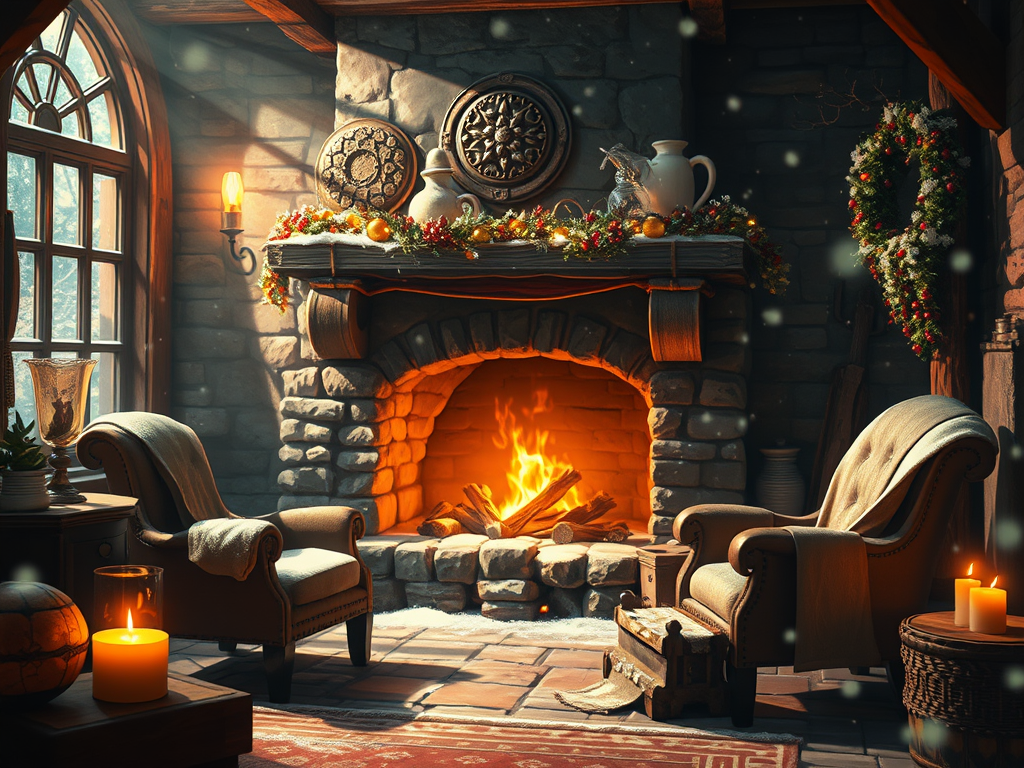
There’s a certain time, often in December, when the world feels a little too dark and a little too wet and you catch yourself gravitating toward the nearest source of warmth like one of those moths with questionable life choices.
It’s on these nights that my mind wanders back to the old hearth fires – the sort households once built their lives around. Before central heating, electric lights, or the modern miracle that is a kettle that boils in under a minute, the hearth wasn’t just a feature. It was the beating, breathing heart of a home.
Across Britain and Ireland, the hearth was treated with a peculiar mixture of respect, superstition, and mild fear. A cold hearth invited mischief from spirits, from faeries and from plain old bad luck. My old neighbour used to say that a house without a living flame was like a person without a pulse:
“might still be standing, but nothing’s really happening in there.”
Even now, I can’t help feeling she was right.
In the Midlands and up into Yorkshire, the fire was called “the mouth of the house,” and households treated it as something that needed to be fed, soothed, and occasionally persuaded not to spit sparks at the new curtains. If you spat in the fire yourself – well, you deserved whatever came next. Spitting into the flames was considered deeply insulting to whoever (or whatever) was believed to dwell in them.
The old folk didn’t always agree on the nature of that inhabitant. In some places it was a brownie, in others a house-spirit, and in the Highlands a figure akin to the Cailleach herself was said to sit invisibly by the grate, warming her spectral bones. Regardless of the name, everyone agreed on one thing:
you didn’t anger the being who kept your home warm through winter.
Nightly rituals were almost universal. Banking the fire, that soothing, rhythmic act of tucking embers under a blanket of ash, was once a formal, near-sacred routine. A charm was often whispered during the last sweep. Something soft, half-remembered, mumbled into the glow. Some were Christian, invoking Christ or Brigid. Others far older, invoking the sun, the saints, or simply “good fortune on the morrow.” In the Highlands the charm was spoken sunwise, smoothing the ash in a spiral as though winding the day closed.
My favourite bit of fire lore comes, of course, from Northumbria, where a sudden roar from the flames meant someone was either talking about you or about to knock on the door. Sparks that flew forward foretold money while sparks flying backwards warned of gossip. A loaf of bread dropped into the hearth was considered a blessing. A poker left pointing outward was a danger.
How many of these beliefs were heeded faithfully?
Hard to say.
But in plenty of old houses the pokers are still kept pointing inward, just in case.
Seasonal traditions around the hearth could be wonderfully dramatic. At Yule, the household log, sometimes as large as a small tree, was dragged ceremoniously indoors, dried through autumn, and lit on Christmas Eve. It was said to protect the family, keep evil at bay, and determine prosperity for the year ahead. A piece was always saved to light the next year’s flame. There are families in rural Britain who still keep that fragment carefully tucked away, as though it’s a fragile relic. In a way, it is.
Imbolc, the festival of Brigid, brought gentler rituals. A white cloth left overnight by the hearth was believed to receive her blessing, and the morning ashes were examined for signs she had visited.
Beltane was more boisterous, involving leaping over small fires for purification (a tradition, I should add, that modern health and safety has politely asked us to reconsider).
Samhain carried the sombre weight of remembrance: a single glowing ember from the hearth was carried around the boundary of the house to keep wandering spirits from slipping in.
The hearth was also a place of magic. Real magic – or as close as common households got.
Cunning folk worked their charms by firelight, burned herbs in the coals, and used the flames like a living oracle.
Rosemary for remembrance.
Juniper for cleansing.
Thyme for protection.
Mugwort for visions.
You can almost picture it… sparks rising, a hush in the room, the soft glow painting the walls with shadows that seem a little too alive. It’s the kind of magic that doesn’t need spellbooks or elaborate rituals. Just a handful of herbs, a quiet moment and a listening heart – that was enough.
There were everyday customs too.
A circle of hearth ash was once used to protect infants from changelings.
Ash mixed with water was fed to cattle on Beltane morning to keep witchcraft at bay.
A bride lighting the first fire in her new home was believed to secure a happy marriage – providing the flame caught quickly.
They were simple gestures, gentle ones, but meaningful.
In an age where light came only from flame, tending it must have felt like tending the soul of the household.
Even now, when most of us warm our homes with boilers or clever little radiators, there’s something deeply human about sitting beside a fire and letting your thoughts roam. A flame becomes a companion, a counsellor, a time machine, and a storyteller.
The crackle, the warmth, the way the shadows shift? it taps into something ancient in us. Some evenings you can almost hear the echo of old charms whispered by people who simply wanted a little warmth and a little luck.
Perhaps that’s why hearth lore lingers. Because it isn’t really about superstition at all. It’s about creating a small pool of light in a very big, very dark world. It’s about gathering, whether around a modern wood-burner or a candle on a drizzly night, and allowing ourselves to remember that warmth has always been the oldest kind of magic.
So tonight, if the rain is drumming on the window and you feel swallowed by the December gloom, light a candle, watch the tiny flame dance, and let it be your hearth for a moment. Whisper something into its glow.
A wish.
A name.
A thank-you.
Old traditions don’t die, they just shrink down until you notice them again.
And who knows? If the flame roars suddenly, maybe someone’s thinking of you. Or maybe – just maybe – some ancient hearth spirit is clearing its throat, reminding you to mind the fire and keep the pokers pointing inward.


Leave a Reply