We tend to think of folklore as something old . Something mossed over, half-forgotten, whispered beside hearths and hedgerows. But folklore has never stopped forming. It simply moved from the fireside to the footlights, from the village green to the gig.
Few figures have gathered modern myth around them quite like Marc Bolan. Not folklore in the medieval sense, no charms or chapbooks, or churchyard rhymes. But something just as potent… living legend, shrine-making, symbolic retelling. The kind of myth that grows when an artist blazes briefly, beautifully, and leaves the world feeling unfinished.
Bolan arrived already half-mythic. Slight, elfin, glittering, his voice hovering somewhere between a purr and a prophecy. Long before the word was fashionable, he was liminal. Not quite masculine or feminine, neither fully earthly nor entirely cosmic. He sang of wizards and druids, cars and stars, love as magic and music as spellcraft.
In older Celtic traditions, the poet is never just an entertainer. They are a threshold figure, someone who walks between worlds, translating the unseen into sound. Bards could bless or curse, heal or unsettle. They were dangerous, necessary people.
Seen through that lens, Marc Bolan becomes something very old indeed.
There is a persistent idea among fans that Marc Bolan was never meant to grow old. Not in the bleak fatalism of rock-star cliché, but in a quieter, mythic way, as if he belonged to a category of beings only loaned to the world for a time. Folklore is full of such figures – fairy lovers who fade at dawn, heroes claimed young by fate, poets who burn too brightly to endure the long years. It’s an uncomfortable thought, but a powerful one, and it explains why his death has been absorbed into story rather than history.
The facts matter less than the pattern.
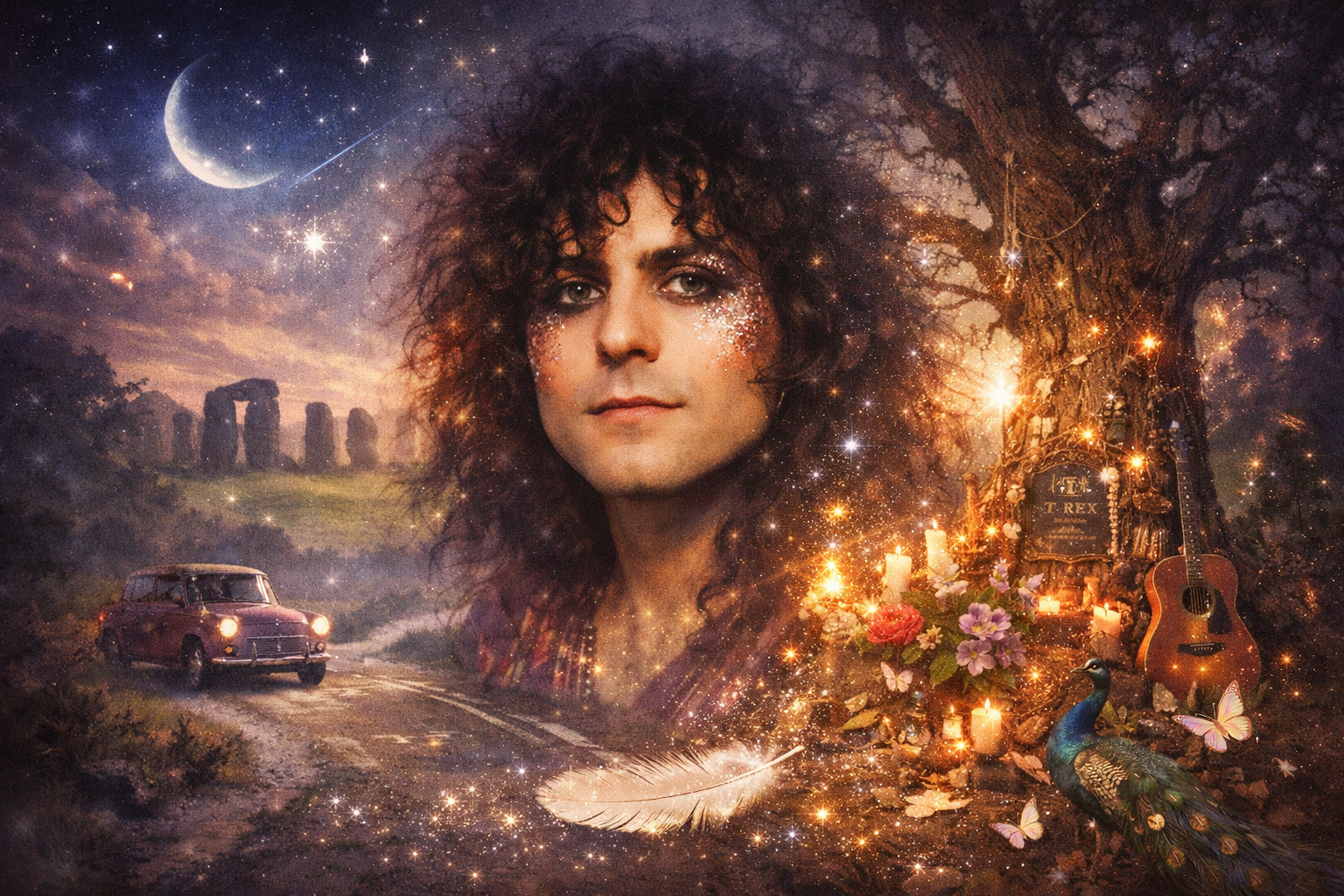
That pattern has rooted itself physically too. The tree at Barnes Common, where Bolan died in 1977, has become a shrine. A modern sacred site shaped by grief, memory, and repetition. Visitors leave flowers, feathers, glitter, coins, handwritten notes. Some people speak of a feeling warmth there. Of calm, of music remembered rather than heard.
In folklore terms, this is how places become charged. A genius loci – a spirit of place – doesn’t need centuries. It only needs emotion, attention, and return. The tree is no longer just a tree. It is a marker between worlds, a point where story pools.
Even glitter itself takes on symbolic weight in the telling. In older traditions, shining substances like dew, gold dust, mica or frost, mark the presence of the Otherworld. Bolan’s glitter becomes more than costume: it is armour, enchantment, a visible sign of magic. When it fades from the story, people read meaning into that too. Folklore always does.
Though he died at 29, Bolan is often quietly folded into the mythology of the so-called 27 Club – not because the number fits, but because the narrative does. Artists taken before their power wanes. Voices silenced while still dangerous. Songs that feel unfinished because they were never meant to finish.
Yet there is gentler folklore too. The idea that Marc Bolan didn’t vanish so much as… disperse. That he reappears whenever glam resurfaces, whenever outsiders find confidence in sparkle, softness, and strangeness. Not reincarnation, exactly. More echo. A chord still humming after the string has been struck.
Marc Bolan has become many things in the retelling: a modern bard, a glittering trickster, a spirit of place, a fallen star who never quite hit the ground.
Proof that myth doesn’t end, it just changes costume.
And somewhere, if folklore has any truth to it at all, there’s still a little stardust in the air.





Leave a Reply