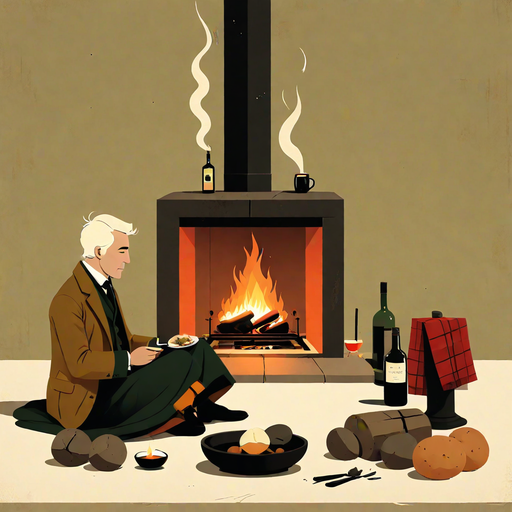
Burns Night, observed annually on January 25th, is a vibrant celebration that pays homage to Scotland’s national bard, Robert Burns. At the heart of this cherished tradition is the Burns Supper, an engaging event where enthusiasts come together to revel in Scottish culture.
The evening commences with a grand feast featuring haggis, neeps, and tatties, with the highlight being the dramatic “Address to a Haggis.” This culinary centrepiece, accompanied by traditional Scottish music and the soul-stirring verses of Burns, transforms the supper into a lively tribute to the poet’s enduring legacy.
As participants savour the rich flavours of Scottish cuisine, toasts resonate throughout the room. The “Immortal Memory” tribute reflects on Burns’ profound impact, while the “Toast to the Lassies” and its witty counterpart, the “Reply from the Lassies,” inject humour and camaraderie into the gathering.
The poetic brilliance of Burns echoes through recitations of verses like “To a Mouse” and “Tam o’ Shanter,” capturing the essence of the human experience. Beyond the confines of Scotland, Burns Night has become a global phenomenon, uniting people in a shared appreciation for literature, music, and the warm spirit of community.
As the evening culminates, hands join for the resonant strains of “Auld Lang Syne,” a poignant farewell that encapsulates the universal themes of friendship and shared heritage. Burns Night is not just a commemoration; it is a spirited affirmation of Scotland’s cultural richness, the enduring power of poetry, and a global celebration of kinship and tradition.
But, I hear you ask, “who was Burns?” and “what are neeps exactly?

Born 25th of January in the year 1796, Robert Burns grew up with his parents William and Agnes, tenant farmers in Alloway, near Ayr in Scotland. He grew up knowing little but hard manual work on farms, and mostly close to poverty. Over the years, and whilst working first with his father on the farms, and then on other farms and then for a short while in a flax shop, he had various romantic adventures with ladies he knew, and fathered around twelve children – mostly with his wife, Jean, and at least five lived beyond infancy!
After flirtations with emigrating to Jamaica to help run sugar plantations, and then the death of Jean from typhus in 1786, Robert eventually managed to get a publisher to accept some “Scotch Poems” in a collection he had written over the previous few years. This was the beginning of a period where he wrote plays, poems and song lyrics about life in Scotland as he saw it. He eventually died in 1787, aged just 37.
His legacy is various – Burns Clubs are worldwide, several museums in honour of him, including his birthplace by the National trust of Scotland, and he is favoured as a poet in such diverse countries as Russia and Canada.
So – on the 25th of January, grab some Neeps and tatties and haggis (swede potatoes and haggis), a wee dram of your favourite whisky, and give thanks for the life and poetry of the Rabbie Burns.
“Slainte Mhath!”



Leave a Reply