There is something deeply unsettling about a bog.
Perhaps it is the silence. The way sound seems to soften across the mosslands. The way the ground shifts beneath your boots as if the earth itself is breathing. Or perhaps it is because peat bogs are strange places where time does not behave properly. Ancient trees rise from the mud with bark still intact. Roman roads vanish beneath black water. Leather shoes, wooden trackways and forgotten offerings wait patiently beneath the surface for centuries. Sometimes, the bog gives up its dead.
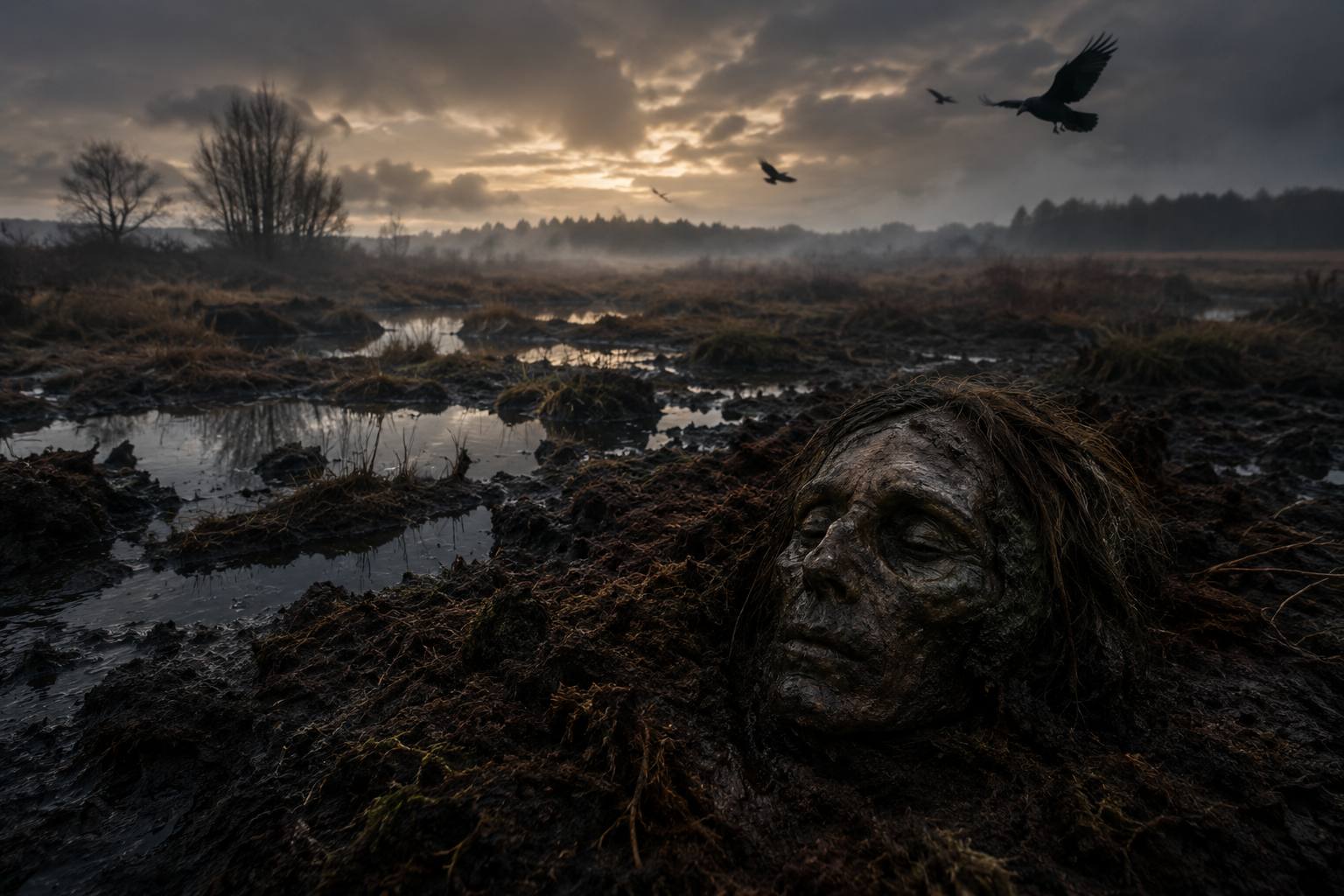
In the north west of England, the story of Worsley Man remains one of the eeriest and least discussed discoveries of its kind. Overshadowed by the more famous Lindow Man of Cheshire, Worsley Man emerged from the peat with a mystery every bit as chilling. His severed head, stained dark by the chemistry of the bog, carried with it questions that archaeologists and historians are still trying to answer today.
The remains were discovered in 1958 near Worsley Moss in Salford, Greater Manchester, when a local man walking across the peat noticed something protruding from the ground. At first glance, it looked horrifyingly modern. Flesh still clung to the skull. Hair remained preserved. Teeth sat intact within the jaw. Police were immediately called and the surrounding bogland was searched extensively in case this was the victim of a recent murder.
That reaction was not unusual. Bog bodies have fooled investigators many times before. The preservative conditions within peat bogs create an uncanny effect. The acidic, oxygen-poor environment slows decomposition dramatically. Skin darkens and toughens like leather while hair and soft tissues survive long after bones would normally decay. To those discovering them, these individuals can appear strangely recent, as though death occurred years rather than millennia ago.
For days the area around Worsley Moss buzzed with rumours. Locals whispered about gangland killings and hidden graves. Police combed through the bog searching for more remains but found nothing further. Eventually, forensic examination revealed the astonishing truth.
The head was ancient.
Today, Worsley Man is believed to date from the Iron Age or Romano-British period, likely around 2,000 years old. The skull showed evidence of violent death, with signs suggesting decapitation. The body itself has never been recovered. Whether the head was separated deliberately as part of ritual activity, execution or warfare remains uncertain.
To understand why discoveries like Worsley Man matter so much, we need to understand the strange role bogs held in ancient Britain and northern Europe. These were not empty wastelands to Iron Age communities. Bogs were liminal places. Threshold spaces between worlds. Dangerous landscapes where solid earth dissolved into water and mist. Across Britain, Ireland, Denmark, Germany and the Netherlands, archaeologists have discovered weapons, jewellery, cauldrons, animal remains and human bodies deliberately placed into wetlands.
Some appear to have been sacrifices. Others may have been executions or punishments. Some could even represent honoured burials. The truth is complicated and deeply human.
The discovery of Lindow Man in Cheshire in 1984 transformed public understanding of British bog bodies and cast new light on Worsley Man. Melanie Giles and other researchers have revisited earlier discoveries using modern forensic techniques and new archaeological approaches. [1]
Lindow Man, nicknamed “Pete Marsh” by journalists, was found with skin, hair and internal organs astonishingly intact. Analysis suggested he suffered what some researchers call a “triple death”. He had been struck on the head, garrotted and had his throat cut before being placed into the bog face down. Pollen and stomach analysis even revealed details of his final meal. Wikipedia[2]
Suddenly, Worsley Man was no longer an isolated curiosity. He became part of a wider and deeply unsettling pattern.
One of the most fascinating developments in recent years has been the shift away from seeing bog bodies simply as gruesome archaeological oddities. Researchers increasingly view them as individuals who occupied important symbolic roles within their societies. Some may have been kings, shamans, criminals, outsiders or sacrificial figures linked to fertility rites and seasonal ceremonies.
Theories surrounding ritual sacrifice remain controversial but compelling. Several bog bodies across Europe display signs of extreme violence that seem excessive for ordinary murder. Some archaeologists argue this reflects ceremonial killing intended to appease gods or sanctify land during periods of crisis. Others suggest these were judicial executions designed to remove social threats. [1]
There is also growing awareness that peatlands themselves were sacred landscapes. The boundaries between water and land were often viewed as spiritually charged in ancient belief systems. Offerings placed into bogs may have been intended for gods, ancestors or spirits dwelling beneath the earth.
Modern science continues to uncover astonishing details from bog bodies. Advances in CT scanning, isotopic analysis and ancient DNA research now allow archaeologists to investigate diet, ancestry, health and geographical movement with remarkable precision. Recent discussions surrounding bog body DNA studies suggest future analysis may reveal far more about where these individuals came from and how they lived. [3]
At the same time, ethical debates have become increasingly important. Should ancient human remains be displayed publicly in museums? Are we learning from them respectfully or turning them into spectacles?Museums across Britain have wrestled with these questions. When Lindow Man returned temporarily to Manchester Museum, curators invited spiritual leaders, artists and local communities to respond to the body and discuss what respectful display should mean. [2]
Worsley Man himself remains less visible than his Cheshire counterpart, yet his story still haunts the mosslands of Greater Manchester. There is something particularly eerie about the fact only his head was recovered. Somewhere beneath the peat, perhaps long since destroyed by industrial cutting, the rest of him may once have rested in darkness.
Peat extraction has already destroyed countless archaeological treasures across Britain. Entire landscapes have vanished beneath commercial harvesting. Archaeologists now warn that peatlands are not only environmentally vital as carbon stores but also irreplaceable archives of human history. [4]
That gives Worsley Man an added poignancy. He survived for two thousand years in the bog only to emerge into a modern world rapidly destroying the very landscape that preserved him.
And perhaps that is part of why bog bodies affect us so deeply. Unlike polished marble statues or distant kings carved into stone, these are ordinary people rendered heartbreakingly real. You can see pores in their skin. Fingernails. Hair. Expressions frozen by chemistry and chance. They look less like relics and more like someone who could wake at any moment.
The ancient dead rarely feel ancient in the bog.
They feel close.
Very close indeed.
Further Reading:
Anne Ross and Don Robins, ‘The Life and Death of a Druid Prince’
Don Brothwell, ‘The Bog Man and the Archaeology of People’
Miranda Aldhouse-Green, ‘Bog Bodies Uncovered’
Melanie Giles, research on British bog bodies and peatland archaeology through:
The University of Manchester(https://www.manchester.ac.uk)
British Museum: Lindow Man Collection Information (https://www.britishmuseum.org)
Manchester Museum (https://www.museum.manchester.ac.uk
Sources and Citations;
Manchester Evening News archive material on Worsley Man and research discussions. ([Head Topics][5])
University of Manchester interviews and peatland heritage projects involving Melanie Giles. ([staffnet.manchester.ac.uk][6])
Background information and forensic summaries regarding Lindow Man and British bog bodies. ([Wikipedia][2])
[1]: https://www.youtube.com/watch?v=3gHIZHdr8WY&utm
Bog Bodies: Secrets of Ancient Sacrifice, Preservation & Power | Prof. Melanie Giles – YouTube”
[2]: https://en.wikipedia.org/wiki/Lindow_Man
[3]: https://www.youtube.com/watch “Ancient DNA Finally Reveals Who The Bog Bodies Really Were – YouTube”
[4]: https://www.youtube.com/watch “Peatlands, Bog Bodies – the Ancient Secrets Britain Is Losing Forever – YouTube”
[5]: https://uk.headtopics.com/news/the-worsley-man-a-bog-body-reveals-a-violent-past-65694747
“The Worsley Man: A Bog Body Reveals a Violent Past | History”
[6]: https://www.staffnet.manchester.ac.uk/salc/about/news-and-events/news/display/
“Learning from the past, looking to the future: A Q&A with Melanie Giles | StaffNet | The University of Manchester”
Copyright © 2026 Mysterious Times / Kirst Mason D’Raven. All rights reserved. This article and images may not be reproduced, distributed or transmitted in any form without prior written permission, except for brief quotations used in reviews, research or educational purposes with appropriate credit.