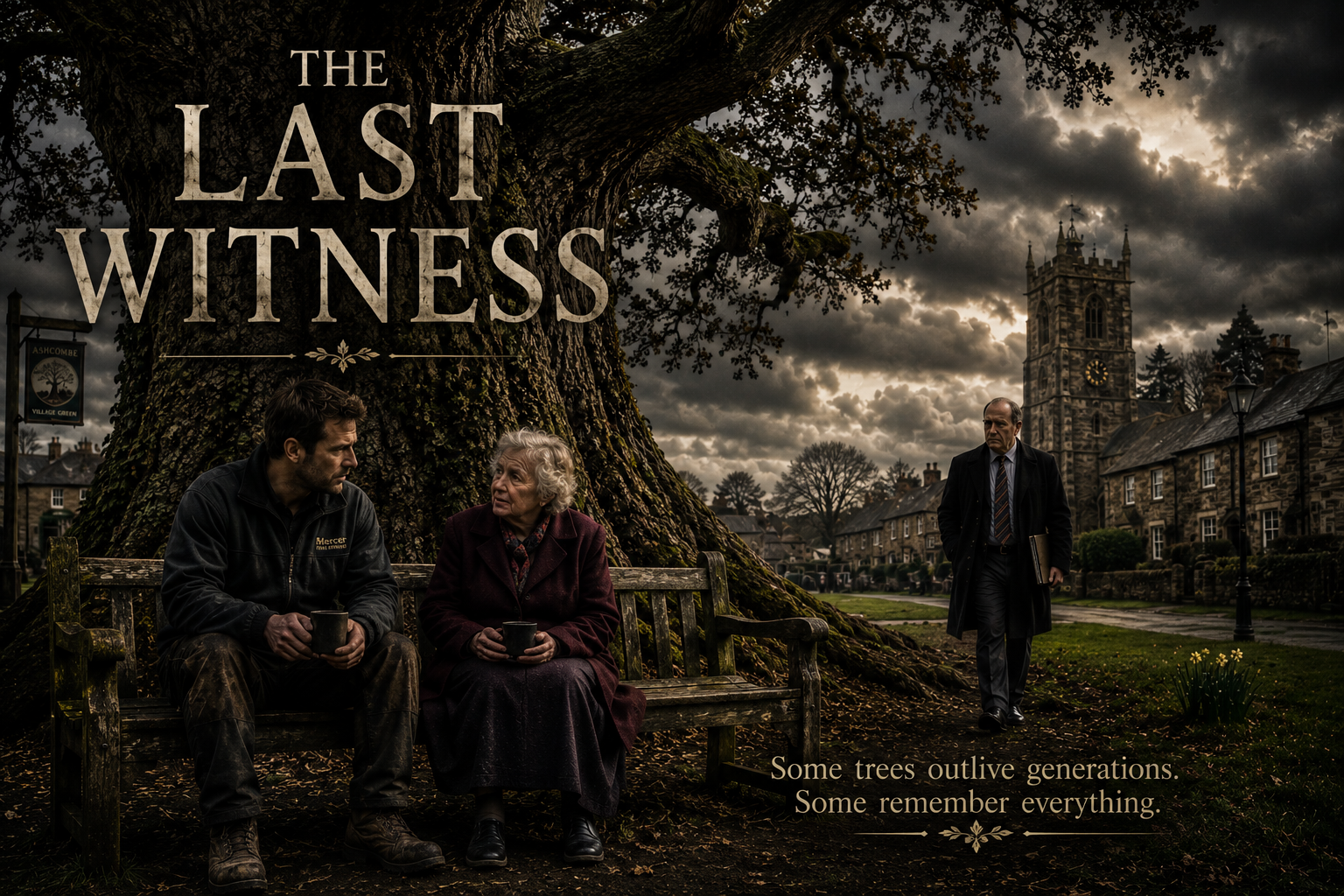
Nobody in the village knew how old the oak was.
People had opinions, naturally -whole villages were built on opinions.
According to Mr Pritchard at the post office, it had been planted after the Civil War, but Jean Bailey said that was rubbish because her grandfather had told her Roman soldiers used to tether their horses beneath it. Old Mrs Fletcher maintained it was already there when the church was built, though she could never remember who had told her.
“It’ll be in parish records,” somebody would say. But it wasn’t. The records mentioned births, marriages, burials, repairs to the church roof and a disagreement over three escaped pigs in 1811, but they said nothing about the oak.
It stood in the middle of the green, wider than the bus shelter and nearly as tall as the church tower. Its lower branches had been climbed smooth by generations of children. A rusted hook remained embedded in one side from the years when the village butcher had tethered his delivery horse there. There were initials carved into the bark, most too weathered to read, though everyone knew where to find the heart containing ‘T.F. + M.B. 1944’.
In spring, daffodils came up around its roots. In summer, the cricket team used its shade for tea. At Christmas, the council wound lights through the lower branches, although every year somebody complained that the extension cable was dangerous.
The tree did not belong to anyone. But that meant everybody believed it belonged to them.
The letter arrived at the parish office on a Tuesday morning. The clerk read it twice, then carried it through to Councillor Baines, who was eating a custard cream over a folder marked ‘HIGHWAYS: OUTSTANDING MATTERS’.
The report was seven pages long. Most of it concerned fungal brackets, crown loss and structural weakness. The important part was at the end.
“The tree presents an unacceptable risk to public safety. Removal is recommended at the earliest opportunity…”
Baines finished his biscuit.
“Well,” he said.
“That’s that, then.”
By teatime, a photograph of the report was on the Ashcombe Community Facebook page.
By seven, there were eighty-three comments.
Somebody blamed the council. Someone else blamed developers. One woman who had moved to the village six months earlier said the tree should be replaced with several smaller ornamental trees, which caused such outrage that she deleted the comment.
At half past eight, Mr Pritchard announced that his father had proposed to his mother beneath the oak. At nine, Jean Bailey replied that everybody’s father had proposed to everybody’s mother beneath that tree, if local memory was to be trusted.
At ten, Councillor Baines turned off his phone.
Daniel Mercer heard about the job on Wednesday.
He was in the kitchen scraping burnt toast into the bin when his wife came in wearing her dressing gown.
“You’ve done it again.” she coughed, theatrically.
“It popped up.” Daniel replied defensively through a mouthful of charcoal.
“But it’s black…”
“It’s not that bad.” Daniel cut in.
Claire lifted the toast between two fingers.“You could mend roads with that.”
Daniel dropped two fresh slices into the toaster. His phone buzzed on the table. He glanced at it.
“Council job.”
“Which council?”
“Westborough. Big oak on a village green.”
Claire poured coffee.“Not that one in Ashcombe?”
“You know it?”
“Everybody knows it.”
“I don’t.”
“You do. We drove past it when we went to that wedding.”
“We’ve been to a lot of weddings.”
“The one where your suit split.”
“It didn’t split.”
“It absolutely did.”
“It was the stitching.”
“It was your trousers.”
He looked back at the message. The council wanted an inspection, traffic management and a quote for complete removal.
“Shame,” Claire said.
“It might be dangerous.”
“I know.”
“You can’t leave a dangerous tree in the middle of a village because people like looking at it.”
“I know.” The toast popped up.
Claire sat down.“Still a shame.”
Daniel had been cutting trees for twenty-two years. He liked them. People assumed tree surgeons must dislike trees, in the same way they assumed undertakers disliked people. The truth was more complicated. He liked healthy trees best. Straight trunks. Balanced crowns. Clean growth. Trees that stood where there was room for them to stand. He had less affection for leylandii planted six inches from a neighbour’s fence, dead sycamores leaning over primary schools, or poplars shedding limbs above parked cars.
He had seen what falling timber could do. Once, outside Chesterfield, a branch no thicker than a man’s thigh had gone through the roof of a conservatory. The family had been away. Daniel still remembered the child’s high chair beneath the broken glass. So when people accused him of destroying nature, he let them finish.Then he got on with his job.
Ashcombe was forty minutes away. He stopped at a lay-by outside Westborough and bought a bacon sandwich from a van run by a woman called Shaz, who had been calling him “love” for twelve years without knowing his surname.
“Busy?” she asked.
“Always.”
“Where today?”
“Ashcombe.”
She paused with the ketchup bottle in her hand.
“Not that old tree?”
“Looks like.”
“My nan used to live there.”
“Did she?”
“Used to take us to village fête. They had a donkey. Miserable thing. Bit my cousin.”
“Tree ever bite anyone?”
“Not that I heard.” She handed him the sandwich.“Be a shame, though.”
Daniel sighed.“So I keep hearing.”
The oak was bigger than he remembered.
He parked his truck beside the village hall and sat for a moment with the engine running.The report had not exaggerated. The canopy had thinned badly on the western side. Several limbs showed signs of old failure. Fungal growth marked the base, and a long seam ran up the trunk where two sections had begun to pull apart.
It was not dead. That almost made it worse. A dead tree was simple. A living tree could continue for years while becoming steadily less predictable. He switched off the engine and reached for his helmet.
An old woman was sitting on the bench beneath the tree. A shopping bag rested beside her. She watched him unpack his equipment.
“You’re here for the oak.”
It was not a question.
“Just having a look today.”
“They’ve already looked.”
“I’m having another.”
“And then you’ll cut it down.”
“If it needs cutting down.”
She gave him a look which suggested she had met men who said such things before.
Daniel walked slowly around the tree, tapping sections of the bark with his mallet. Across the village green, three boys came out of a shop carrying sports bags and ice lollies, and made their way noisily over the grass. One of the boys slapped the tree trunk as they passed.
“Hello Arthur!” said the boy. The others laughed.
Daniel looked at he old lady on the bench.
“Arthur?” He asked.
“That’s what they call it” she answered.
“Why?”
“No idea”
The boy turned around “Because that’s his name!” he shouted back.
“Why? Who told you that?”
“Dunno…” he shrugged. “Everyone knows it”
They ran off towards the recreation ground, laughing.
Daniel knelt down beside the old tree and began to examine the exposed roots.
“You’ll be Daniel Mercer then?” she asked. He looked round.
“How did you know that?”
“Your names on your van.”
“Oh, right.”
“I’m Edna Fletcher.”
He stood and wiped his gloved hands on his trousers.
“Nice to meet you”
“No it isn’t. You’ve come to murder our tree.”
“I’ve come to stop it murdering someone else.”
She considered that.
“Fair enough.”
Daniel almost smiled.
She moved her shopping bag and patted the bench . Daniel remained standing.
“You married?” she asked.
“Yes.”
“Children?”
“Daughter.”
“Grandchildren?”
“Not yet.”
“You’ll understand when you get some.”
“Understand what?”
“Why old things matter.”
He looked up into the branches.
“I understand why they matter.”
“Do you?”
“Yes.”
“Still going to cut it down?”
“Depends on what I find.”
Mrs Fletcher looked towards the church.
“My husbands ashes are under that tree.”
Daniel followed her gaze towards the base of the tree.
“I’m sorry.”
“He’s not the only one.”
“What do you mean?”
She waved her hand.
“Bits of people. Ashes. Wedding rings. Things people couldn’t bear to be rid of.”
“Your saying people buried things under this tree?”
“Not buried..” She nodded towards the trunk.
“Gave them to it.”
Daniel glanced at the hollow opening on the Northern side. It had narrowed over time, the bark had folded around it like scar tissue. Someone had fitted wire mesh over the gap years ago, presumably to stop children crawling inside.
“What sort of things?”
Mrs Fletcher looked annoyed.
“I’ve just told you!!”
“When?”
“Over the years.”
“Who did?”
“People!”
“That’s not very specific.”
“It wasn’t meant to be.”
A van pulled up behind Daniels truck. Councillor Baines got out, his highly polished shoes sinking into the soft earth.
“Mr Mercer.”
“Morning.”
Baines nodded towards Mrs Fletcher. “Edna.”
“Murderer.”
“Let’s not start.”
“You started when you ordered that report.”
“I ordered a safety inspection.”
“And now you’ve brought him.”
Daniel raised a hand. “I’m right here…”
Baines lowered his voice. “Best not to encourage her.”
“I can hear you,” Mrs Fletcher said.
Daniel spent another two hours inspecting the tree. By the end he knew the report was right. The oak might stand through another winter. It might stand through ten. Or it might shed one of it’s main limbs during the next strong wind and kill whoever happened to be standing underneath it.
Of course, there were ways to reduce the risk. Remove the heaviest limbs. Brace the split. Fence off a wider area. But it would cost more money and delay the inevitable. Councils disliked both.
Baines waited beside the truck as Daniel removed his helmet.
“Well?”
“Well..” replied Daniel. “It’s in poor condition..”
“Dangerous?”
“Yes.”
“So it comes down.”
Daniel looked back towards the tree. Mrs Fletcher was still on the bench, pretending not to listen.
“I’ll send options.”
“We need a quote for removal.”
“You’ll get one.”
“And a date?”
“You’ll get that too.”
He drove home through steady rain.
That night, Daniel dreamt about the tree. He knew it was the same tree though it was little more than a sapling. A man sat beneath it pulling off worn leather sandals. He wore a red tunic underneath a battered cloak. There was dried mud on his calves and blood on one knee – Daniel couldn’t tell if the blood was his or not.
The man took a small bronze coin from a pouch and turned it in his fingers, studying the face. Then he pressed the coin into the soft earth beside the tree.
“For luck.” He said.
Daniel woke at 4:09am. Rain ticked against the bedroom window. Claire snored slightly beside him. He went downstairs, drank water and stood at the open kitchen doorway, looking out into the garden. He told himself the dream meant nothing. He had spent the day looking at an ancient tree and his mind had supplied an ancient man. By morning, he had almost forgotten it.
The council accepted Daniels the cheapest option. Complete removal. Baines called the following Friday.
“How soon?”
“Two weeks.”
“Can you do sooner?”
“I’ve got other work.”
“The weather’s turning.”
“The weather always turns.”
“There’s a meeting on Monday. People are getting worked up.”
“People always do.”
“We’d prefer it dealt with.”
Daniel looked at the Ashcombe report on his desk.
“I’ll see what I can do.”
The following Tuesday, Daniel returned to Ashcombe with two men from his crew.
Kev was fifty-four, broad across the shoulders and the resigned air of a man who is permanently unimpressed. Milo was half the age of Kev, with long hair and a recently sprouted moustache that Daniel had not summoned the courage to mention yet.
They unloaded barriers, ropes and signs. A small crowd had aleady begun to gather.
“Good turnout.” Kev said
“Village tree.”
“Could sell tickets.” Kev laughed at his own joke, nudging Milo.
“Don’t..” hissed Daniel.
They fenced off the green. Mrs Fletcher stood outside the barrier wearing a red wool coat.
“You came back then?”
“I told you I would.”
“I hoped you were lying.”
“Sorry.”
“No you’re not.”
He looked at her.
“No. Not really.”
The first stage was crown reduction. Remove weight from the outer branches before dismantling the main limbs. Milo took up position in the tree. The chainsaw started. The crowd flinched at the sound. Daniel had seen that reaction before. A chainsaw in a forest sounded like work. A chainsaw next to a familiar tree sounded like violence. The first branch came down cleanly onto the rigging rope and Kev lowered it gently to the ground. A woman in the crowd began crying. The three men by the tree pretended not to notice.
By lunchtime, the oak looked wrong. Not smaller exactly. More… Exposed.
The weather began to worsen. Wind pushed across the green pushing fine drizzle. Daniel called a halt.
“We’ll finish tomorrow.”
Councillor Baine appeared from the village hall.
“You said today!”
“I said we’d start today.”
“But it needs doing!”
“And it will be done. Just not today!”
“Can’t you just… carry on?” Baines flapped his hands towards Daniel as if shooing away an annoying child. Daniel fixed the councillor with a calm stare.
“You can. I’m going home.”
That night, Daniel dreamed of a small girl crouched inside the hollow trunk. The tree was bigger this time, though still young enough for it’s trunk to be circled by two arms. Beyond the green, a bell rang slowly.
The girl held a tiny bird carved from pale wood. A cart rolled along the road, something lay in the back covered with old sacks. The girl didn’t look at it. She pushed the wooden bird deep into a split in the wood.
“Don’t let it take Mam.” she whispered. Daniel could smell smoke.
He woke coughing, but there was no smoke. He sat on the edge of the bed until Claire stirred.
“You alright?”
“Bad dream.”
“Tree?” Daniel looked round at her, sharply.
“How did you know?”
“You were talking.”
“What did I say?”
“Something about a bird.”
He lay back down.
“Work nonsense..”
Claire put her hand on his arm.
“You don’t usually dream about work.”
“I usually cut smaller trees.”
The next morning, a dead blackbird lay beneath the oak. Milo found it while he was moving the barriers.
“Bad omen.” He said.
“It’ll have hit a window.” Kev said.
“There are no windows.”
“Then it didn’t hit a window.”
Daniel picked up the dead bird with a glove and gently placed it beneath the hedgerow. They worked slower.
By mid afternoon, most of the branches were down. The main trunk remained, rising thick and hollow a full twelve feet before splitting into jagged stumps. The crowd had thinned but Mrs Fletcher had not left.
Daniel marked the first cut across the trunk of the tree. The saw bit through the outer wood. It sounded different as it reached the hollow. He stopped the chainsaw.
“What?” called Kev as Daniel pulled the saw free. Something metallic dropped into the sawdust and mud at his feet. Milo stooped to look.
“Coin.” He picked it up and rubbed it against his sleeve. It was green with age. Daniel held out his hand. The coin was small and uneven with the worn outline of a face on one side. For a moment he was back in the dream, watching the mans muddy fingers pressing it into the earth.
“Where did that come from?” asked Milo. Kev peered into the cut.
“Inside..” Kev paused.
“There’s more..”
Daniel went to retrieve a torch from the truck. He shone it into the old tree. The beam of light caught on metal, glass and pale scraps of paper.
They widened the opening by hand. The first thing that Daniel reached was a tiny bird. One wing had broken away and it was blackened with age but the shape was unmistakeable. He didn’t speak.
“What is it?” asked Milo, leaning over his shoulder. Daniel placed the bird beside the coin.
Mrs Fletcher pushed through the barrier.
“Edna, you can’t -” Shouted Baines.
“Oh, do shut up.” Mrs Fletcher came straight towards the three men standing by the trunk. Daniel should have asked her stay back. But he didn’t. Instead, they began to remove the objects from the trunk.
A clay marble. A buckle. Three wedding rings, tied together with faded red thread. A brass military button, blackened with age. A child’s leather shoe, stiff and cracked. A photograph of a young man in uniform. A glass bottle containing a curl of hair. A bundle of letters tied with a blue ribbon, the paper reduced to soft, brown layers. A silver thimble. A tin whistle. A wooden horse with only three legs. A pair of wire-rimmed spectacles. A length of old lace, tinted sepia by the tree. A railway ticket. A tiny china dog. Each object had been pushed into the hollow or lowered through openings in the trunk. Some were centuries old but others were recent enough to be recognised by the people in the crowd.
Jean Bailey came first, picking up the china dog and saying
“That was my mother’s…”
– Nobody asked how she knew. She held it against her chest. Then Mr Pritchard found a rusted cigarette case engraved with the initials ‘A.P.’.
“My uncle Arthur..” he said. “Killed at Anzio..”
Councillor Baines appeared to at a loss for both words and facial expression.
“What’s all this?”
Mrs Fletcher sat on a section of felled branch and sighed.
“Things people wanted kept”.
“You knew about this?” Baines’ face was approaching the colour of the port he secretly kept a bottle of in his office desk drawer, next to his ‘spare’ receipt book.
“Why didn’t you say?”
“I did.”
Daniel looked at her. She met his eyes. He thought of the dream, the girl, the bell. The wooden bird.
“This one,” he said. “Do you know this one?”
Mrs Fletcher took the bird, her hand trembling slightly.
“No.” Then after a moment, she added, “But my grandmother used to talk about one like this.”
“What did she say?”
“That it belonged to a child during the plague…”
Councillor Bains interrupted her with a sharp exhalation.
“Oh, come on…!!”
Mrs Fletcher rounded on him.
“You asked!”
“I’m asking what these… things are doing inside a tree, not inviting fairy tales!”
“They’re not fairy tales….”
“A Roman coin? A plague charm? You expect us to believe -“
Daniel handed him the coin.
“Get it looked at.”
Baines glanced down.
“But it proves nothing -” He began,
“No” interrupted Daniel. “But it’s a start.”
Work, it appeared, had finished for the day.
The village hall had become an impromptu store room. Tables were covered with clean sheets, and each object was placed carefully in rows. Somebody made tea. Somebody else brought sandwiches. The school sent over cardboard boxes and tissue paper.
By evening, the hall was full. People came to look. Some recognised things. Most didn’t.
A woman in her seventies found a silver bracelet she had hidden in the tree after her sister died at sixteen. A man discovered his father’s campaign medal, which the family had assumed lost.
Mrs Fletcher picked up the wooden horse.
“My husband made one like this when he was a boy.”
“Is it his?” Daniel asked.
She shook her head.
“Too old.”
She turned it in her palm.
“People used to say the tree kept what you couldn’t carry.”
“What does that mean?”
“Exactly what it says.”
Daniel sat opposite her. Outside, rain streaked the windows. Beyond the glass, the stripped trunk stood against the dark.
“So, did you really put your husband’s ashes in it?”
“Some of them.”
“Why?”
“House felt too quiet with them on mantelpiece.”
“You could’ve scattered them.”
“I did.”
“In the tree?”
“Aye.”
He looked towards the window.
“You should have told the council.”
“And have them put up a plaque? Charge people fifty pence to look?”
Daniel smiled. Mrs Fletcher held the horse closer.
“What happens now?”
“That’s not my decision.”
“You’re the one with the chainsaw.”
“That doesn’t make me important.”
“Today it does.”
The council held an emergency meeting the following evening. The village hall was packed. People stood along the walls and in the doorway. A heritage officer spoke about conservation. A museum representative spoke about cataloguing. Councillor Baines spoke for too long. The tree could not safely remain as it was. Everyone agreed on that much. The question was whether the trunk should be removed, preserved, enclosed or allowed to collapse naturally. Daniel sat at the back, Claire beside him, clutching his hand.
“You didn’t mention there’d be this many people,” she whispered.
“I didn’t know.”
Mrs Fletcher stood when public questions began.
“You’ve all talked about what’s safe,” she said. “Fair enough. Nobody wants a child crushed. But you’re talking like the tree’s a problem to solve.”
Baines shifted in his chair.
“What do you suggest, Edna?”
“Give it time.”
“The arborist has already explained—”
“I heard him.”
She looked back at Daniel.
“Can it stand if people are kept away?”
“For a while,” he said. “With bracing. Regular inspections. Wider fencing.”
“How long?”
“Could be months. Could be years.”
“And if it falls?”
“We make sure there’s nobody near it.”
Mrs Fletcher faced the council.
“There you are.”
The heritage officer adjusted her glasses.
“A controlled retention might allow further archaeological investigation of the hollow.”
Mrs Fletcher frowned.
“You mean digging through everybody’s things.”
“We would document them properly.”
“They’ve managed without documentation.”
Claire nudged Daniel.
“I like her.”
“So does everybody except the council.”
The vote passed by one. The trunk would remain. A permanent fence was erected around it. The removed branches were milled into benches for the green. The objects went on display in the village hall for three months, then were divided between families, the local museum and a locked archive cabinet. The wooden bird stayed with Mrs Fletcher.
Daniel returned twice a year to inspect the oak. Each time, she met him on the green.
“You’re late,” she would say.
“I’m early.”
“Not by my clock.”
She brought tea in a flask and sandwiches wrapped in foil. They sat on one of the oak benches while he explained cracks, moisture and decay. She ignored most of it. Once, she asked whether trees could feel pain.
“Not like us.”
“How do you know?”
“I don’t.”
“That’s better.”
The dreams stopped after the cutting. Almost. Once, Daniel saw a young man in uniform standing beneath the tree while a woman tucked his photograph into the hollow. Another time, children danced around the trunk while church bells rang and somebody played an accordion badly. He no longer woke frightened.
He began writing the dreams down. He did not tell Claire. She found the notebook anyway.
“Are these stories?”
“No.”
“What are they?”
“Dreams.”
“They’re good.”
“They’re not for reading.”
“I’ve read them now.”
“You’ve got no respect for privacy.”
“You leave things beside the kettle.”
Three winters passed. The oak survived two storms, a summer drought and a lightning strike in a field half a mile away. Then, on a still January night, it fell. There was no wind. No rain.
At six the next morning, Mr Pritchard found it lying across the fenced ground, its great hollow trunk split open to the sky. He rang Mrs Fletcher first. Then Daniel.
By eight, half the village had gathered. Nobody said much. The church opened its doors and made tea. Children climbed onto the lower sections until their parents told them to get down, then climbed back when nobody was watching.
Daniel walked the length of the fallen trunk. Inside the deepest part of the hollow, beneath layers of rotted wood, he found one last object. A modern school photograph in a plastic sleeve. Six children stood in two rows beside the oak. On the back, written in blue biro, were the words:
“So it remembers us too.“
Daniel recognised the handwriting. Mrs Fletcher was standing nearby.
“You put this in.”
“No.”
“It’s recent.”
“Recent to a tree.”
“Edna.”
She smiled. “Does it matter?”
He looked at the children in the photograph. Some were now adults with children of their own.
“No,” he said. “I suppose it doesn’t.”
The village planted another oak in spring. Not on the same spot. A little way to the east, where it would have room to grow. The youngest child at the school lowered it into the earth. Mrs Fletcher threw in the first handful of soil. Daniel added the second. There were speeches, though nobody remembered them afterwards. The benches remained. The daffodils returned. Life carried on.
Years later, Daniel visited Ashcombe with his granddaughter. The new oak was taller than he was by then, though its trunk was still thin enough for the child to circle with both arms.
“Was this the old one?” she asked.
“No. The old one was over there.”
“What happened to it?”
“Got tired.”
“Trees don’t get tired.”
“This one did.”
She considered that. Then she took something from her coat pocket. A small red marble.
“Where did you get that?”
“Found it.”
“Where?”
She shrugged and pushed it into the earth between the oak’s roots.
“What are you doing?”
“So it knows me.”
Daniel looked across the green. Mrs Fletcher’s bench was empty now. The church clock struck four. A bus stopped beside the post office. Two boys ran across the grass, one carrying a stick like a sword. His granddaughter took Daniel’s hand.
“Come on, Grandad.”
He let her pull him away. Behind them, the young oak shifted gently in the afternoon wind. Not speaking. Not watching. Just standing where it had been planted, with a red marble hidden among its roots and years enough ahead of it to become whatever the village needed.
A landmark.
A shelter.
A story.
Perhaps, one day, a witness.