Let’s go for a wander…
There are places that quietly insist you slow down – not because they’re grand or famous, but because they carry themselves with the quiet confidence that only comes from surviving for more than a thousand years.
Simon and I visited Heysham on a warm afternoon in April 2024. The sort of day that persuades you spring has actually won at last. The sea shimmered beneath a bright blue sky, gorse blazed yellow across the cliffs and the cries of gulls drifted endlessly over Morecambe Bay.
It should have felt cheerful. Instead, it felt… ancient.
There’s something about Heysham that’s difficult to explain until you’ve stood there yourself. It isn’t eerie, not exactly. Nor is it frightening. It’s simply a place where history refuses to stay neatly in the past. You don’t just look at it. You feel it.
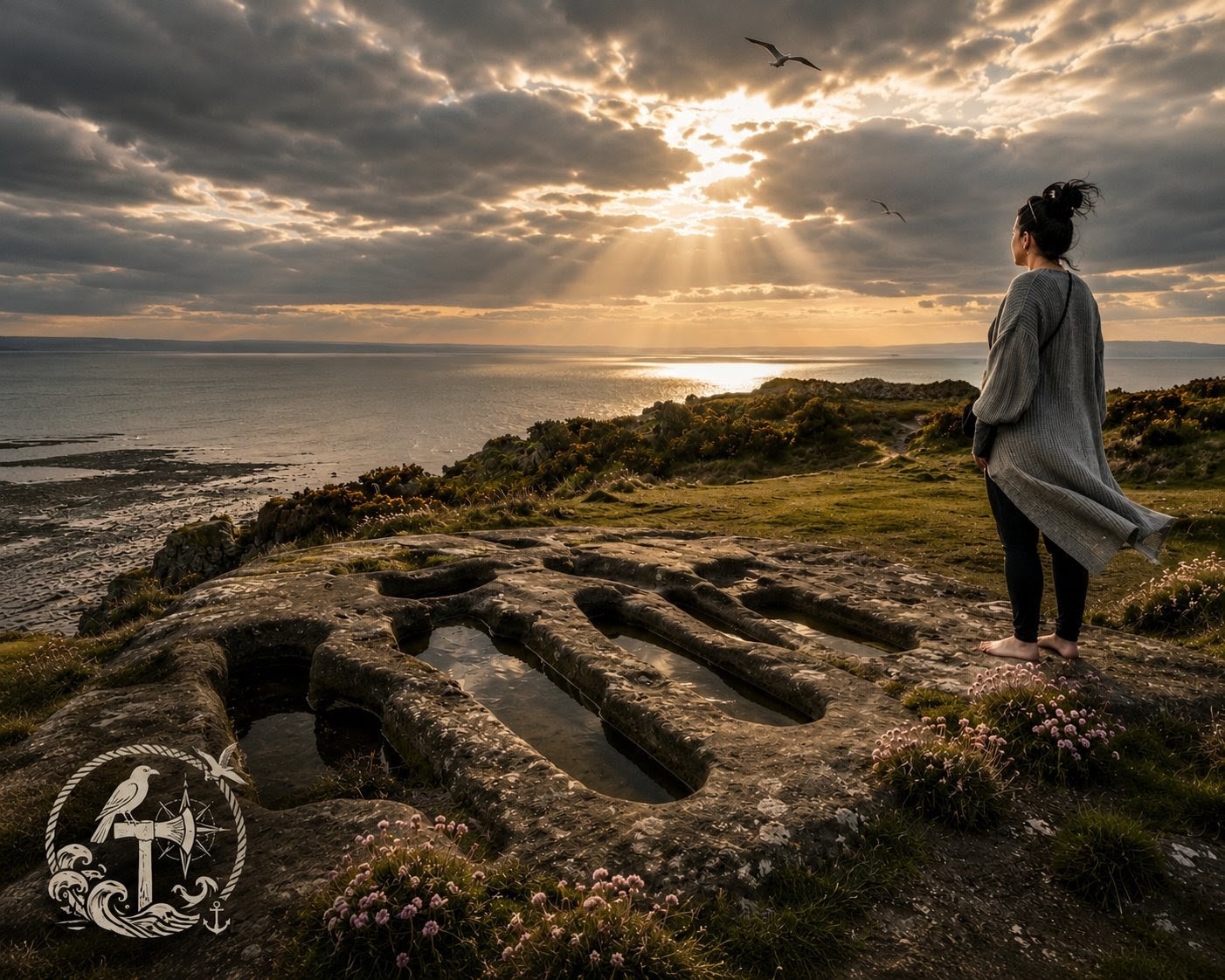
The reason most people make the climb to the headland is obvious enough. Just a few yards from the cliff edge, carved directly into the living sandstone, lie eight extraordinary graves unlike almost any others in Britain. They haven’t been built from stone.They ARE the stone. For more than a thousand years they’ve watched the tides roll in and out across Morecambe Bay, silent witnesses to Viking ships, medieval pilgrims, fishermen, storms, wars and generations of curious visitors wondering exactly the same thing – Who layed here?
The simple answer is that nobody knows.
The longer answer is considerably more interesting.
Archaeologists generally believe the graves date from somewhere between the eighth and eleventh centuries, making them part of an early Christian cemetery associated with St Patrick’s Chapel. They were painstakingly carved into the sandstone using iron tools, each one shaped to receive a body before being covered with stone slabs. Some even include small sockets that may once have held wooden or stone crosses marking the dead – I mean – imagine the effort involved?
Today we’d hire machinery to cut into solid rock. Whoever created these graves did so by hand, strike after strike, day after day, on a windswept cliff overlooking the sea. People don’t expend that sort of effort without good reason.
What makes the mystery even deeper is that the graves themselves have given up very few clues. The burials are long gone. No grave goods survive to identify those laid to rest here. No inscriptions tell us their names. No records explain why these particular individuals deserved such remarkable tombs.
For generations historians have suggested they may have belonged to monks, priests, local rulers or particularly important members of the early Christian community. Others have wondered whether saints or missionaries found their final resting place here. All remain possibilities. None can yet be proven.
One curious detail has fascinated archaeologists for years. Some of the graves appear surprisingly small. Too small, perhaps, for a fully grown adult. Various explanations have been offered. Were they intended for children? Did they hold only selected bones after earlier burial elsewhere? Could they have contained relics belonging to holy figures rather than complete bodies? Like so much at Heysham, every possible answer seems to create another question.
Standing beside them, however, those academic debates begin to feel strangely distant. The graves are remarkably tactile. The sandstone has softened beneath centuries of wind and rain. Rainwater gathers in the hollows after showers. Lichen spreads across their edges. Grass pushes through tiny cracks in the rock as though nature itself has slowly begun reclaiming them.
Then there’s the view…
Even if the archaeology were absent, you’d probably stop to admire it. The headland commands magnificent views across Morecambe Bay towards the Lakeland fells, with the sea stretching away almost to the horizon. On the day we visited, the water glittered beneath the spring sunshine while the gulls wheeled lazily overhead. It struck me that whoever chose this place for burial must surely have appreciated the view too.
After spending time among the graves we wandered over to St Patrick’s Church and again, the atmosphere changed completely. Outside, everything was alive with light and sound. The sun was surprisingly warm, the sea breeze carried the smell of salt from the bay and the gulls never stopped calling to one another above the cliffs. Inside, another world waited. The church was cool and still, the thick stone walls holding back both the heat and the noise. Beautiful floral displays filled the building with the unmistakable scent of fresh roses. After the brightness outside, it felt almost like stepping into a place suspended outside time altogether. There was nothing gloomy about it. Just peace.
It reminded me that churches were never intended simply as historical monuments. They remain living places, shaped not only by centuries of history but by the quiet care of the people who continue to look after them.
Afterwards we spent some time wandering through the churchyard itself. Like many ancient burial grounds, it rewards anyone prepared to slow down. Weathered names, worn inscriptions and gravestones leaning gently with age tell stories every bit as fascinating as the famous rock-cut graves nearby. Every churchyard becomes a history book if you’re willing to read it carefully enough.
Of course, Heysham has gathered its fair share of modern stories too. Heavy metal fans may recognise the rock-cut graves from the cover of a Black Sabbath album which seems oddly appropriate. There is something undeniably dramatic about these ancient tombs perched above the sea. They’re beautiful rather than sinister, mysterious rather than frightening, but they possess an atmosphere that artists and photographers have found irresistible for decades.
Yet despite appearing on album covers, postcards and countless social media feeds, the graves have never surrendered their greatest secret.
Who were the people buried here?
Perhaps they were local nobles. Perhaps monks. Perhaps pilgrims fortunate enough to earn a place beside the chapel. Or perhaps they were just ordinary people whose names have disappeared while the place itself endured.
Sometimes archaeology reminds us just how little survives. A thousand years can erase names, faces and entire lives while leaving behind a handful of carved stones and a thousand unanswered questions.
As Simon and I made our way back down from the headland, I found myself looking back one last time. The graves remained exactly as they’d been when we arrived, quietly overlooking the sea, utterly unconcerned by our curiosity. The gulls were still crying overhead. The tide continued its slow journey across the bay. The spring sunshine still bathed the cliffs in gold. And the people resting beneath – or perhaps once resting beneath – that weathered sandstone continued to keep their silence.
Heysham stays with you. Not because it frightens you or because it claims to hold supernatural secrets. Because it reminds you that history isn’t always found in castles or great cathedrals. Sometimes it’s carved into a windswept cliff overlooking the sea, where the names have long been forgotten, but the questions remain.
I visited Heysham to try to solve a mystery. Instead, I discovered that not all mysteries need solving.
Sometimes it’s enough simply to stand for a while, listen to the waves, and remember that we are only the latest visitors to a place that has been telling its story for over a thousand years.
Sources
Potter, T. W. & Andrews, R. D. Excavation and Survey at St Patrick’s Chapel and St Peter’s Church, Heysham, Lancashire, 1977–78.
Williams, Howard. Research into the early medieval cemetery at Heysham.
Historic England – St Patrick’s Chapel and Rock-Cut Graves, Heysham.
National Trust – Information on St Patrick’s Chapel and the rock-cut graves.
Black Sabbath – album artwork inspired by the Heysham rock-cut graves.