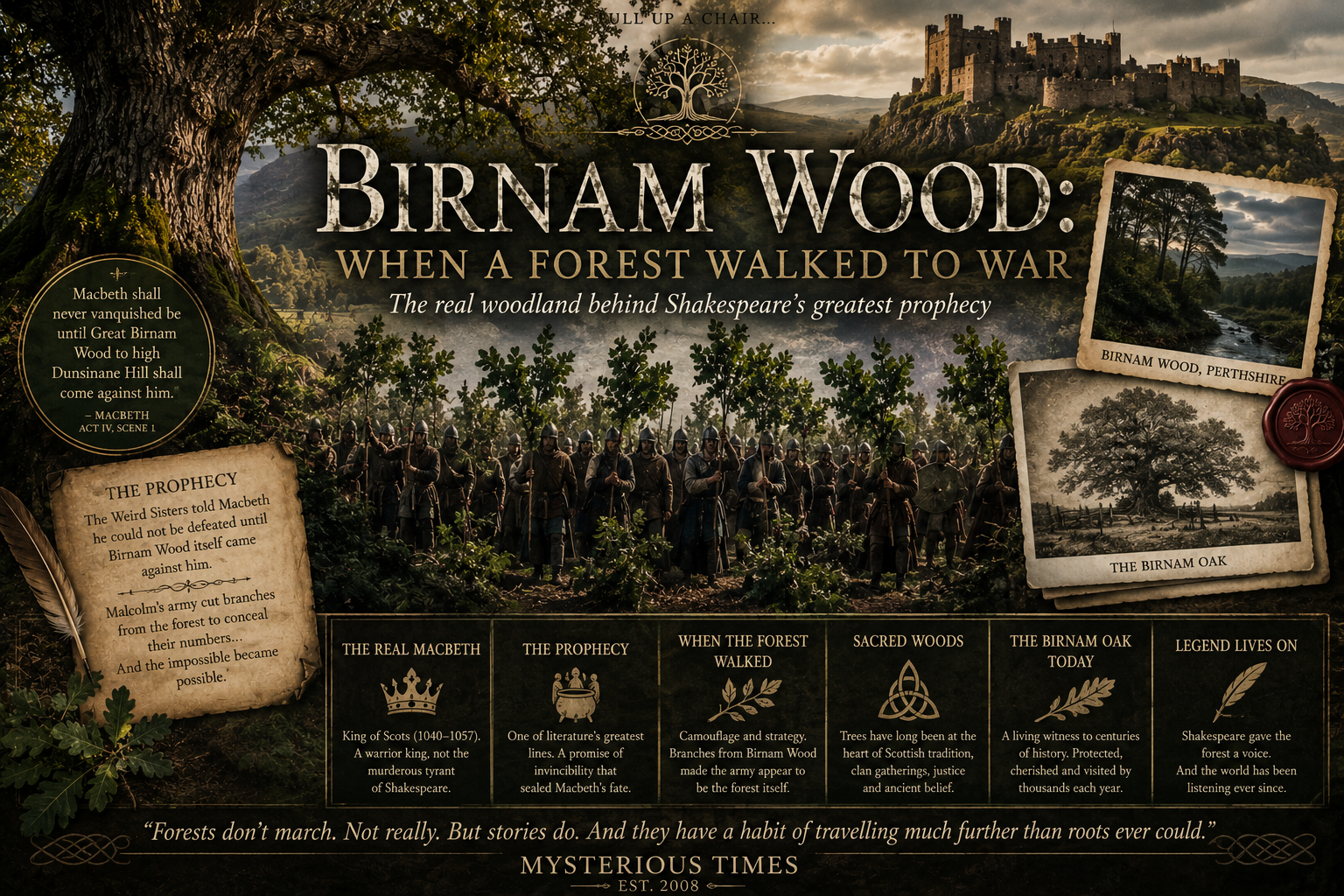
Forests don’t march. Trees don’t wage war. Woodland stays exactly where nature planted it, quietly marking the passing of centuries while kingdoms rise and fall around it. And yet, according to one of Britain’s greatest stories, an entire forest once advanced across the Scottish countryside to bring about the downfall of a king.
It sounds like fantasy. Like something whispered around a campfire on a dark autumn evening. Except…
There really is a Birnam Wood.
There really is a Dunsinane Hill.
There really was a King Macbeth.
And while Shakespeare embroidered history with the flourish only he could manage, the roots of his greatest prophecy stretch deep into the soil of Perthshire.
Like so many of Britain’s greatest legends, the truth is every bit as fascinating as the myth.
Drive north through Perthshire and you’ll eventually arrive in one of Scotland’s most beautiful landscapes. The River Tay glides quietly through the countryside. Ancient woodlands cling to rolling hills. Dunkeld Cathedral rises above the trees, while nearby the village of Birnam welcomes walkers, historians and lovers of literature alike. It’s an easy place to fall in love with. Quiet. Timeless. The sort of landscape that seems almost reluctant to acknowledge the modern world.
Among these woods stand descendants of the ancient forest that once covered much of Highland Perthshire. The famous Birnam Oak, though no longer as mighty as it once was, remains a living reminder that these woods have watched Scottish history unfold for centuries. Stand beneath its branches and it’s easy to imagine why stories settled here. Some places seem almost designed for legends. Legends like Macbeth, for instance.
Mention Macbeth today and most people picture a murderous tyrant driven mad by ambition but that’s Shakespeare’s Macbeth. History paints a rather different portrait.
The real Macbeth, or ‘Mac Bethad mac Findláich’, became King of Scots in 1040 after defeating King Duncan in battle. Not murdering him in his sleep, on a battlefield. That distinction matters.
Eleventh-century Scotland was a violent place. Kingship rarely passed peacefully. Macbeth ruled for around seventeen years – a remarkably long reign by medieval standards – and contemporary accounts suggest his kingdom was comparatively stable. He even made a pilgrimage to Rome in 1050, reportedly distributing alms to the poor “as though he were sowing seed.” Hardly the portrait of Shakespeare’s blood-soaked despot.
So why the transformation?
The answer lies not in medieval Scotland……but in Jacobean England.
When William Shakespeare wrote Macbeth around 1606, England had a new monarch. King James VI of Scotland had become James I of England following the death of Elizabeth I three years earlier. James traced his ancestry to Banquo – a character Shakespeare significantly expanded and glorified within the play.
Whether Banquo himself ever existed remains uncertain, but celebrating the supposed ancestor of the reigning king was undoubtedly good politics. Macbeth, by contrast, became the perfect villain.
History bent to serve theatre. Fact gave way to drama. And one of literature’s greatest tragedies was born.
Among the play’s many unforgettable moments, none captures the imagination quite like the prophecy delivered by the Weird Sisters. Macbeth is told he need fear no enemy…
“…until Great Birnam Wood to high Dunsinane Hill shall come against him.”
It sounds impossible. Forests don’t move. Trees cannot march.
Secure in that certainty, Macbeth believes himself invincible. Until Malcolm’s army approaches.This is the moment where Shakespeare’s genius meets military practicality.
According to tradition, Malcolm ordered each of his soldiers to cut a branch from Birnam Wood and carry it as they advanced towards Dunsinane. The leafy boughs concealed the size of the advancing army from Macbeth’s scouts. Seen from a distance…It appeared as though the forest itself had begun to move. The impossible had become possible. The prophecy fulfilled itself, not through magic, but through clever strategy. It’s a wonderful reminder that some of history’s greatest legends are born from entirely practical decisions.
One commander wanted camouflage.
Four hundred years later, the entire world remembers a marching forest.
But long before Shakespeare put words into the mouths of witches, Scotland’s forests already held profound significance. Ancient trees marked boundaries between clans. Justice was dispensed beneath spreading branches. Gatherings took place in sacred groves. Certain trees became associated with saints, while others retained echoes of much older beliefs that survived beneath the surface of Christian Scotland.
Oak represented strength.
Yew symbolised death and renewal.
Rowan offered protection against misfortune.
Hazel promised wisdom.
The great Caledonian Forest, which once covered vast areas of the Highlands, was more than woodland. It was home, larder, sanctuary and temple. In a world where survival depended upon the landscape, trees were never simply scenery.
They were companions.
Time has changed the woodland, just as it has changed the story. The vast forests that once blanketed Scotland have largely disappeared, replaced by farmland, settlements and managed woodland. Yet the Birnam Oak survives. Weathered. Scarred. Supported by careful conservation. Like the Major Oak we visited in Sherwood Forest, it has become something more than a biological organism. It has become a witness.
Thousands of visitors pause beneath its branches every year. Some arrive because they love Shakespeare. Others because they love Scottish history. Many simply come because they feel drawn to old trees. Perhaps they don’t even know why.
One of the things that fascinates me most is how stories reshape our understanding of places. Had Shakespeare never written Macbeth, Birnam Wood would still be beautiful. Still ancient. Still worthy of protection. But it might never have become one of the world’s most recognisable forests. The story transformed geography. The same woodland became something entirely different. Not because the trees changed, Because we did. Once we’ve heard the story, we can never look at the landscape in quite the same way again.
So as our celebration of Britain’s Great Trees draws to a close, I keep returning to a thought that has quietly threaded its way through every article.The Major Oak reminded us that trees outlive generations.The Chained Oak showed us how stories can wrap themselves around bark as tightly as iron.The Capon Tree became the heart of a community. The woman in the wych elm showed us that trees sometimes become unwilling keepers of humanity’s darkest secrets. And now Birnam Wood reminds us that forests don’t merely witness history.
Sometimes they become part of it.
Perhaps that’s why we feel so at home among ancient trees. They ask nothing of us. They simply stand. Patiently. Silently. Waiting for the next generation to arrive and tell the old stories once again.
Forests don’t march. Not really.
But stories do.
And they have a habit of travelling much further than roots ever could.