WARNING – THIS ARTICLE DISCUSSES DARK FOLKLORIC THEMES THAT SOME PEOPLE MAY FIND DISTRESSING. READER DISCRETION IS ADVISED.
You might need to pull up a chair for this one.
For most of this week we’ve wandered through Britain’s Otherworld with a sense of wonder. We’ve walked the fairy paths, we’ve crossed the bridge, we’ve stood before the ancient queens and listened for the distant cries of the hounds of Annwn.
But every story has a shadow. Not every encounter with the Fair Folk has a happy ever after.
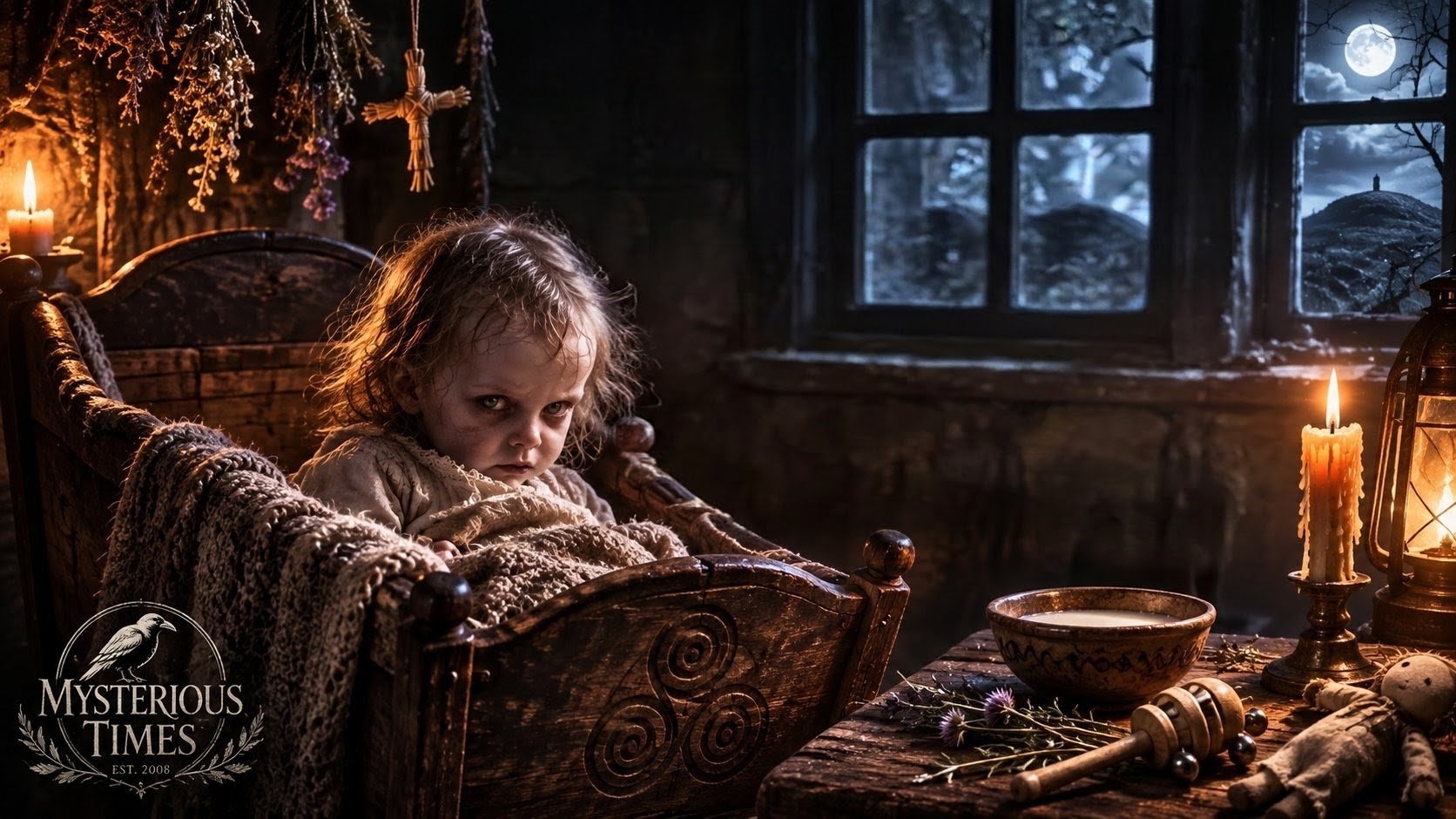
Imagine waking one morning to find that the child sleeping in the cradle no longer seemed quite… right.
The face is familiar, the eyes seem the same… yet, something has changed. The baby cries constantly but you just don’t seem to be able to soothe them. They refuse food, or never seem satisfied by it. They stare at you with an expression that seems strangely old. They do not behave as you expect. Your neighbours begin to whisper. An elderly relative quietly suggests the unthinkable –
Perhaps that isn’t your child at all. Perhaps the fairies have taken them.
Across Britain, Ireland and much of Northern Europe, generations believed that the Fair Folk sometimes stole healthy human babies, leaving one of their own behind in the cradle. The replacement was known as a ‘Changeling’. To modern readers, it sounds like the stuff of dark fantasy. But to many families in the distant past, it was a terrifying possibility.
The details differed from village to village, but the stories shared familiar themes. Fairies coveted beautiful infants, talented musicians, new mothers and, in some traditions, anyone whose life or gifts might strengthen the Otherworld.
The child that was left behind was rarely described as monstrous, instead they were just… wrong. Too quiet, too hungry, too knowing, too distant. Sometimes they failed to grow or became unexpectedly frail. Sometimes they screamed through the night for reasons nobody could understand.
Looking back with modern knowledge, the tragedy becomes painfully clear. Many of the behaviours once blamed on changelings are now recognised as signs of illness, disability or neurodivergence. Conditions that today might lead to diagnosis of autism, cerebral palsy, epilepsy or metabolic disorders were, in isolated communities with little understanding, frightening mysteries. People searched for answers. Folklore gave them one.
That does not excuse what sometimes followed.
Belief in changelings could have devastating consequences. Across Britain and Ireland, stories survive of desperate families attempting to force the fairy child to reveal itself. Strange rituals were carried out in the hope that the Fair Folk would return the ‘Real’ child. Most remained in the realm of folklore and storytelling, but history also records heartbreaking cases where genuine children suffered because frightened adults believed ancient tales over their own eyes.
The most infamous was the death of Bridget Cleary in Ireland in 1895. Although she was an adult rather than a child, her husband became convinced that she had been replaced by a fairy changeling. What followed shocked the nation and is often described as one of the last fatal cases linked to fairy belief. The modern world may have arrived with its electricity, railways and science but old fears had not vanished quite as completely as many assumed. It’s easy to dismiss such beliefs as ignorance. Much harder to imagine living without the knowledge we now take for granted.
Picture a rural family two or three hundred years ago. A child develops in ways nobody can explain. There are no specialists. No hospitals within easy reach. No understanding of genetics or neurological conditions. The local wise woman, priest or neighbour offers the only explanation available. The Fair Folk have been here. Folklore often filled the spaces left by medicine. Sometimes it offered comfort or hope. Sometimes it caused terrible harm.
But changelings are not just stories about fear, there is love there too. The parents didn’t want their ‘own’ children back because they hated them. They did so because they loved them. Behind every changeling story lies a family desperately trying to make sense of something that made no sense at all. That is why the stories resonate with us today. The idea of someone we love becoming strangely unfamiliar is arguably one of our deepest fears. Illness changes people. Dementia changes people. Trauma changes people. Thankfully, the folklore doesn’t usually take precedence over knowledge these days. The Fair Folk, it seems, were never just creatures of magic. They became mirrors for our anxieties, our grief and unanswered questions.
By the end of the nineteenth century, belief in changelings had largely retreated into folklore, surviving in stories, novels and local traditions rather than everyday life. Yet the old tales still linger in quiet corners of Britain and Ireland, reminding us that the landscape beyond the hedgerow was never inhabited solely by wonder. It held sorrow too.
That may be the reason the oldest fairy stories are still shared today. Because they are rarely about fairies. They are about us. About the the things we couldn’t explain. About the people we were afraid of losing. About the desperate hope that, somehow, they might find their way home again.
So if you’ve walked with me beyond the hedgerow this week, remember one thing. The Otherworld was never just beautiful. It reflected every joy and every fear carried by the people who imagined it.
And maybe that is the strangest magic of all.