Arthur Bell knew it was human before he saw the fingers because Bertie told him so.
The Labrador stopped twenty yards short of the cliff and lowered himself towards the sand, belly almost touching the ground. His ears went back. A growl starting somewhere deep inside him. Arthur pulled at the lead impatiently.
“Come on.”
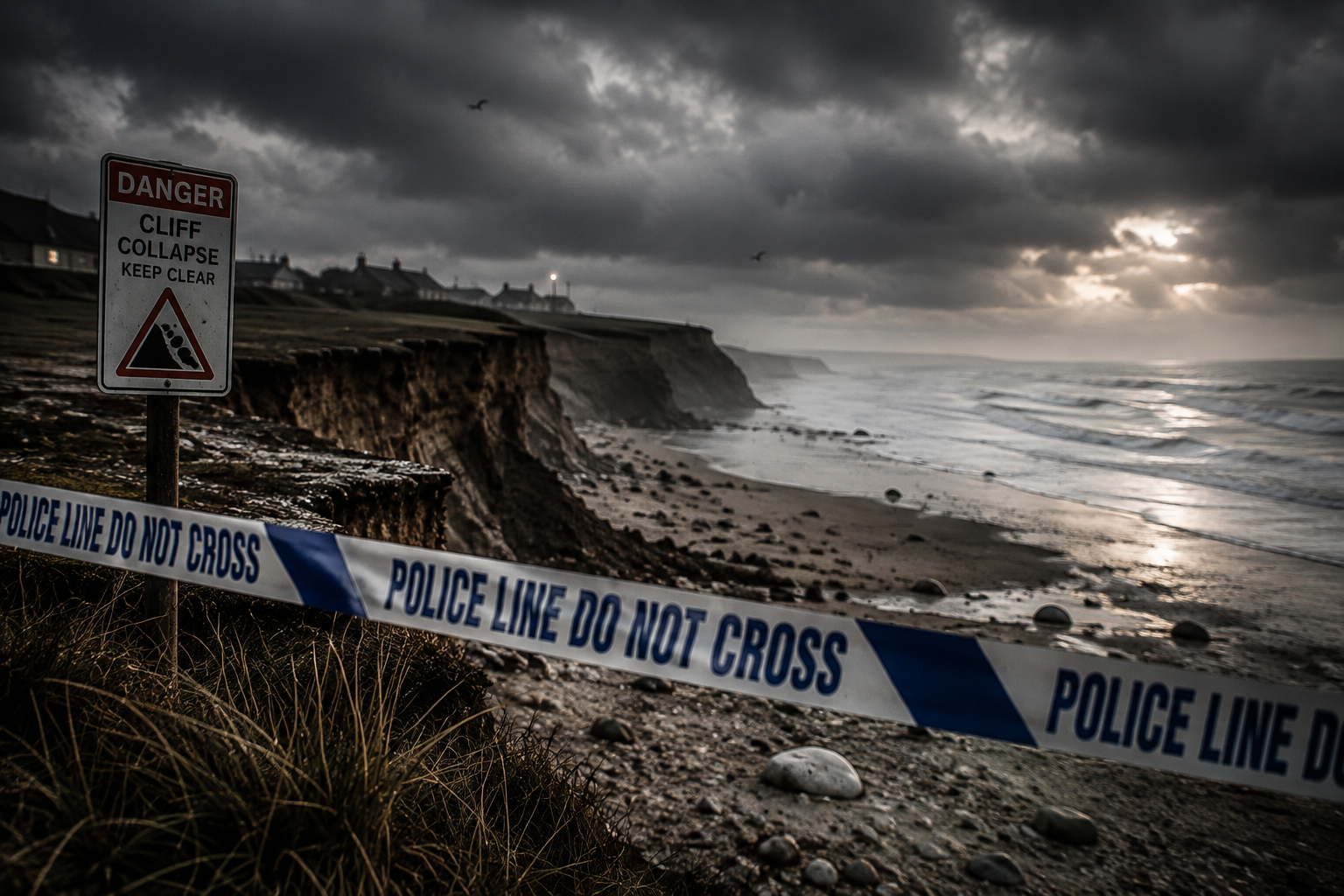
The storm had battered the Yorkshire coast through most of the night. It had torn fencing from the cliff top, ripped great slabs of earth from the land, and thrown half the beach into places it hadn’t been the day before. The sea was still filthy with it. Brown water throwing white foam, thick with black tangles of weed onto the foreshore. Arthur had spent thirty-two years with the coastguard. He had seen what the sea could do to boats. He pulled the lead again, more insistently this time, but Bertie still wouldn’t move. Arthur sighed. He had seen what the sea could do to people, when they got caught by the tides.
He followed the dog’s stare. Something protruded from the cliff, pale against the dark clay. Arthur walked closer.
The hand hung downwards, it’s remaining four fingers brushing crumbs of loose soil from the cliff face. The fifth finger lay several feet away on the sand. For a few seconds Arthur simply stared. Then he looked towards the sea. The tide had turned.
“Fuck.”
He dragged Bertie back towards the path and took out his phone. Behind him, another piece of the cliff collapsed.
By ten o’clock the beach belonged to the police, not that the sea appeared to recognise their authority. Blue-and-white tape snapped in the wind while officers carried equipment across the sand and tried not to look at the water creeping steadily towards them.
Detective Sergeant Chris Hargreaves stood beneath the cliff staring at the arm.
There was more of it visible now. Not because anyone had excavated it. Because the earth was still falling away.
“How stable?”
The coastguard officer beside him looked up.
“It isn’t.”
“Helpful.”
“You asked.”
A trickle of mud slid down the cliff face forcing both men to step backwards, hurriedly. Hargreaves looked at his watch.
“Where’s the anthropologist?”
“Coming down now.” He gestured towards where a woman was making her way across the beach.
She was perhaps forty-five. Brown hair tied roughly at the back. Dark trousers. Walking boots. Wax jacket. A rucksack slung over one shoulder. Nothing about her suggested forensic expert. She looked more like somebody who’d taken the wrong turn on a coastal walk. Hargreaves raised the tape.
“Dr Watson, I presume?”
She stopped and looked at him, glancing towards the bones then back at him.
“Is that genuinely what you’ve decided to lead with?”
He smiled.
“Couldn’t resist.”
“You could. You chose not to.”
She ducked beneath the tape.
“Maggie Watson.”
“Chris Hargreaves.”
“Who’s been near it?”
“Photographer. CSI. First attending officer.”
“Who found it?”
“Retired coastguard. Walking his dog.”
“Dog touch anything?”
“No.”
“You sure?”
“Owner says not.”
“Owners say lots of things.”
She dropped the rucksack.
“Scene photographs?”
“Done.”
“Then move.”
Hargreaves moved backwards as Maggie crouched.
The hand was almost black where it disappeared into the soil, but the exposed bones were cleaner. The weather had already begun erasing the evidence. Maggie looked at the detached finger lying on the sand.
“That come off during the collapse?”
“We think.”
“You think?”
“We didn’t see it happen.”
“Then we don’t know.”
Hargreaves watched her. She examined the cliff not the body. The layers above it and the layers beneath. Roots protruded from the exposed earth. A length of plastic drainage pipe hung several metres overhead.
“How much cliff went overnight?”
“Couple of metres in places.”
“Any machinery been through here recently?”
“No.”
“Beach replenishment?”
“Not here.”
She nodded. Then, under her breath, said:
“All right.”
Hargreaves frowned.
“All right what?”
She didn’t answer. She pulled on gloves, took out a brush, and began.
The first thing Maggie found was a beetle. It crawled from the empty space beneath the scapula and disappeared into the mud. The second was a piece of dark, coarse cloth. Almost indistinguishable from the soil around it. The third thing was damage to the wrist.
“Old fracture,” she said.
Hargreaves crouched behind her.
“Cause of death?”
Maggie looked at him.
“Healed.”
“Right.”
“People generally need to be alive for that.”
He ignored it.
“Male?”
“Probably.”
“How old?”
“Adult.”
“That’s broad.”
“Human beings are inconvenient.”
She exposed another section. The bones were stained dark by the earth. There was no flesh. No recognisable face waiting inside the cliff. Just structure. Architecture without the building.
Hargreaves watched her work.
“How long?”
“Don’t know.”
“Guess.”
“No.”
“You must have an idea.”
“I have several.”
“Recent?”
“No.”
That changed things.
“How not recent?”
Maggie sat back.
“Long enough that whoever did this probably isn’t worried about us finding him.”
“Did what?”
“Buried him.”
“So, he was buried.”
“No.”
“You just said -“
“I said whoever did this.”
She pointed at the surrounding earth.
“No grave cut.”
Hargreaves stared at it.
“You can tell?”
“Yes.”
“So how did he get there?”
“I don’t know.”
Another piece of earth fell from above and struck the sand beside them. Maggie looked up.
“We need him out.”
The coastguard officer was already walking over.
“You’ve got maybe ninety minutes before I’m pulling everybody off this section.”
Hargreaves looked towards the water. It was closer now.
“Can you recover him in ninety minutes?”
Maggie looked at the skeleton.
“No.”
“Then what?”
“We recover what we can.”
“And the rest?”
She looked towards the sea.
“Hope it’s still here tomorrow.”
It wasn’t an excavation, Maggie hated anyone calling it that afterwards. Excavation implied control. This was salvage. The cliff was unstable and the tide was rising. Rain had started again. They worked under floodlights despite it being afternoon because the sky had turned almost black. Bone emerged from the earth faster than Maggie wanted. Shoulder. Ribs. Vertebrae. Pelvis.
Every few minutes someone shouted a time. Seventy minutes. Fifty. Thirty…
A rib came free in Maggie’s hand. She swore.
“Problem?”
“I didn’t want it to move.”
“Can you put it back?”
She stared at Hargreaves.
“No.”
She placed it carefully into a tray. There was a mark across the bone. Narrow. Deep. Hargreaves saw it.
“What the hell is that?”
“I don’t know.”
“Knife?”
“Maybe.”
“That’s a knife mark.”
“Are you a forensic anthropologist?”
“No.”
“Then at the moment it’s a mark.”
She bagged the rib separately.
“Twenty minutes.” Somebody called.
The pelvis was exposed enough now. Maggie examined it.
“Male.”
“Definitely?”
“As close as I’m prepared to give you here.”
“Age?”
“Twenty-five to thirty-five.”
“Cause?”
She gave him a look.
“Had to try.”
Ten minutes.
They found the whistle as the water reached the outer cordon. It lay beneath the ribs, green with corrosion. Maggie saw it and stopped.
“Photograph.”
The photographer moved in. Shooting quickly from several angles for scale and location. Then Maggie lifted it.
It was a brass whistle, heavy despite its size. She turned it in her fingers.
Hargreaves looked over her shoulder.
“Police?”
“No idea.”
“Military?”
“No idea.”
“Ship?”
Maggie looked towards the sea.
“Maybe.”
The coastguard officer shouted.
“That’s it. Everybody out.”
Maggie didn’t move.
“Maggie.”
She looked back at the cliff. Part of the lower skeleton was still inside it, legs, and feet – maybe even boots. Evidence.
A person.
“We haven’t finished.”
“We’re finished.”
“Five minutes.”
“No.”
“Three.”
The coastguard officer stepped towards her.
“Dr Watson, that cliff comes down, we’re digging you out as well.”
Maggie looked at the bones. For a moment Hargreaves thought she might refuse. Then she stood.
They carried what they’d recovered up the beach. Maggie was the last to leave. Halfway to the sea wall she looked back.
A wave broke across the place where she’d been kneeling.
At 3:14 the following morning, another section of cliff collapsed.
By daylight, the remaining bones were gone.
Maggie stood in the mortuary looking at half a man.
Skull. Upper torso. Both arms. Pelvis. One femur. Everything below it had disappeared into the North Sea.
Hargreaves stood on the other side of the table.
“Can you work with that?”
“I’ll have to.”
The skull was damaged but not by violence. Pressure, earth and time had collapsed the left side of the face inward long after death. Maggie lifted the mandible. Several of the man’s teeth had been lost during life. One abscess had eaten into his jaw.
“That would’ve hurt.”
Hargreaves looked at it.
“What?”
“Tooth.”
“Can that identify him?”
“No.”
“Then why does it matter?”
Maggie looked up.
“Because it hurt.”
He didn’t ask again.
She moved to the wrist. The fracture was unmistakable now, badly aligned. Whoever had treated it hadn’t done much beyond pulling it straight and hoping.
“He’d have lost movement.”
“How much?”
“Enough to notice.”
“Still worked?”
“Look at the shoulder.”
Hargreaves looked.
“I don’t know what I’m looking at.”
“Exactly.”
She indicated the attachment points.
“He compensated. Changed how he used the arm. Worked through it.”
“Job?”
“Physical.”
“Fisherman?”
“Maybe.”
“You hate that word when I say it.”
“I hate it when anybody says it too soon.”
He pointed towards the damaged rib.
“And that?”
“Perimortem.”
“English?”
“At or around the time he died.”
“Knife?”
“Possibly.”
“So, we’ve got a possible stabbing.”
“We’ve got trauma.”
“Difference?”
“About twenty years in prison.”
Hargreaves fell silent.
Maggie bent over the rib. Under magnification, the wound wasn’t clean. The bone had failed under force. Blunt, not sharp. Something had struck him hard enough to break it. Or he’d struck something. She wrote it down.
Cause undetermined.
She hated those words. She wrote them too often.
The police stopped treating it as a potential homicide when the preliminary dating came back as nineteenth century.
Hargreaves phoned.
“So that’s us done.”
“Probably.”
“You don’t sound happy.”
“I’m ecstatic.”
“What happens now?”
“I find out who he was.”
Silence.
“Maggie.”
“What?”
“He’s been dead at least a hundred years.”
“Yes.”
“We’re not looking for an offender.”
“No.”
“So, who’s paying you to -“
“I’ll speak to you later.”
She ended the call.
The archive smelled of mould. Not pleasantly old. Mould.
Maggie sneezed twice within the first ten minutes. Peter Larkin pushed a box towards her.
“Wrecks. 1800 to 1870.”
She stared at it.
“That’s one box?”
“That’s volume one.”
“Jesus Christ.”
“Busy coast.”
She opened it.
Men disappeared everywhere – that was what the records told her. They fell from boats. They were washed overboard. Drowned drunk. Drowned sober. Drowned trying to save cargo worth more than their lives.
Bodies came ashore bloated beyond recognition.
Some men never came ashore at all.
Unknown male.
Again.
Body not recovered.
Again.
Presumed drowned.
Again.
Human beings reduced to three words because there was no room for grief in the ledger.
Maggie worked through them.
Hours.
Then days.
The whistle was nineteenth century. That helped, but not enough.
A conservationist found traces of lettering beneath the corrosion.
V. Possibly L. Then B.
Peter stared at the photograph.
“Volunteer Lifeboat.”
“You sure?”
“No.”
Maggie smiled.
“Good answer.”
“But I’d put money on it.”
“How much?”
“Fiver.”
“Steady.”
The local volunteer rescue boat had operated before the organised lifeboat service became established.
Peter found crew lists. Then wreck reports. Then January 1867.
Five local men launched into a winter gale after a schooner was driven towards the rocks. The rescue boat had overturned. Four men were recovered but one man wasn’t.
Thomas Ward. Thirty-one. Rope-maker. Married with one daughter.
Body not recovered.
Maggie stared at those three words.
Peter leaned over her shoulder.
“Age fits.”
“Yes.”
“Occupation?”
“Could fit the shoulders.”
“Location.”
“Fits.”
“Whistle.”
“Maybe.”
Peter sighed.
“You’re a miserable sod to solve a mystery with.”
“We haven’t solved it.”
She kept reading.
There was another report about a collection for Ward’s widow and child.
Then another short paragraph.
Six months before his death, Thomas had been injured at work. A fall at the ropewalk.
Broken left wrist.
Maggie’s finger stopped halfway down the page. Peter saw it.
“What?”
She pushed the clipping towards him.
He read then looked at her.
Neither spoke.
Maggie sat back. For the first time in two days, she felt the muscles in her shoulders release.
“Hello, Thomas.”
The evidence never became perfect because evidence rarely did.
The date, age, sex, and injury were right. The occupation fitted the skeletal changes.
The location fitted. The whistle fitted. The damaged rib was consistent with violent blunt-force trauma around death. An overturned rescue boat in heavy surf could easily have caused it.
Could.
That word again. Maggie wouldn’t turn could into did simply because it made a better story. The identification remained probable.
Thomas Ward. Thirty-one years old. Rope-maker. Husband to Eileen. Father to a six-year-old girl called Mary.
On 17 January 1867, Thomas had heard that men were dying offshore and climbed into a boat.
He never climbed out.
Eileen waited for a body that didn’t come. Mary grew up asking where her father lay.
The sea had kept that answer until the people who needed it were long dead.
They buried what remained of Thomas Ward on a wet Tuesday morning.
There were twelve people there. Maggie stood at the back. She always stood at the back.
A distant descendant had come from Leeds. Another from Newcastle. Neither had known Thomas existed six weeks earlier. Now one of them was crying.
Maggie watched the coffin go into the ground.
Half a man inside it, the rest somewhere beneath the North Sea, smashed apart on rock or buried under tonnes of sand. Maybe carried miles away to wash up on a different beach. It didn’t matter. Enough of him had come home.
Afterwards, Hargreaves found her beside the church wall.
“You didn’t tell me this was today.”
“You weren’t invited.”
“Charming.”
“You’d have worn that tie.”
He looked down.
“What’s wrong with my tie?”
“Everything.”
Rain collected on the old gravestones and for a moment neither spoke.
“You found him, then,” Hargreaves said.
“Part of him.”
“You know what I mean.”
Maggie looked towards the fresh grave.
“No. I didn’t find him.”
“Could’ve fooled me.”
“I identified some bones.”
“Thomas Ward’s bones.”
“Probably.”
“For fuck’s sake, Maggie.”
She smiled faintly.
“Probably matters.”
“Not to his family.”
“Especially to his family.”
Hargreaves considered that.
“Why?”
“Because I won’t lie to them just because the truth is less satisfying.”
He nodded. Then:
“They’ve got a name for you.”
Maggie closed her eyes.
“Who?”
“Station.”
“No.”
“You don’t even know what it is.”
“I know enough.”
“The Bone Reader.”
She opened her eyes.
“That’s fucking awful.”
“I quite like it.”
“You would.”
“Apparently you talk to them.”
“Who?”
“The bones.”
“I don’t talk to bones.”
“CSI said you did.”
“I said hello.”
“To a skeleton.”
“Basic manners.”
Hargreaves laughed. Maggie started towards the gate.
“Dr Watson?”
She kept walking.
“I presume?”
She stopped and slowly turned to face him.
“Hargreaves.”
“Yeah?”
“If you’re ever washed up on a beach…”
He grinned.
“…I’m putting you down as unidentified female, sixty to seventy.”
His face fell.
“I’m forty-eight.”
“Not after a week in seawater.”
She walked away.
Hargreaves called after her.
“That’s abuse of scientific authority.”
Maggie raised one hand without turning around.
Behind them, rain fell on Thomas Ward’s grave.
A name had been cut into the temporary marker.
THOMAS WARD
1835–1867
For one hundred and fifty-nine years there had been nothing to mark where he lay.
No stone.
No grave.
No body.
Only a woman who eventually stopped waiting and a little girl who grew up without her father.
Maggie hadn’t saved Thomas Ward. She hadn’t solved his death. She hadn’t even found all of him.
She had done something smaller.
She had looked at what the sea had left behind and refused to call it enough.
And when the dead man finally gave her his name, she had written it down.

Leave a Reply