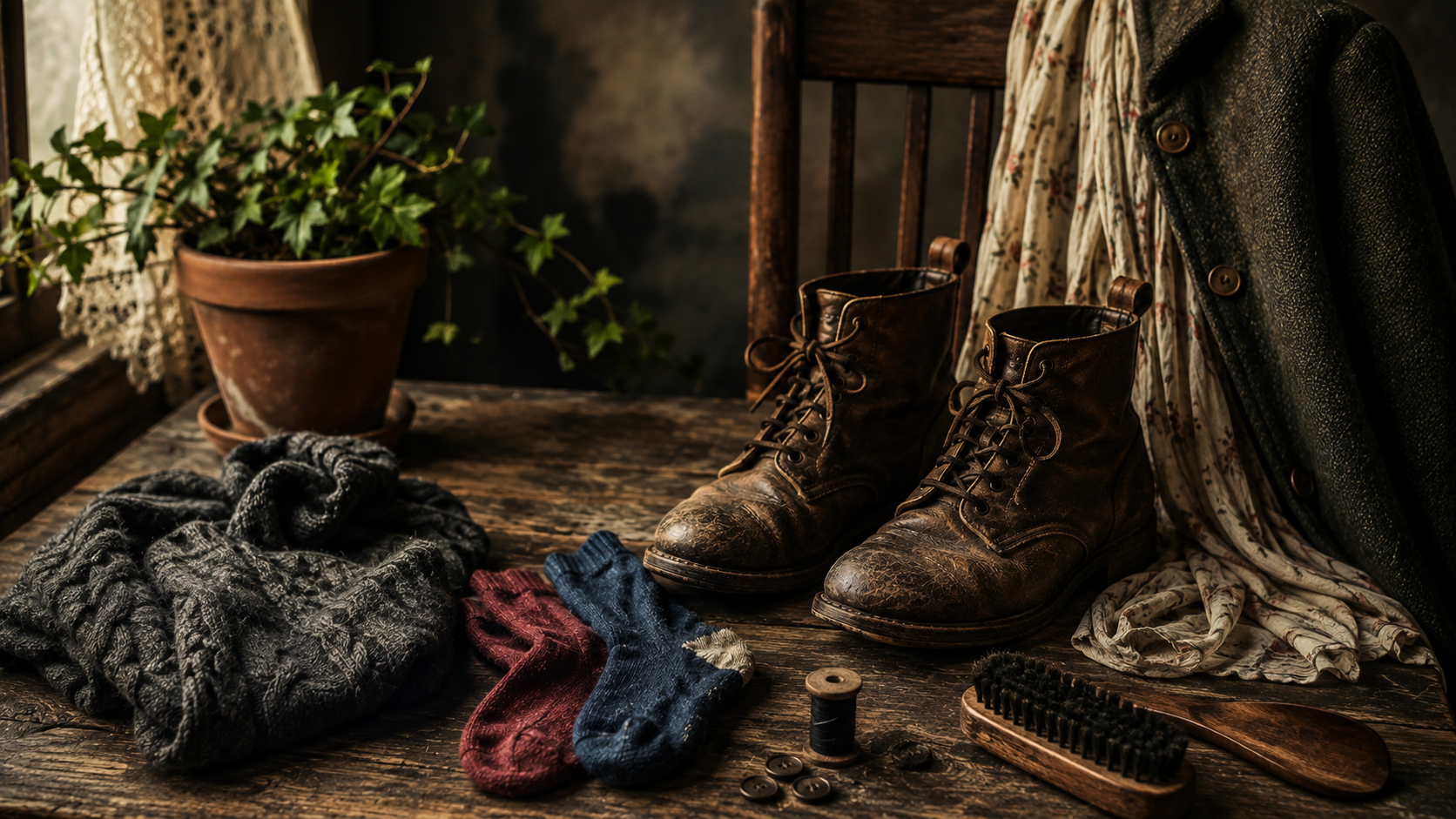
There is a reasonable chance that somewhere in Britain this morning, somebody put a pair of shoes on the table and another person reacted as though they had just released a live badger into the kitchen.
“GET THOSE OFF THERE!!”
Why? Bad luck.
Why is it bad luck?
Well… It just is.
Welcome back to Old Magic. Pull up a pouffe…
Yesterday we discovered that the humble penny has spent centuries doing considerably more work than it’s monetary value would suggest.
Today we’re getting dressed. And apparently we’ve been doing that wrong as well.
Before the modern wardrobe became somewhere where we stand despairingly insisting that we have absolutely nothing to wear while surrounded by roughly enough clothing to equip a small theatrical company, getting dressed could involve a rather lengthy collection of rules.
Which foot went first, which way your clothes were facing, whether your buttons were lined up, where you wore something new for the first time, whether you dared to repair a garment while it was still attached to your body, even which pocket received the first coin. Clothing was not just something you wore. It touched the body. It absorbed something of the wearer. It could represent you in your absence. And like so many ordinary objects in folk belief, it existed in a world where small actions could have disproportionately large consequences.
Let’s begin with something many people will still recognise –
Putting your clothes on inside out.
Accidentally pulling on your jumper or discovering at lunchtime that your T-shirt has spent six hours proudly displayed beneath your chin is now mostly just embarrassing. Historically though, you might have been considerably more interested in what it meant.
The belief that accidentally reversed clothing carried significance is centuries old. The precise significance varied enormously, because folklore has never been particularly interested in maintaining a standard operating procedure, but by the eighteenth and nineteenth centuries, accidentally putting clothing on inside out was widely associated with luck. There was, however, one important condition:
Don’t correct it.
Once you’ve put the garment on wrongly, turning it the right way could undo whatever luck the mistake had produced.
In Shropshire, Charlotte Sophia Burne recorded wonderfully specific versions of the belief. At Pulverbatch, a woman who discovered that she had put her flannel petticoat on inside-out declared that she expected a stranger to arrive. Elsewhere, an accidentally reversed stocking could be considered particularly fortunate.
And at Edgmond, the rules became even more precise. Put your right stocking on inside-out on Monday morning, and you could apparently expect to receive a present before the week was over. Which raises several questions:
Does Tuesday work?
What if it’s the left stocking?
What if you realise before breakfast?
Can you deliberately put it on backwards?
Unfortunately, the supernatural customer-service department appears to have closed without leaving instructions. Rude.
But turning clothes inside-out wasn’t merely a way of predicting presents. Sometimes it could save you from the Devil.
Burne recorded a wonderful Shropshire belief concerning difficult stiles. Anyone who has walked through the British countryside knows the particular species of stile involved. It looks perfectly straightforward. Then you attempt to climb it and suddenly discover that you have apparently lost all understanding of knees. In parts of Shropshire, there was another possible explanation.
The Devil was stopping you.
A person might struggle repeatedly to cross a stile without success because supernatural interference was preventing them. Fortunately, there was a solution. Turn an article of clothing inside-out and the enchantment would be broken. Burne reported that the belief wasn’t merely theoretical. Women were known to reverse their gowns before attempting particularly troublesome stiles. Imagine being immediately behind one of them.
“Are you going over then?”
“Can’t. Satan’s got me.”
*rustling noises*
“Right. Try now.”
And off she goes.
Ridiculous? Perhaps. But the magical logic underneath it is surprisingly elegant. Something has made the world behave incorrectly, so you make yourself incorrect. Inside becomes outside, normal becomes reversed. The supernatural force is disrupted and order can reassert itself.
The same idea appears in traditions concerning fairies and pixies.
Across parts of Britain, people who became inexplicably lost in familiar countryside could be described as ‘pixy-led’.
You knew the road and the fields. You might even be within sight of home. Yet somehow every path led nowhere, as if the landscape had become confused. One remedy was remarkably simple.
Turn your coat.
Stories from Devon describe people unable to find their way until they reversed an item of clothing, after which the supernatural confusion immediately ended. The idea is considerably older than the Victorian folklore collections that preserved many examples. Richard Corbet, writing in the seventeenth century, referred to the practice of turning cloaks in connection with Puck and supernatural misdirection. Again, the world has been turned wrong, so turn some thing else wrong. Two wrongs appear to make a right. At least where pixies are concerned.
Clothing could also predict what sort of day you were about to have. William Henderson’s nineteenth-century collection of northern English and Border folklore records a belief that putting a button or hook into the wrong hole while dressing in the morning foretold misfortune before the day was over.
Consider that tomorrow when you’re late for work. One button out of alignment, entire cardigan increasingly diagonal. And somewhere, deep within the ancestral memory of northern Britain:
“Oh, bugger.”
Even repairing clothing could be dangerous if you did it at the wrong time. Many families still know some version of the warning:
Never sew something while your wearing it.
Today the sensible explanation is obvious – needles are pointy, human beings are soft. Not combining the two seems like a wise thing to do. But folklore supplies rather more interesting consequences.
Versions collected in Britain and elsewhere warn that repairing clothing while it remains on the body might cause poverty, invite people to speak badly of you or somehow attach misfortune to the wearer. The wording varies but the underlying image is very literal –
You aren’t just stitching cloth. You may be stitching something to yourself.
There are traditions of stitching sorrow, trouble or poverty into the garment and therefore into the person wearing it. A practical warning becomes sympathetic magic.
Then there were new clothes.
Buying a new coat today generally involves removing approximately seventeen labels, discovering one of them has left an indestructible plastic barb somewhere near your shoulder blade and wearing the thing. Earlier generations sometimes had more ceremonial requirements.
A new garment might need to be worn somewhere significant for its first outing and Church was a particularly fortunate choice in several recorded traditions. The first wearing mattered.
Again, we encounter the magical importance of beginnings – start correctly and perhaps everything that follows will be correct too. And of course there was the financial component. As we discovered yesterday, northern folklore records the instruction that when a new coat or dress was first worn, money should immediately be placed in the right-hand pocket. Do that and the pocket would supposedly never remain empty. Put it into the left pocket first and you might condemn yourself to poverty for as long as you owned the garment. One tiny action establishes the future. The first condition becomes the continuing condition. The new garment begins prosperous. Therefore its wearer remains prosperous.
And tucked amongst these customs is a phrase that some readers may still have heard:
“Health to wear it.”
Perhaps a parent or grandparent said it when you showed them something new. Perhaps you still say it yourself. It sounds like nothing more than a pleasant little expression, but older versions expand the sentiment:
Health to wear the garment
Strength to wear it out
And enough prosperity to replace it when you do.
It is, effectively, a blessing.
Not dramatic magic. There’s no candles or wand. No incantations spoken beneath a full moon. Just somebody looking at your new coat and wishing health, longevity and future abundance upon you. Sometimes Old Magic is very polite.
Then we reach shoes, and shoes is where everything gets completely out of hand.
Shoes occupy an extraordinary place in folklore. They carry the shape of the wearer, they travel with us, they touch the boundary between the human body and the ground. They wear out in ways peculiar to the person who owns them and therefore they can become intensely personal objects. This helps to explain why shoes repeatedly appear in customs involving luck, marriage, fertility, travel, protection and the dead.
One of the strangest historical traditions involved throwing shoes at people – Not angrily, For luck. Old shoes could be thrown after newlyweds as they departed. Shoes were also thrown after travellers or people setting out on important journeys. Irish folklore records a shoe being thrown after someone heading to a fair, the way it landed interpreted as an omen for the success of the trip.
The wedding tradition was widespread enough to attract numerous attempted explanations. One nineteenth century theory suggested that it represented the transfer of authority over the bride from the father to the husband. Maybe, but that’s the problem with folklore origins.
A custom exists. People forget why. Someone later proposes an explanation. The explanation gets repeated. A hundred years later, a website announces confidently:
THIS IS WHERE THE TRADITION COMES FROM.
Not necessarily, sometimes we simply don’t know.
And that brings us to perhaps Britain’s most aggressively surviving piece of shoe folklore.
Put a new pair of shoes on the table and wait. Someone will notice and there is a decent chance that person will react immediately. Shoes on the table are bad luck. Very bad luck. But exactly why is considerably less clear.
Modern explanations abound, of course…
One popular story links the custom with miners, claiming that a dead miner’s boots would be placed on the table after a fatal accident. Another associates shoes on tables with laying out the dead at home. Others invoke poverty, contamination or various historical practices.
The difficulty is not finding explanations, it’s proving them. The taboo itself is well established in British folklore but the neat origin stories are considerably harder to demonstrate and that, dear reader, is the most interesting part, because here we can watch the very process Old Magic is concerned with.
The explanation disappears but the prohibition survives.
A mother tells her daughter:
“Get those shoes off the table.”
The daughter grows up.
Years later her own child puts trainers on the kitchen table.
“GET THOSE OFF THERE!”
“Why?”
“It’s bad luck.”
“Why?”
“I don’t know. It just is.”
Another generation successfully recruited.
And footwear still attracts little rituals today. Lucky socks. Football boots put on in a particular order. A particular pair worn for interviews. Shoes that must never be placed somewhere. Shoes tied to wedding cars. The pair somebody wore when something wonderful happened and therefore wears again when they need the universe to cooperate.
Not every personal habit is descended from historical folk magic, of course. Humans just like rituals and that may be exactly why the older ones survive so effectively. They fit something we already do. We repeat the actions that worked before and avoid the actions associated with disaster. We develop routines. We create patterns. And clothing is particularly good at accumulating them because getting dressed is something we do every day. Well.. most days, anyway.
Twentieth-century folklorists Iona and Peter Opie found these beliefs still flourishing among British schoolchildren. Inside-out clothing could still bring luck and children developed their own rules surrounding garments, colours and games.
A boy in Pontefract described footballers deliberately wearing odd-coloured socks because they believed it helped them win – different century, different clothing. Same idea. You change what you wear, you change what happens.
Which brings us back to tomorrow morning. You get out of bed, choose your clothes. Perhaps you put the same leg into your trousers first every day without ever noticing. Perhaps you have a favourite pair of socks. Perhaps something accidentally goes on inside-out. Perhaps you discover you’ve missed a button. Perhaps you put on something new and someone says:
“Health to wear it.”
Perhaps you put your shoes on the table and somebody loses their bloody mind.
Most of us no longer imagine that getting dressed determines what the universe has planned for us. We don’t worry that pixies will scramble the landscape, we have roadworks for that. We don’t turn our coats to escape Puck. We don’t usually suspect Satan of interfering with countryside furniture. But fragments remain. Little rules and sayings. Tiny rituals performed before we’ve even left the house.
And that’s Old Magic.
It doesn’t always survive in spellbooks. Sometimes it survives in wardrobes. Sometimes it survives in something your grandmother told your mother, who told you. Sometimes nobody remembers what it originally meant, they only remember the instruction.
Wear this.
Don’t wear that.
Put this side on first.
Leave it inside-out.
Never sew it while you’re wearing it.
And for God’s sake…
get those bloody shoes off the table.