Imagine London in the closing years of the nineteenth century.
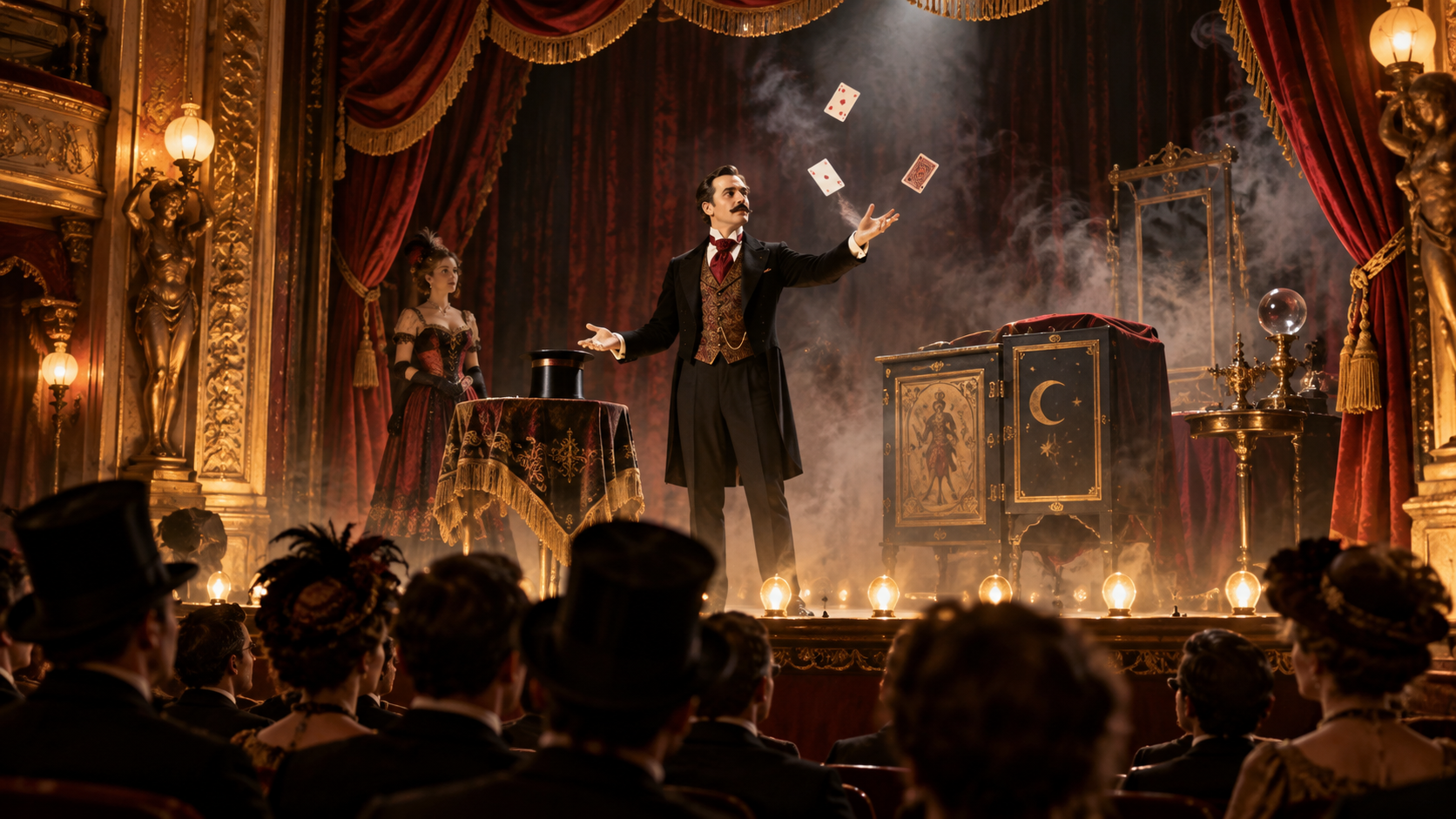
The streets outside are noisy with horses, wheels and shouting newspaper sellers. Gas lamps still glow, but electric light is creeping into the city. Telegraph wires carry messages faster than any human being could travel. Photographs have learned to move. Machines talk, play music and perform tasks that would have been called witchcraft not very many generations before. And in Piccadilly, you can buy a ticket to be lied to. Not cheated. Not defrauded. Lied to quite openly, with your full cooperation, by some of the most celebrated entertainers in the country.
Welcome to the Golden Age of Magic.
There had been conjurors long before the Victorians. Sleight of hand, cups and balls, disappearing objects, fortune telling, automata and apparently impossible feats had been performed at fairs, markets, private houses and royal courts for centuries. But during the nineteenth century something changed. The magician became respectable. More importantly, the magician became a star.
There had been conjurors long before the Victorians. Sleight of hand, cups and balls, disappearing objects, fortune telling, automata and apparently impossible feats had been performed at fairs, markets, private houses and royal courts for centuries. But during the nineteenth century something changed. The magician became respectable. More importantly, the magician became a star. One of the men usually credited with helping that transformation was the French magician Jean-Eugène Robert-Houdin.
Originally trained as a watchmaker, Robert-Houdin brought his fascination with mechanisms and automata onto the stage. When he opened his Paris theatre in July 1845, his advertising did not promise demons, sorcery or genuine supernatural powers. It announced ‘automata, sleight-of-hand and magic’ and told the audience that the experiments were inventions of Robert-Houdin himself. The programme sounds wonderful even now. There was a Cabalistic Clock, an Orange-Tree, a Mysterious Bouquet, Obedient Cards, a Miraculous Fish, a Fascinating Owl and something intriguingly called Pierrot in the Egg.
The theatre opened at eight. The box office opened half an hour earlier. The cheapest seats cost one franc fifty centimes; the dress circle cost five.
Robert-Houdin had turned conjuring into an evening at the theatre.
Robert-Houdin had turned conjuring into an evening at the theatre.
There was another important difference in presentation. The magician was no longer required to look like a mysterious sorcerer who had wandered in from some vaguely imagined eastern kingdom carrying forbidden knowledge. Robert-Houdin cultivated the appearance of a sophisticated gentleman entertaining sophisticated guests. The magic did not disappear when the wizard’s robes came off. If anything, it became more unsettling. Because now the impossible was happening in a respectable room, performed by a respectable-looking man who seemed to be suggesting that there was a perfectly rational explanation for everything you had just witnessed. He just wasn’t going to tell you what it was.
Meanwhile, across the Channel, Britain was developing its own appetite for theatrical mystery.
In May 1873, John Nevil Maskelyne and George Alfred Cooke began performing at the Egyptian Hall in Piccadilly. Eventually their extraordinary run there would make the building synonymous with stage magic.
The Egyptian Hall was already difficult to ignore. Its elaborate Egyptian-inspired façade had been designed to attract attention decades before Maskelyne and Cooke arrived. By the late Victorian period, however, it had acquired another identity. It became England’s Home of Mystery. And what went on inside was considerably stranger than a modern audience might imagine from the word “magic show”. A surviving programme from 1884 includes plate dancing, mental telegraphy, ventriloquism, magical illusions, musical performances, a light-and-dark séance and something billed as the Wonderful Skeleton.
Another programme advertises Maskelyne and Cooke as both “Royal Illusionists” and “Anti-Spiritualists”.
The nineteenth century was not merely an age of stage magic. It was also the great age of Spiritualism. Mediums claimed to communicate with the dead. Tables moved. Musical instruments apparently played without human hands. Spirits produced knocks in darkened rooms. People were tied to chairs only for mysterious manifestations to occur around them. Magicians looked at some of this and thought:
“Hang on. We can do that.”
The resulting war between conjurors and fraudulent mediums would become one of the most fascinating collisions between entertainment and supernatural belief in the Victorian world. But more on that later this week. For now, take your seat at the Egyptian Hall.
An advertisement from 1878 promised a programme of “inexplicable illusions and mechanical wonders”. Magic had found a new accomplice.
Technology.
The Victorians were living through an extraordinary period in which apparently impossible things kept becoming possible. Electricity could produce light. Telegraphy could make words travel invisibly across enormous distances. Recorded sound would allow the voices of absent people to be heard. Photography could capture a face with astonishing accuracy. Then, even the photos began to move. The magician did not need to oppose this new scientific world. He could use it. Another programme advertises Maskelyne and Cooke as both “Royal Illusionists” and “Anti-Spiritualists”.
The nineteenth century was not merely an age of stage magic. It was also the great age of Spiritualism. Mediums claimed to communicate with the dead. Tables moved. Musical instruments apparently played without human hands. Spirits produced knocks in darkened rooms. People were tied to chairs only for mysterious manifestations to occur around them.
Magicians looked at some of this and thought: “Hang on. We can do that.”
The resulting war between conjurors and fraudulent mediums would become one of the most fascinating collisions between entertainment and supernatural belief in the Victorian world.
We will return to that later this week.
For now, lets take our seats at the Egyptian Hall.
An advertisement from promised a programme of “inexplicable illusions and mechanical wonders. Mechanical wonders. Magic had found a new accomplice.
Technology.
The Victorians were living through an extraordinary period in which apparently impossible things kept becoming possible. Electricity could produce light. Telegraphy could make words travel invisibly across enormous distances. Recorded sound would allow the voices of absent people to be heard. Photography could capture a face with astonishing accuracy. Then even photographs began to move. The magician did not need to fight this new scientific world. He could use it.
Mechanisms could be concealed inside furniture. Lighting could control what an audience noticed. Mirrors and optics could manipulate perception. Electromagnetism could move things without an obvious physical connection. Automata could appear almost alive. The distinction between a scientific marvel and a magical one was not always immediately obvious to the person watching it.
There is a glorious coincidence in ‘The Graphic’ of 12 October 1878. Among its advertisements was one for Maskelyne and Cooke’s mysterious mechanical entertainment at the Egyptian Hall. Elsewhere in the very same issue was a discussion about whether electric light might eventually replace gas lighting in London’s streets. Reality itself was starting to behave suspiciously like a magic trick.
Perhaps that helps explain why magic flourished rather than faded in an increasingly scientific society. Knowing that something must have an explanation is not the same as knowing what that explanation is and the audience’s pleasure lay somewhere in that gap.
By the 1890s the programmes at the Egyptian Hall had become wonderful mixtures of magic, technology, comedy and topical entertainment.
There were mechanical orchestras, thought-reading demonstrations, satirical sketches about Spiritualism. There were automata, David Devant and eventually there were moving pictures. A programme from 1897-98 advertised animated photographs of Queen Victoria’s Diamond Jubilee procession alongside Devant’s magic and a sketch involving a séance.
Imagine that.
An audience could sit in one theatre and watch a magician apparently violate the laws of nature, see machinery apparently operate by itself, laugh at supposed communication with the dead and then watch people who were not physically present move across a screen. Which part was the magic?
The performers themselves were changing too. A successful magician no longer sold only tricks. He – or, as we shall see later this week, sometimes very definitely she – sold a personality. Posters became spectacular. Stage names became exotic. Costumes, publicity photographs and carefully cultivated mystery transformed performers into recognisable celebrities. Some built identities so elaborate that the magician himself effectively became another illusion. Chung Ling Soo would take that idea to an extraordinary extreme. The Great Lafayette would build an enormous theatrical spectacle around his own carefully controlled persona. Adelaide Herrmann would prove emphatically that the title “Queen of Magic” required no king standing beside her. And David Devant became one of Britain’s best-known magicians.
By the end of the century, audiences were no longer simply going to see a magician. They were going to see the magician whose name was printed across the poster. Magic had become showbusiness.
In 1905, the same year that the Egyptian Hall was demolished, another significant event took place. Twenty-three magicians met at Pinoli’s Restaurant in Soho and they decided to form an organisation devoted to their art.
It became The Magic Circle and David Devant became its first president.
There is something rather fitting about the timing. The great Victorian Home of Mystery disappeared, but the culture of professional magic it had helped nurture was strong enough to organise, preserve its traditions and, perhaps most importantly, protect its secrets. The Magic Circle eventually adopted the motto
Indocilis privata loqui:
“Not apt to disclose secrets.” Because the secret is part of the bargain. A magic audience knows it is being deceived.That is what makes stage magic fundamentally different from fraud. The magician does not ask us to hand over our savings because he can speak to our dead grandmother. He does not demand that we accept his supernatural powers as genuine. He stands beneath the theatre lights and effectively issues a challenge.
“Watch carefully.”
So we do. We watch the hands. We watch the box. We watch the assistant. We watch the curtain. We tell ourselves that people cannot vanish, objects cannot pass through solid matter, thoughts cannot be read and a human body cannot possibly disappear from a place we have been staring at continuously. And then it happens anyway. For a few seconds, reason and eyesight disagree. That tiny moment of uncertainty was the commodity the great stage magicians sold.
Perhaps that is why the Golden Age of Magic arrived alongside such astonishing scientific progress rather than being destroyed by it. The nineteenth century had repeatedly taught people an uncomfortable lesson. Yesterday’s impossible could become today’s technology. The magician merely asked the audience one more question.
“Are you absolutely certain you know which is which?”