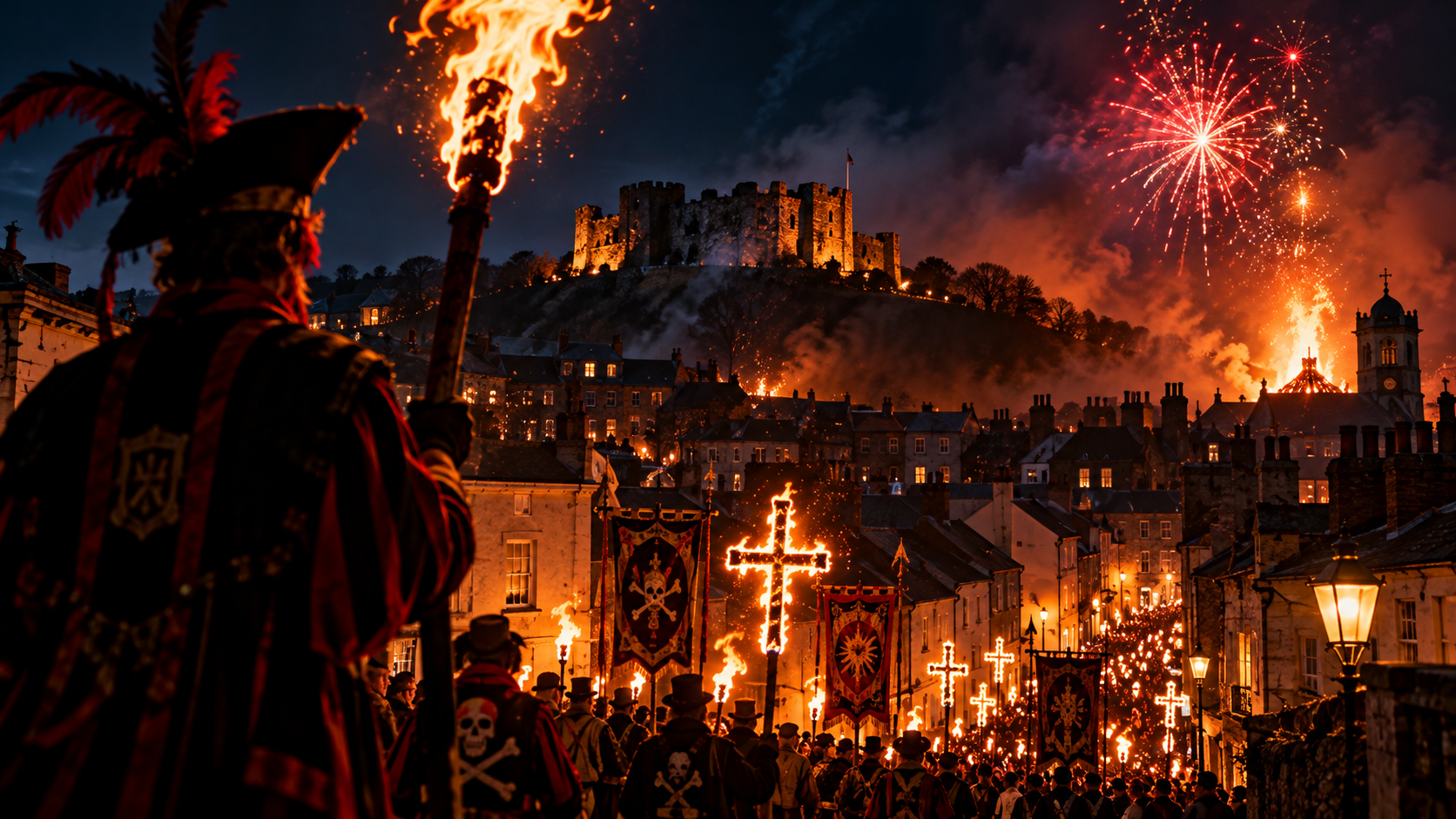
Every November, the historic Sussex town of Lewes undergoes a remarkable transformation. Streets that ordinarily accommodate shoppers, commuters and tourists become crowded with torchbearers, marching bands, elaborate costumes and enormous effigies. The air fills with smoke, fireworks and the noise of thousands of people celebrating a tradition that has survived centuries of religious controversy, public disorder and official attempts to bring it under control.
To call it Bonfire Night scarcely does it justice. Lewes does not simply light a bonfire and let off a few fireworks. Its celebrations are organised by independent bonfire societies, each with its own identity, customs and procession. The event is part historical commemoration, part community spectacle and part expression of a distinctly Sussex determination not to be told what to do.
The familiar explanation for Bonfire Night begins in 1605, when Guy Fawkes was discovered guarding gunpowder beneath the House of Lords. He belonged to a group of Catholic conspirators, led by Robert Catesby, who intended to destroy Parliament and kill King James I. Their plot failed, and Parliament subsequently established an annual thanksgiving on 5 November. Bonfires, bells and public celebrations became part of the national response.
But Lewes has another history of religious violence, one that predates the Gunpowder Plot by almost half a century.
Between 1555 and 1557, during the reign of Mary I, seventeen Protestants were burned at the stake in Lewes for heresy. Their executions formed part of the Marian persecutions, when England’s religious direction was again being forcibly changed following the Protestant reforms of Edward VI. These were not symbolic burnings or theatrical demonstrations. Seventeen people were executed because of their religious convictions.
Their memory remains central to Lewes Bonfire. Seventeen burning crosses are carried during the commemorations, and a memorial erected on Cliffe Hill in 1901 overlooks the town. The association gives Lewes an unusually solemn element beneath the noise and spectacle. Yet it is important to distinguish the sixteenth-century executions from the much later development of the modern bonfire processions. The martyrs’ deaths are historical fact, but the ways in which they came to be commemorated have their own history.
One of the earliest recorded Lewes celebrations dates to 1679, during a period of renewed anti-Catholic agitation surrounding the alleged Popish Plot. The town’s inhabitants reportedly paraded images of Guy Fawkes, the Pope and a Jesuit priest before consigning them to a bonfire. It was an expression of religious and political feeling rather than the carefully organised community festival familiar today.
Over the following centuries, Lewes acquired a reputation for particularly unruly Fifth of November celebrations. The Bonfire Boys, as the participants became known, treated the streets as their own. Fires were lit in public places, burning tar barrels appeared, fireworks were discharged and the authorities struggled to maintain order.
By the nineteenth century, the celebrations had become a recurring confrontation between local custom and public authority. Magistrates and police were understandably concerned about the danger posed by uncontrolled fires and explosives in a crowded town. The Bonfire Boys, meanwhile, regarded official interference as an attack on a tradition they believed belonged to them.
Matters came to a head in 1847, when attempts to suppress the celebrations produced serious disorder. The following year, a compromise moved the principal bonfire away from the High Street to Wallands Park. It was an attempt to preserve the festivities while reducing the danger to buildings and bystanders.
That compromise might have marked the beginning of a quieter tradition, had events elsewhere not reignited the town’s religious passions.
In 1850, Pope Pius IX restored the Roman Catholic diocesan hierarchy in England. Although this was an ecclesiastical reorganisation, it provoked widespread Protestant hostility. In Lewes, where memories of the Marian martyrs could be mobilised alongside the Gunpowder Plot, the reaction was particularly strong.
The Bonfire Boys returned to the streets. Papal effigies, anti-Catholic banners and processions reflected the fierce sectarian feeling of the period. This is an uncomfortable but essential part of the tradition’s history. The celebration was not always the broadly communal spectacle it has become, and some of its imagery originated in hostility towards a religious minority.
During the 1850s, organisation gradually replaced much of the earlier disorder. Cliffe and the town society, later known as Lewes Borough Bonfire Society, established formal structures in 1853, although Lewes Borough also traces its origins to earlier Bonfire Boys’ activity. Commercial Square followed in 1855, and further societies developed in subsequent decades.
The societies introduced distinctive costumes, officers, banners, procession routes and increasingly elaborate tableaux. They created a framework in which a turbulent popular custom could continue while becoming a major annual event.
Even then, the relationship with authority was not entirely peaceful. In 1906, police attempted to prohibit street fires and the dragging of burning tar barrels. Four prominent Bonfire Boys were arrested and subsequently acquitted. According to local historical accounts, supporters celebrated outside the police station with another fire in the road.
There is something wonderfully characteristic about that particular episode. The authorities objected to fires in the street, and the response to a successful court case was apparently to light another one.
Today, Lewes Bonfire remains a collection of individual society celebrations rather than one centrally staged display. Torchlit processions wind through the streets, accompanied by music, banners, commemorative crosses and elaborate figures. The societies eventually gather at their respective firesites for bonfires and fireworks, while their members maintain traditions handed down through generations.
Some of the imagery continues to provoke debate, particularly where historical anti-Catholic symbolism survives. Understanding its origins does not require endorsing it. Equally, removing the religious conflict from the story would produce a misleadingly comfortable account of how the celebration developed. Lewes Bonfire is a living tradition, and living traditions carry the contradictions of the communities that created them.
It is tempting to describe any great communal fire as the survival of an ancient pagan rite, especially when flames, darkness and elaborate costumes are involved. Yet the evidence for Lewes points towards a much more specific historical development. Its documented foundations lie in post-Reformation religion, the Gunpowder Plot, local political protest and the organisation of nineteenth-century bonfire societies. There is no need to invent a prehistoric ceremony to explain it.
Indeed, the documented story is considerably more interesting.
Lewes Bonfire demonstrates how a national commemoration can acquire a fiercely local identity. A thanksgiving established after an attempted act of political violence became entangled with the memory of religious executions, nineteenth-century anti-Catholicism, resistance to authority and the creation of organisations that continue to shape the town’s cultural life.
The flames have meant different things to different generations. They have expressed thanksgiving, remembrance, hostility, rebellion, solidarity and celebration. The people carrying the torches today inhabit a very different society from the Bonfire Boys who fought the police in 1847, yet they participate in a tradition whose history remains visible in its rituals.
Perhaps that is why Lewes Bonfire is so compelling. It has never been merely about setting something alight. It is about who has the right to gather, what a community chooses to remember, and how inherited customs change without entirely losing their past.
Every November, the torches return to Lewes. The streets glow, the crowds assemble and the bonfire societies take their places.
The town has spent centuries learning how to organise its celebrations.
It has never entirely lost its appetite for a little rebellion.