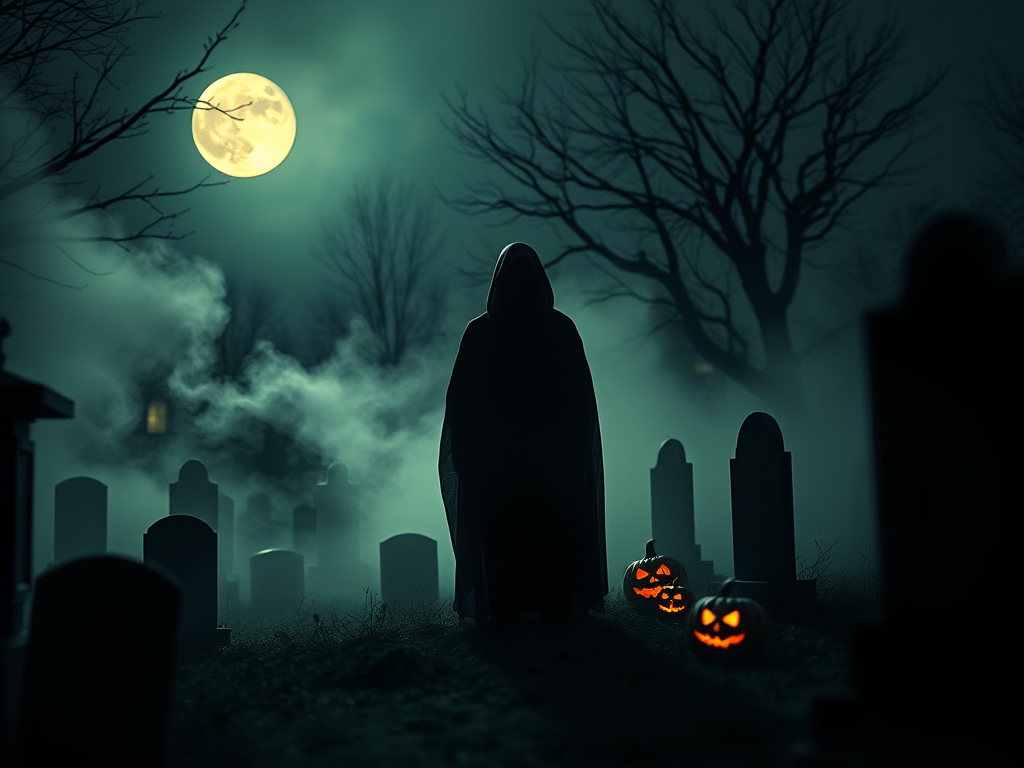
Halloween, a day saturated with mystery, costumes, and eerie tales, stands as a modern celebration of ancient traditions rooted in the supernatural. But what if the night that beckons us to connect with the spooky, otherworldly, and ghostly realms held a similar significance on the other side of the veil?
Could Halloween also be a holiday for the spectral and paranormal entities that we, as investigators and researchers, strive to study, contact, or understand? Considering this possibility – imagining that ghosts, spirits, and other paranormal beings might also acknowledge or celebrate Halloween ( or even exist) – demands a shift in how we approach our research and fieldwork, as well as how we respect and interact with these entities on this singular night of the year.
For a paranormal investigator, contemplating Halloween as a potential holiday for spirits might initially sound like a stretch. Yet, if one reflects on the history and nature of Halloween, its connection to the afterlife and supernatural seems undeniable. Halloween’s origin lies in the Celtic festival of Samhain, marking a time when the veil between the living and the dead was believed to be at its thinnest, allowing for easier communication between worlds. Over centuries, this festival morphed through various cultural filters to become Halloween as we know it today.
While some dismiss it as purely commercial, Halloween’s reputation as a night where we acknowledge, engage with, and perhaps even honor spirits is well established. If we allow the possibility that spirits are conscious, self-aware, and capable of retaining some sense of earthly customs or timing, is it worth wondering whether Halloween could hold similar importance for them? Perhaps it represents a time when they feel freer, stronger, or more connected to our world, a night when they too can roam with less restriction, possibly feeding off the energy of so many living beings actively thinking about them. Scary thought, huh?
In the field of paranormal investigation, there is an unspoken assumption that spirits exist in a kind of timeless state, without consideration for holidays, seasons, or traditions. This assumption can be limiting. Just as the living have customs and annual events, spirits might hold onto aspects of earthly life, including the rhythms of holidays that were important to them. Halloween, with its potent symbolism and widespread energy, might present a unique opportunity or reason for them to manifest more fully, communicate more vividly, or interact with greater vigor.
For paranormal researchers and investigators, this means that treating Halloween as a holiday for spirits could open up new avenues of investigation, enabling a more respectful and perhaps effective approach to contacting and studying these entities.
On Halloween, many people dress as ghosts or ghouls, decorate homes with gravestones, and tell ghost stories, thereby immersing themselves in a “spirit-friendly” environment. This collective focus on the supernatural could create a powerful energetic shift, generating an atmosphere conducive to spirit activity. If spirits are sensitive to our world and feed off emotions, intentions, or environmental energy, Halloween might amplify their capacity to interact with us.
Recognising this can guide paranormal investigators in structuring their activities on Halloween night to align with this energy. Instead of approaching the evening with the typical scientific detachment or investigational rigor, researchers might adopt a more open, festive mindset, allowing for a unique engagement that respects and welcomes the spirits in a way that speaks to Halloween’s essence.
The potential significance of Halloween to the spirit world also brings into question the behaviour and etiquette of investigators on this night. If Halloween is indeed a special time for spirits, it suggests that our approach on this day should differ from other investigations. Just as we wouldn’t barge into someone’s home uninvited on their holiday, perhaps we should exercise greater care in how we seek to contact spirits on Halloween.
Investigators might consider approaching their work as a form of respectful visitation rather than aggressive inquiry, acknowledging that this night might hold a personal or communal significance for spirits. Some researchers might even feel inspired to bring offerings – items such as candles, seasonal foods, or objects that have symbolic meaning for Halloween – to honour spirits, creating a reciprocal exchange rather than merely expecting the spirits to perform or respond to questioning.
Additionally, Halloween presents a unique moment to experiment with more personal or less conventional methods of spirit communication. By engaging in activities that echo the festive spirit of Halloween, such as storytelling, lighting candles, and even playing traditional Halloween games, researchers might create an environment where spirits feel invited to join in and participate.
While scientific methods are essential in the field, paranormal investigators know well that rigid techniques do not always yield results; sometimes, opening oneself up to the moment, and allowing for flexibility, invites the unexpected. Halloween offers a perfect opportunity for researchers to balance traditional investigative tools with atmospheric, ritualistic elements that might encourage spirits to communicate in ways beyond the standard electronic voice phenomena sessions, temperature readings, or electromagnetic field monitoring.
For researchers, it is also worth reflecting on how spirits or entities may perceive the surge of attention Halloween brings. It is easy to forget that ghosts might have a perspective on our world and may even be aware of the annual shift as people suddenly become more interested in contacting them or exploring the paranormal.
In most cases, paranormal investigators dedicate only certain periods or locations to spirit investigation. But on Halloween, there is a wider cultural fascination with ghosts, an entire atmosphere ripe with curiosity and anticipation. This could heighten spirits’ awareness, causing them to “wake up” or become more active in response to the living world’s heightened awareness of their presence. Paranormal researchers might thus use Halloween as an opportunity to delve into less-visited sites or lesser-known haunted locations, where spirits could be more “awake” than usual, driven by the unique energy of the night.
This line of thinking can also influence how organisers of paranormal events approach Halloween. Many ghost tours, haunted house events, and investigations are already planned for this night, drawing crowds eager to experience or witness something supernatural. Recognising Halloween as a potential holiday for spirits can encourage organisers to create events that do not merely sensationalise the paranormal, but instead offer genuine moments of connection or tribute to spirits. For example, a ghost tour might include a moment of silence or a ritual to honour the departed, while haunted house events might offer areas for people to light candles or leave respectful offerings. Embracing this idea can not only elevate the experience for participants, making it feel more authentic, but also perhaps foster a greater sense of harmony between the worlds of the living and the dead.
Ultimately, the concept of Halloween as a potential holiday for spirits also invites a deeper reflection on what it means to be a paranormal investigator. Many who are drawn to this work feel a sense of curiosity, reverence, or even duty to understand what lies beyond. Yet, the search for the truth about spirits often becomes a pursuit of evidence, where the human elements of mystery, respect, and reverence are secondary. Halloween offers a reminder that, as much as we seek to know, there are aspects of the spirit world that might remain forever unknowable.
If Halloween is indeed a special night for spirits, then our best work might be done not by demanding proof or answers but by standing as respectful observers and humble participants in a night that bridges two worlds. Acknowledging the possibility of Halloween as a holiday for spirits enables us to let go, just for one night, of the relentless quest for answers, and instead immerse ourselves in the mystery of the moment, allowing spirits to come to us as they wish, without our expectations or demands.
Furthermore, adopting this perspective encourages us to think more broadly about the nature of spirits and the paranormal. If we entertain the idea that spirits might experience certain days or occasions differently, it invites questions about their perception of time, memory, and emotion. Do they remember their earthly lives? Are they bound to the calendar cycles that once structured their existence? Are there other days, places, or times when spirits feel more present or able to communicate? Halloween could become a kind of experimental gateway, inviting investigators to explore these deeper questions and allowing for fresh perspectives in understanding the spirit world.
There is an intimacy in imagining that Halloween might mean something to the spirits we study – a shared ritual, a night when both the living and the dead participate in a communal recognition of mystery, darkness, and memory. For paranormal investigators, researchers, and organisers, this possibility opens up new dimensions for interacting with the spirit world. Halloween becomes more than a night for chasing shadows or seeking out strange occurrences. Instead, it becomes a mutual observance, a night that can be approached with reverence, curiosity, and perhaps even a sense of celebration shared across worlds.
To move forward, the work of paranormal investigation on Halloween might thus include a blend of scientific inquiry and ritual observance, a balance of respect and curiosity, a willingness to let go of rigid methodologies and instead engage with spirits on a human level. Perhaps the best approach on this night is to simply be present, to create space for the unknown to reveal itself without coercion, to acknowledge that this is a holiday that belongs as much to the spirit world as it does to ours.
By embracing Halloween as a potential holiday for the dead, we allow ourselves to step into the role not only of investigator but of participant, making room for moments of genuine connection, understanding, and shared wonderment that stretch beyond what can be measured or recorded.
This mindset shift may not yield the definitive answers or concrete proof that investigators often seek, but it opens up a different, perhaps richer kind of knowledge, a sense that, in some way, we are part of something larger and more mysterious than ourselves. On Halloween, we stand on the edge of that mystery, hand in hand with the shadows, inviting them to join us, not as objects of study, but as guests in a shared celebration of the unknown.
For one night, we set aside our equipment and our questions, allowing the spirits to speak, to dance, or to rest as they choose, free to observe their own holiday alongside us, in whatever way they may wish.
I am, of course, not serious.
Happy Halloween 👻🎃:)


Leave a Reply