I’m sitting by the log fire on a freezing night in Derbyshire while Simon ties up the loose ends of Forever 26, Until I’m Not (my rapidly forthcoming novel) and my thoughts turn to carving the Samhain pumpkin.
However, in the absence of actually being able to be arsed to move from in front of the aforementioned cosy fire, my mind drifts instead to Halloween traditions – thank you, ADHD… 🤣
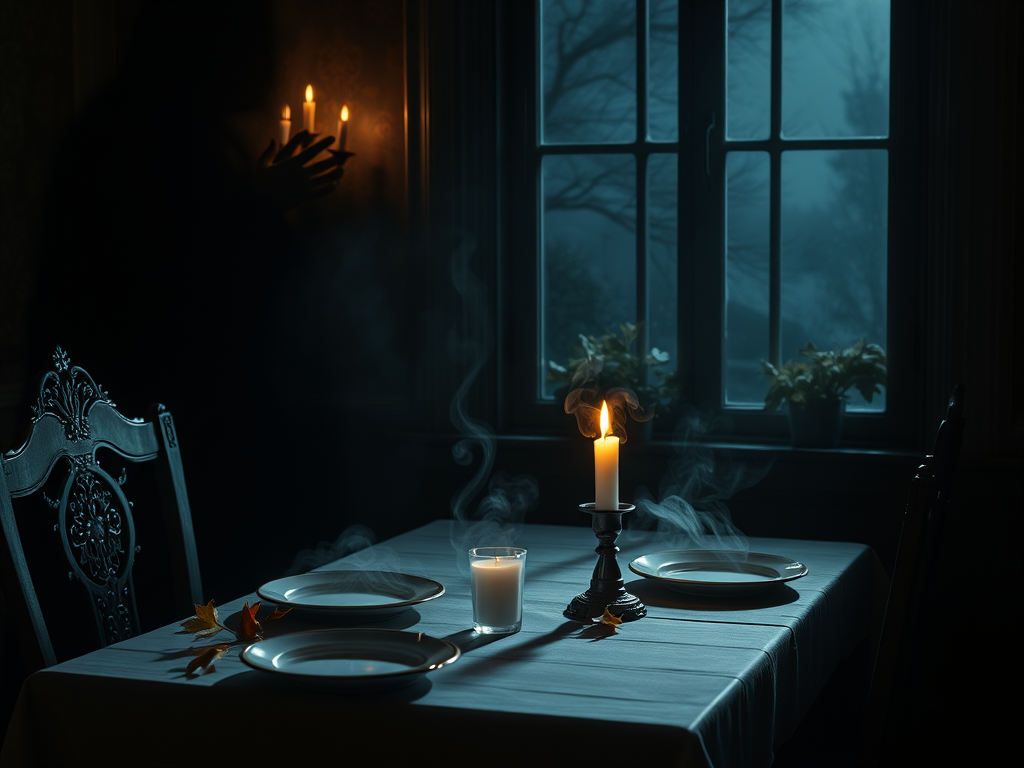
One tradition that’s always fascinated me is the old custom of the dumb supper – not “dumb” as in foolish, but “dumb” as in silent. A feast held without a word, for the benefit of the dead, or for those impatiently hoping to see a glimpse of their future beloved. It sounds quaintly Victorian now, but it’s far older than that, woven through the folklore of the British Isles and carried across the Atlantic by settlers who clung to their fireside customs as tightly as they clutched their faith.
Imagine the scene:
a creaking farmhouse, candles guttering, girls in white aprons moving quietly about the kitchen as the clock ticks towards midnight, each glance towards the empty chair at the table betraying both fear and excitement…
The dumb supper was first recorded in Britain and later in the rural backwaters of America in North Carolina, Kentucky, Tennessee… wherever old beliefs travelled and refused to die. Folklorist Wayland D. Hand, who compiled hundreds of accounts in the Frank C. Brown Collection, found the same ritual turning up again and again, told by grandmothers and farmers’ wives alike.
In these stories, young women would prepare a simple meal in total silence, setting a place for an unseen guest. The table might be laid backwards, dessert served first, chairs turned the wrong way round in a deliberate inversion of the everyday world, because, as folklore insists, when things are reversed the veil between worlds grows thin.
Speak a word and the spell is broken.
Remain silent and, so they said, a spirit, often the shade of a future husband, might appear and take his seat at the table.
Of course, some versions were far darker. In certain corners of the countryside, the supper was said to summon not a lover but a ghostly procession, or even a coffin carried by invisible hands… a vision of one’s own death if the ritual was done improperly.
In the Victorian imagination, these warnings blossomed into the stuff of parlour horror. A few unlucky souls were said to faint dead away when a shadow really did appear in the empty chair, or when the candle flame flared blue at the stroke of midnight. More likely, some lad from the village had been hiding in the scullery, waiting for the right moment to give the girls a fright. Of course that never stopped the story spreading and growing each time it was told.
By the twentieth century, the dumb supper had shifted from love-divination to ancestor worship, adopted by spiritualists and later by modern pagans as part of their Samhain observances. It became less about summoning and more about remembering.
Today, many people still set an extra place at the table on Halloween night, laying out bread, wine, or a favourite meal for those who have gone before, and eating in silence as a mark of respect. In this quieter form, the supper feels both eerie and tender. A recognition that the dead are never very far away.
As the folklore writer on Atlas Obscura put it, it’s a meal where “the living eat with the dead,” each side acknowledging the other for a brief, candlelit hour.
It’s easy to see why the tradition persists. There’s something hauntingly beautiful about the idea of eating in silence, listening to the pop of the fire and the sigh of the wind outside, imagining that those we’ve lost might be sitting beside us for one last meal. In the hush, you might hear a familiar creak, a whisper, or the faint scrape of a chair leg. Nothing more than the house settling, perhaps, but enough to raise the hairs on your neck.
And yet, beyond the spookiness, there’s comfort in it. The dumb supper reminds us that death isn’t an ending, just a change of state. That love, like the candle flame, flickers but doesn’t go out. Whether you see it as witchcraft, folklore, or simply an act of remembrance, it’s one of those old customs that manages to feel both unsettling and profoundly human.
So, as the fire crackles and the pumpkin sits uncarved on the hearth, I’m tempted to try it myself this Samhain. Perhaps I’ll lay an extra place – a glass of bourbon, a slice of homemade cake, maybe a few of those cocktail sausages Nathaniel from Forever 26 was so obsessed with – and just sit for a while in the quiet. No phone, no music, no chatter. Just the silence, and whoever might choose to join me.
After all, as every good witch knows, the dead appreciate good manners – and a proper supper served with respect.



Leave a Reply