
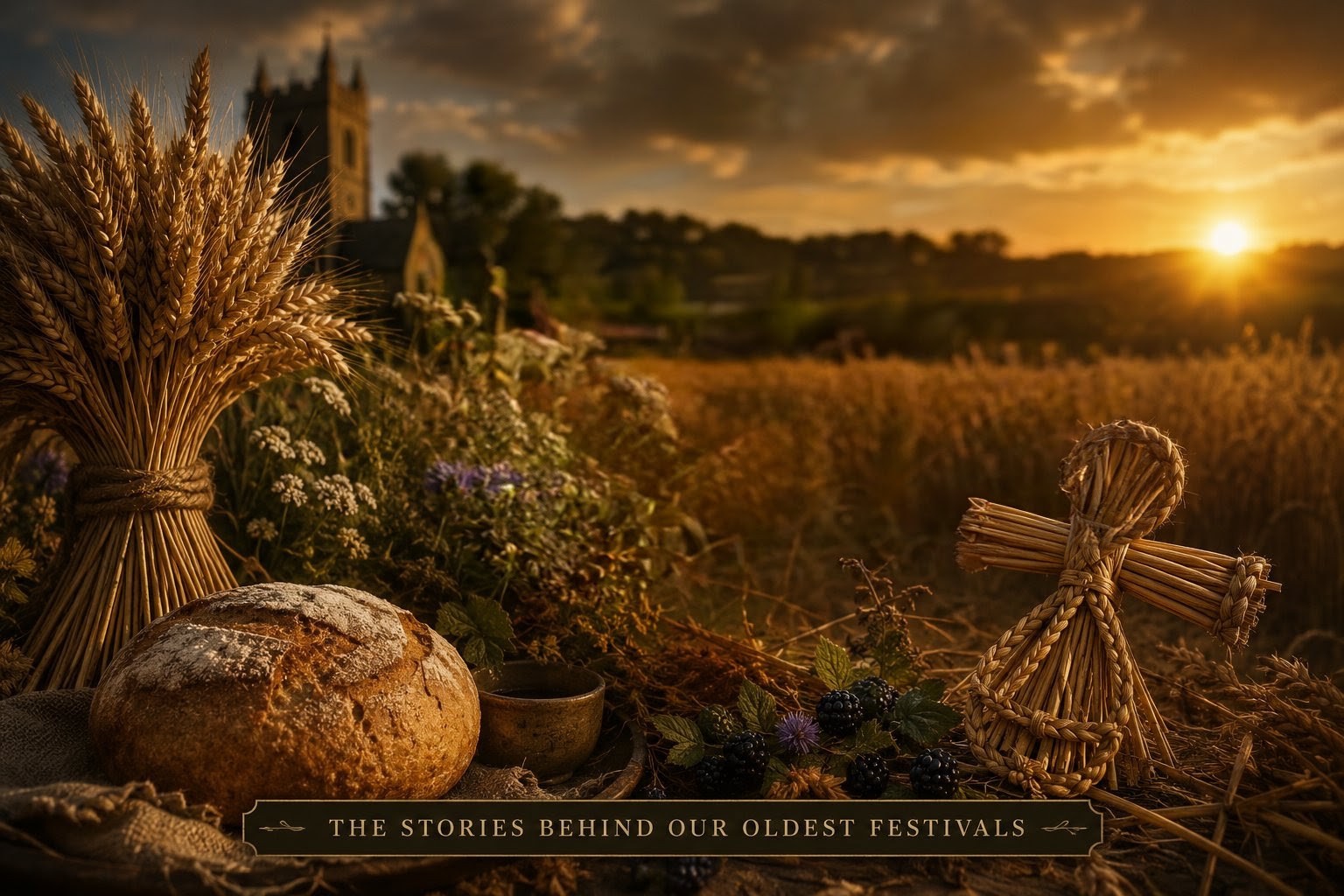
Stand at the edge of a field as the golden light begins to fade and the wheat whispers in the breeze. Somewhere overhead, a rook calls as it makes it’s way back home to roost. The air all around you is heavy with that warm, earthy, baked cookie smell.
Across the field, silhouetted against the evening sky, stands a solitary figure, watching. It doesn’t move.
Of course it doesn’t, after all – It’s only a scarecrow. You know that.
So why do you keep looking back?
I think the greatest mystery surrounding scarecrows isn’t why they’ve become the villains in so many horror films and ghost stories. It’s why we ever began to fear them at all. For most of their history, scarecrows weren’t sinister. They weren’t haunted, cursed or hanging around waiting to come to life beneath the full moon. They were practical, ingenious and. above all, reassuring. They stood quietly among the crops, protecting the harvest from hungry birds long before plastic tape, gas cannons and electronic bird scarers appeared on the landscape. They were guardians.
The idea is an ancient one. Long before the familiar figure of a man stuffed with straw appeared in British fields, farmers across the world devised ingenious ways to protect their crops. In ancient Egypt, children hid among the wheat clapping pieces of wood together to frighten away quail. In Greece, carved figures dedicated to Priapus were believed to keep birds from vineyards, while medieval farmers across Europe relied on noise, ribbons and simple wooden frames draped with old clothing.
The scarecrow we recognise today emerged gradually. A crossed wooden frame, worn trousers, an old jacket – some gloves if any were available. A battered hat to shield an imagined face from the weather. Stuffed with straw after the harvest and planted firmly among the ripening grain, it borrowed just enough of the human form to persuade cautious crows that someone was watching and, most of the time, it worked. At least for a while.
The crows learned because of course they did. If the figure never moved, never shouted or waved or chased them away, the bravest birds realised the deception. Farmers responded by changing the clothes, moving the scarecrow to another part of the field or adding bright ribbons or rattles to renew the illusion. Dressing the scarecrow became an annual ritual almost as familiar and important as the harvest itself.
But there is something very curious about this instinct that we humans have to create figures in our own image, isn’t there? Churchyard effigies, snowmen, festival giants and children’s dolls. We seem endlessly drawn to fashioning faces fro whatever materials happen to be close at hand. There’s little wonder that we have never regarded the scarecrow as entirely ‘ordinary’ when even in broad daylight there is something about a human shaped figure that makes you feel kind of uneasy.
It’s all down to pareidolia, of course. Our good old brains recognising faces and human forms even when none exist. It’s the same instinct that makes us see animal shapes in clouds or faces in the bark of old trees. Faced with a scarecrow standing alone in an empty field, our minds instinctively ask the same question:
“Is it moving?”
The answer was, for generations at least, almost certainly no. Because way back, scarecrows represented security. They stood watch over the very crops upon which the community depended. A successful harvest meant bread on the table, fodder for the animals and the promise of surviving another long winter. If a humble figure made of straw and rags helped protect that precious grain, it had earned its place in the landscape – even if it was a bit creepy.
Across the UK, that affection is very much still alive. Every summer, villages celebrate ‘Scarecrow Festivals, transforming lanes, gardens and village greens into open air galleries filled with wonderfully inventive creations. Some depict characters from history, literature or television. Others celebrate local heroes, current events or just delight in making visitors smile. At this time, somewhere in Derbyshire, there is a garden proudly displaying an astronaut riding a rocket. You should see it, it’s epic. People spend weeks making them, while thousands of people wander from one display to the next, clutching their scarecrow trail guide, raising money for churches, schools and community projects along the way.
It really is difficult to imagine anything less sinister, but that’s because the scarecrow exists in two entirely different worlds – one belongs to village fetes, homemade scones and summer afternoons. The other belongs to horror.
By the late twentieth century, popular culture had completely transformed the benevolent field guardian into something far darker. Films, novels and television discovered that an abandoned field and a motionless human figure made an irresistible combination. Throw in a little mist, a gathering storm and the suggestion that the figure may have moved while nobody was looking and – ding ding ding! We have a winner! – the humble bird scarer became an icon of folk horror.
None of that belonged to the original tradition. The scarecrow was never intended to frighten people. It was built to fool birds. I think that says more about us than it does about the scarecrow itself. We are the ones imagining faces where there are none. We fill the empty fields with ghost stories and old nightmares. We bring our fears with us, then wonder why the countryside feels haunted. The scarecrow just stands where it always has. Watching. Waiting. Protecting the harvest from hungry crows.
Poor thing.
It’s only trying to do it’s job.




Leave a Reply