The fields are quiet now. The combines are gone, the tractors are back in their sheds, and only the neat rows of stubble remain where, days before, golden wheat rippled beneath summer sun. It’s easy to think of harvest as just another job completed before the weather changes. Yet for centuries, the end of the harvest was marked not just with relief, but with ceremony.
Across Britain, particularly in parts of Devon and Cornwall, farming communities gathered for a tradition known as ‘Crying the Neck’. It was a ritual of gratitude, celebration and, perhaps, quiet superstition – a final acknowledgement that the land had provided once again. And, like so many old customs, it sits comfortably between Christianity and something far, far older.
For much of history, a failed harvest meant hunger, Families lived from one growing season to the next and every sheaf mattered. Harvest was not just an economic necessity, it was the difference between comfort and hardship, survival and starvation. It is hardly surprising that people developed customs to honour the moment the last of the crop was safely gathered.
the word ‘Neck’ is generally thought to refer to the final sheaf or bundle of standing plant left in the field. Rather than cutting it immediately, workers often left it until every other corner of the field had been harvested. It became the symbolic heart of the crop – the last place where the spirit of the harvest was believed to linger.
Throughout Harvest Lore week we’ve met many expressions of that belief. In some places, the final sheaf became a beautifully woven corn dolly. Elsewhere it was said to shelter ‘Jack in the Corn’, the elusive spirit of the harvest. Through the old ballads, ‘John Barleycorn’ himself was cut down so others may live. Here, at the very end, is where all those threads meet.
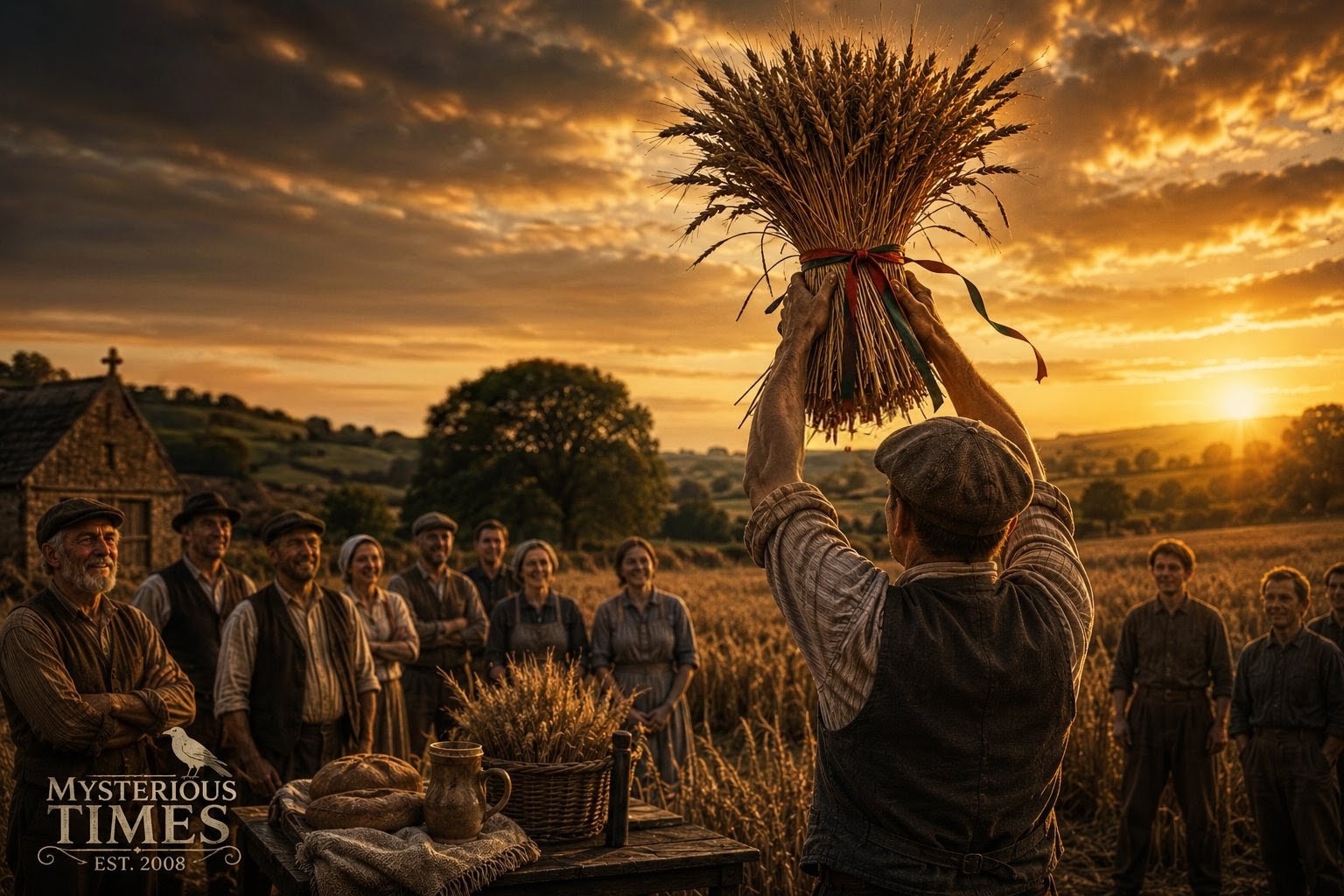
When only the neck remained, the workers would gather together. One chosen harvester cut the final handful of plant while the others watched in silence. Traditionally, the harvester would raise the final sheaf above his head and shout:
“I’ve got the Neck!”
The others would reply:
“What have ‘ee?”
Again came the answer:
“The Neck!”
This call and response was repeated three times, growing louder with each exchange until it echoed across the fields. To modern ears it may sound like little more than an odd country tradition, but for those taking part it marked something deeply significant. The harvest was over. The grain was safe. Another year had been won.
The final sheaf was treated with great care. Rather than being threshed with the rest, it was often tied with ribbons and carried home in procession. Sometimes it hung in the farmhouse throughout winter, much like a corn dolly, as a token of prosperity and good fortune. in some communities it was kept til the following spring, when a few grains from the old harvest were mixed with the new before sowing. A symbolic way of ensuring that one years abundance would pass into the next.
After the harvest came the celebration. Harvest suppers have a long history across Britain, bringing together landowners, labourers and families around the same table. Bread baked from the new grain, roast meats, pies, cider and ale all found their place in the feast. Songs were sung, stories were exchanged and, for one evening at least, the relentless rhythm of agricultural life gave way to gratitude. These gatherings reminded everyone that farming had always been a communal endeavour. No single person brought in a harvest alone. Every hand mattered.
Although mechanisation transformed agriculture in the twentieth century, Crying the Neck never disappeared completely. In parts of Devon and Cornwall, heritage farms, museums and local communities continue to revive the custom each year. Visitors gather as volunteers cut the final sheaf by hand before raising it high and calling out the ancient words once more.
Whether these voices are preserving folklore, celebrating rural heritage or honouring generations of farming families is beside the point. Traditions survive because they continue to mean something to somebody. That’s why these customs still resonate today. In a world where food seems to appear magically on supermarket shelves, these rituals remind us that every loaf of bread begins in a field, every harvest depends on weather, labour and hope and every meal owes something to those who came before us. The old farmers understood that gratitude was worth expressing out loud.
The fields are bare now.
The harvest spirit has been carried safely home. The songs have faded, the suppers are over and another agricultural year has drawn to a close. But the story is never truly finished.
When spring returns, the grain will be sown again. Summer will ripen the fields. Jack will hide among the standing corn. John Barleycorn will rise once more, only to fall beneath the sickle. And somewhere, as the final sheaf is lifted against the late summer sky, an old voice will ring out across the stubble;
“I’ve got the Neck!”
and from across the field will come the answer, just as it has for generations:
“What have ‘ee?”
“The Neck!”
Some traditions are just too good to let die.