The year is 1817, and in a small village called Almondsbury, just north of Bristol, England, a strange story is about to break out which would entertain the local gentry for months, if not years.
Accounts vary on many of the details, and whilst we have tried to read as many as possible, we cannot be held responsible for any supposed inaccuracies described.
A woman in bedraggled clothing and a strange manner was found in the Village late one evening. She seemed unable to speak English, was heard to mumble words of a strange language and tried to communicate mostly through gestures. One word which was picked up was “Caraboo, Caraboo”, though no-one could decide if she meant this as a name, or where she was from. It was decided by the people who found her that she should be taken to the local Magistrate, Mr Samuel Worral who lived at Knole Park Manor House. Mr and Mrs Worrall seem to have become quite fascinated by the young woman and, after a couple of nights when she was put up in a local Inn, and then a brief stay in incarceration as a vagrant, they finally decided to look after her at their own house.
The story goes that whilst at the Inn, the woman had pointed to a picture of pineapples and used the words “ananas” or “nannas” which was likened to the Indonesian for pineapples. This seemed to sway the Worrals, and Mrs Worrall, Elizabeth who had been born in America, was most captivated by the rumour that when she was in prison, the woman’s language had been verified by a Portuguese sailor, who seems to have improvised a life story for her on the spot:
She was the Princess Caraboo, from the Island Javasu somewhere in the Indian Ocean. Apparently, he told anyone who would listen, she had been kidnapped by Pirates, but had managed to jump off the ship and swim ashore in the Bristol Channel.
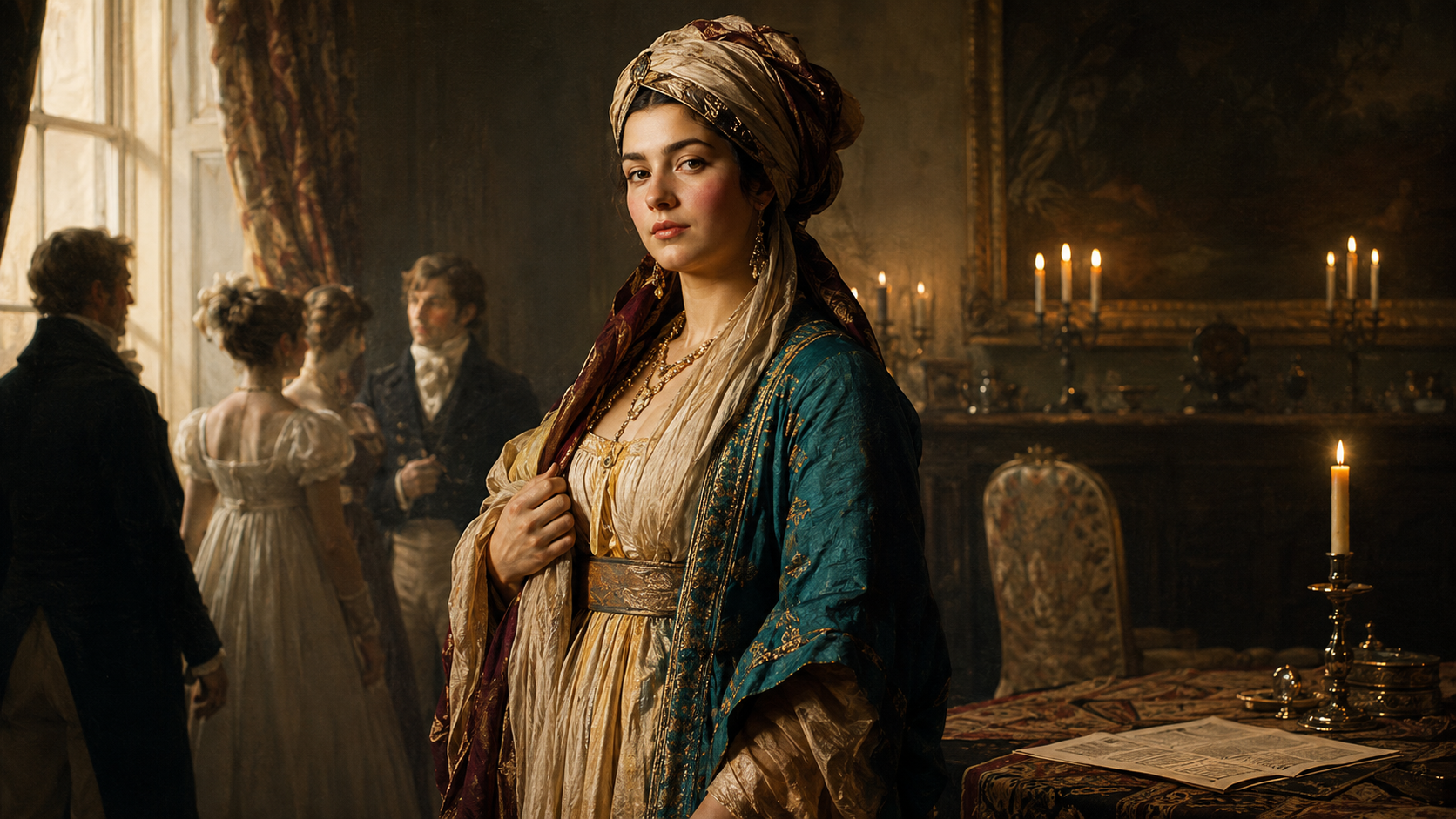
The Worralls had her released, took her to Knole Park and for a few months they all enjoyed a curious fame which elevated them all in the eyes of Polite English Society. Parties were thrown and visitors came from far and wide to meet ‘Princess Caraboo’ – the Princess from the East Indies, who in turn for her keep and fine clothes made to her design, would dance, sing and talk her strange language. She was suddenly a star that polite society was keen to meet and talk about. Local rival Broadsheets wrote stories about her, concentrating on her exotic dress, language, dancing and demeanour and at least two well known Artists of the day did paintings of her.

“Princess Caraboo” by Edward Bird (1772-1819) Reproduced Courtesy of Bristol Museums, Galleries & Archives.
However, fame was to be the downfall of Princess Caraboo.
After nearly three months, her picture was seen in the Bristol Journal, one of the Broadsheets by a lady who ran a boarding house. Mrs Neale recognised the woman in the picture and seems to have gone directly to Knole and told Elizabeth Worrall that she recognised the woman as someone called Mary Willcocks, who had boarded with her and entertained the house occupants with acting and funny accents. Mrs Worral obviously confronted the Princess and there may have been a confession made.
The rest of the story becomes a scrabble for the truth, with The Worralls, the Broadsheets and other National Newspapers writing about the hoax, the Worralls, further wild stories from Mary Willcocks’ life and a lot of articles making fun of the middle-class and gentry who had been taken in by the whole sordid business.
What happened after is a mishmash of reports from various sources, most of whom seem to have merely copied, embellished or down right made up stories to sell Newspapers, in a way that seems so similar to us today. Scandal, especially involving someone as exotic and different as this, would have been great fodder for greedy journalists from any age. She may or may not have gone to prison again, and may or may not have been pardoned. She may well have been given passage to Philadelphia in the US and lived there for up to seven years. There are even allegations that at some time, she had been on St Helena having drifted there on a dinghy after a storm, where she met and spent time with the Exiled Emperor Napoleon! Whatever the truth, Mary proved to be very enterprising and somehow managed to put on shows while in America, exhibiting herself as her alter ego ‘Princess Caraboo’, and then, seven years later, sailed back to England and did the same exhibitions for a while in London on new Bond Street.
Mary’s life from then seems to have become less hectic, and less fame chasing, but no less interesting. A marriage to a Mr Richard Baker, the birth of a daughter, a decade importing and selling leeches to the Bristol Infirmary, whilst going by a variety of different surnames. She was known as Willcocks, Baker, Burgess and who knows, maybe a few other names too. Amazingly she managed to live until 1864, died sometime after a fall, and left her leech business to be run by Mary Ann, her daughter, who died herself in 1900, killed by a house fire.
The known facts about Mary Willcocks’ life are quite few in reality. She was born in 1792 or 3, in Devon, to a Cobbler and his wife. She was known to have been employed as an actress in different towns while a teen and in her twenties, we can make our own assumptions about what this actually meant in real terms, in a world where women were still mostly looked on as chattels, and the act of vagrancy was punishable by prison. At 24 years old she had had at least one child, in 1816, that died a bit later in the year.
The time taken over by the fame in 1817, mere months, became her whole story, with most accounts making her into a callous hoaxer, an imposter, a liar and vagrant. But, for a poor family’s daughter, to keep herself as an actor for years, be picked up, thrown in jail and then thrust into the gaze of local and national dignitaries and minor royalty, Mary shows remarkable skill and dedication to her cause. To never utter English words for so long that no-one noticed that she may be English. To catch on to words and phrases she heard and maybe use them to her advantage. To voyage from England to America, and survive there only to return seven years later. And after all this, to carry on thriving until the age of 74, running an enterprising business. This woman was quite obviously smart, quick witted, inventive and willing to do what it takes.
Whilst history reports her, undeniably, as a fraud, we can allow ourselves I believe, to admire much about her, and think of her more as an opportunist who made more money for the people who used her, than she ever did for herself. As far as the evidence shows, she was much less a villain, than a woman capable of making the most of what was put in front of her.
____________________________________________________________
Kind thanks to the Bristol Museums, Galleries & Archives for their permission to use the painting of Princess Caraboo. https://collections.bristolmuseums.org.uk